Outbound prospecting involves proactively contacting companies that don't yet know you, via email, LinkedIn, or phone. When done well, it allows you to choose your clients rather than waiting for them to find you. When done poorly, it results in ignored messages and blocked email addresses. Here's a complete method, from targeting to meeting.
Outbound prospecting: the essentials
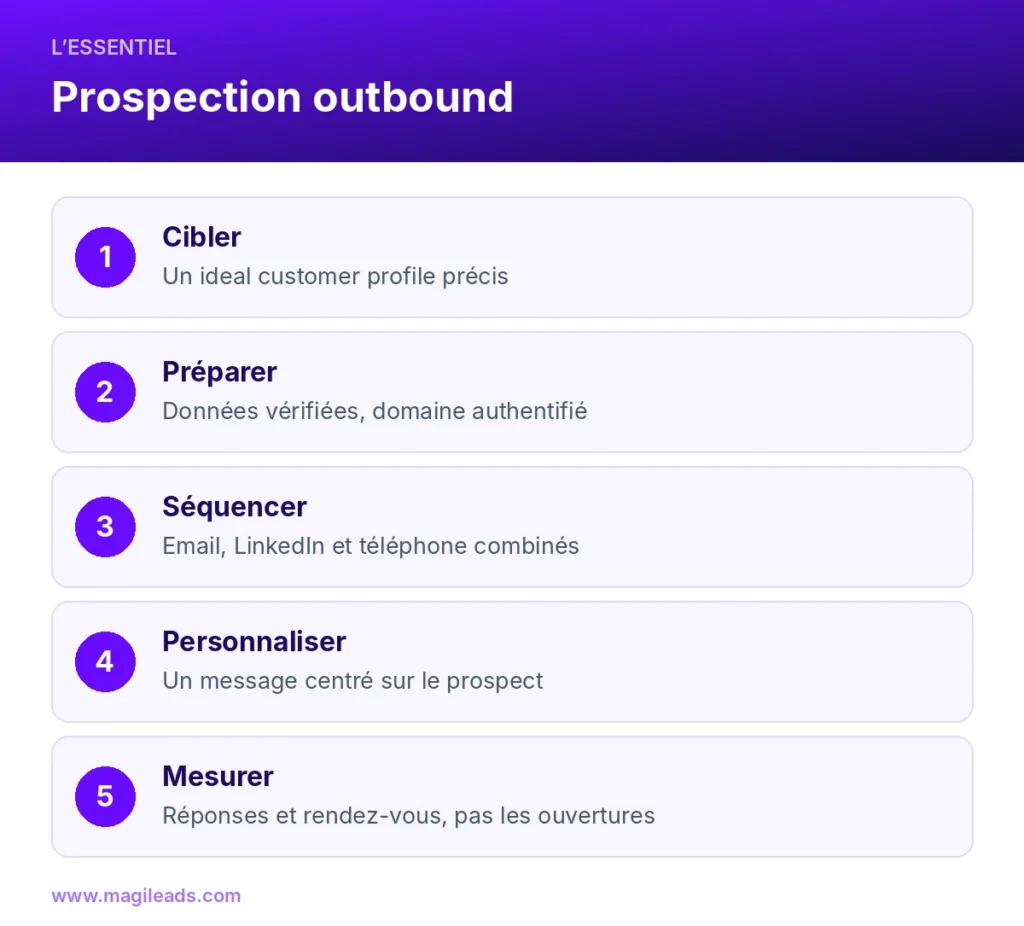
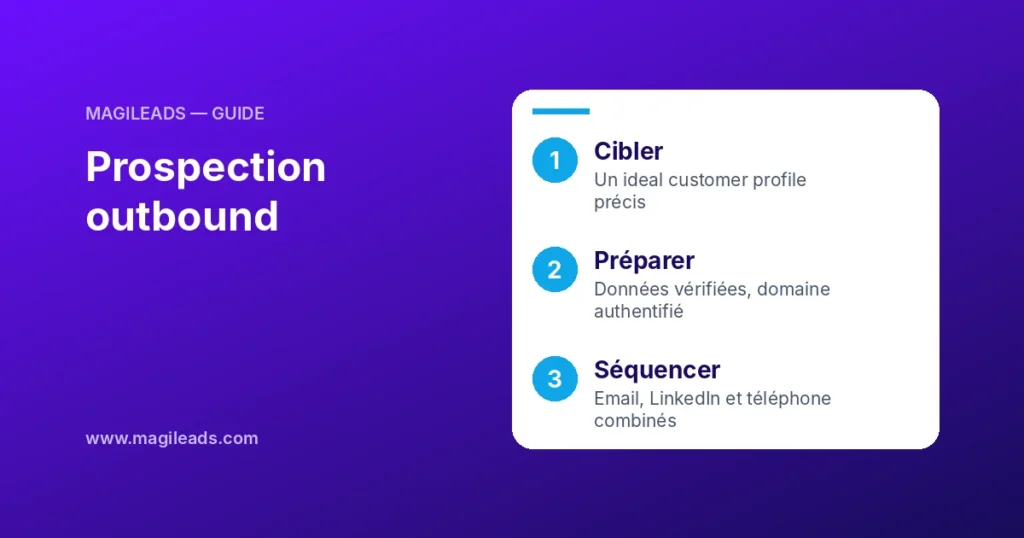
- Targeting : a specific ideal customer profile.
- Prepare : data verified, domain authenticated.
- Sequence : email, LinkedIn and phone combined.
- Personalize : a message focused on the prospect.
- Measure : responses and appointments, not openings.
Outbound and inbound prospecting: what are the differences?
In inbound marketing, the prospect comes to you: they read an article, download a guide, or fill out a form. In outbound marketing, you go to them. The two approaches are complementary: inbound marketing attracts prospects who are already actively searching, while outbound prospecting allows you to reach the accounts you've chosen, at the time you've chosen.
| Criteria | Inbound | Outbound prospecting |
|---|---|---|
| Who initiates contact | The prospect | Your team |
| Account selection | Limit | In short: you target your ideal accounts |
| Timeframe for initial results | Several months | A few weeks |
| Main channels | Content, SEO, social media | Email, LinkedIn, phone |
| Main risk | Low-skilled traffic | Deliverability and brand image |
The 5 steps of outbound prospecting
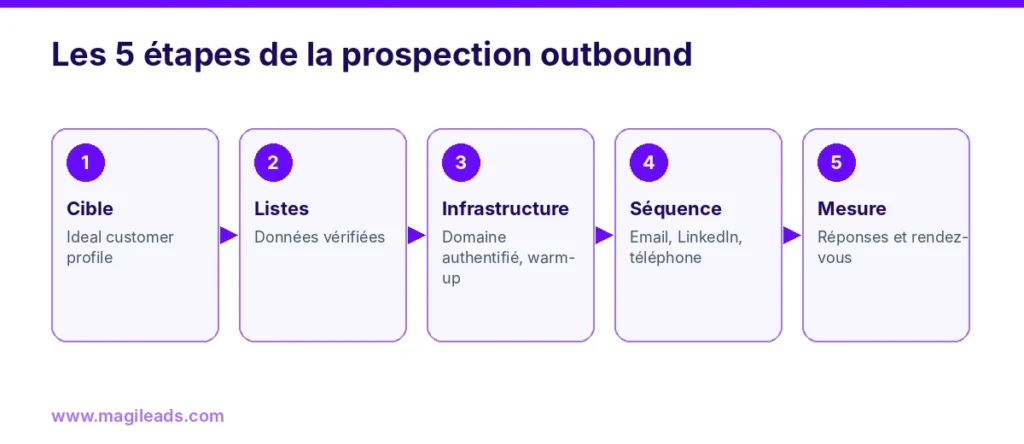
1. Define the target
It all starts with your ideal customer profile : sector, size, region, company situation, and then the roles to contact. A vague target audience produces generic messages and low response rates.
2. Compile and verify the lists
Build your lists from a B2B database, LinkedIn, or your own files, then check the emails before sending. A high bounce rate is the fastest way to damage your email address reputation. To learn more: find a prospect's email address.
3. Prepare the sending infrastructure
Before launching an outbound email campaign, use a dedicated sending domain, authenticated with SPF, DKIM, and DMARC, and gradually warm up your email addresses. On LinkedIn, keep the number of invitations reasonable.
4. Construct the sequence
An effective outbound sequence combines multiple channels and approaches. For example: LinkedIn profile visit, invitation, initial email, brief follow-up, LinkedIn message, and then a final email that politely closes the conversation. Each step provides a new reason to respond.
5. Measure and adjust
Track the response rate, the percentage of positive responses, and the number of appointments, rather than the open rate, which has become unreliable. Adjust only one variable at a time: the target audience, the hook, the subject line, or the pace.
Outbound prospecting channels
The email
Email remains the most cost-effective channel for reaching a large number of prospects. It requires constant attention to deliverability and a short, prospect-focused message. Get inspired by our prospecting email templates and our tips for writing effective prospecting subject lines.
LinkedIn allows you to build familiarity before email: a profile visit, an invitation, a conversation. It's particularly useful for decision-makers who heavily filter their emails. See our guide to automated LinkedIn prospecting.
The phone
The telephone remains the most direct channel for assessing a need and securing an appointment. It works best when used after initial written contact, with prospects who have shown a sign of interest.
Example of an outbound prospecting sequence
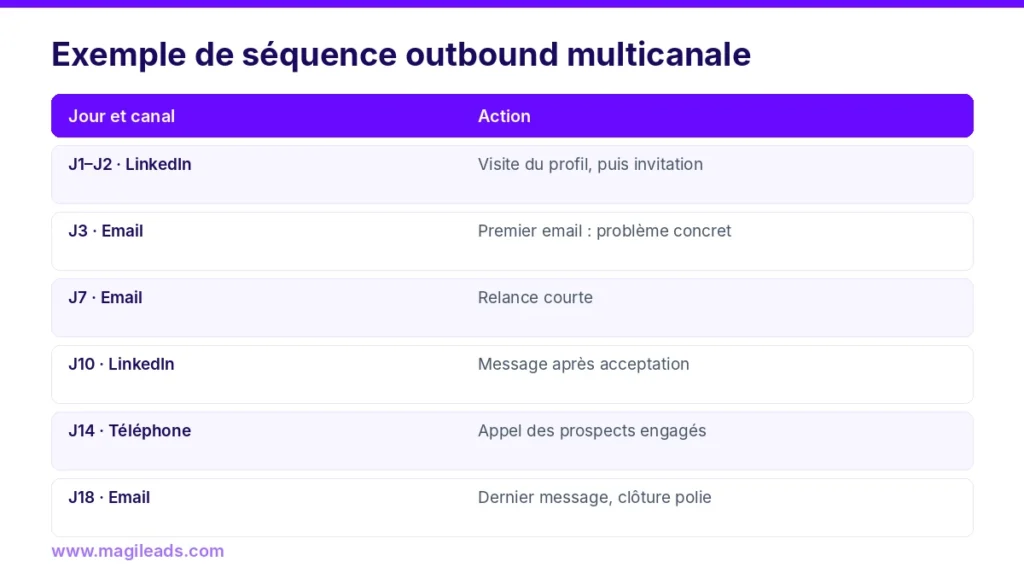
| Day | Channel | Action |
|---|---|---|
| J1 | View profile | |
| J2 | Invitation without commercial message | |
| D3 | First email: concrete problem, simple request | |
| J7 | Short relaunch in the same thread | |
| J10 | Message if the invitation is accepted | |
| J14 | Phone | Calling prospects who have interacted |
| J18 | Final message: you are closing the topic |
The sequence stops as soon as the prospect replies, regardless of the channel. For the number of follow-ups, see our article " How many emails to send in a sequence."
Best practices for outbound prospecting
- Personalize the beginning of the message using a real element: news, recruitment, fundraising, publication.
- Don't talk about yourself first : start with the prospect's problem.
- Make a single request, simple to accept.
- Comply with the legal framework : message related to the recipient's function, information on the origin of the data, unsubscribe link.
- Rely on signals to choose the right time; see our article on business signals.
Indicators to monitor
| Indicator | What it measures |
|---|---|
| Bounce rate | The quality of your lists |
| LinkedIn acceptance rate | The relevance of the targeting and the profile |
| Response rate | The interest generated by the message |
| Percentage of positive responses | The alignment between the offer and the target audience |
| Appointments obtained | The overall effectiveness of outbound prospecting |
Automate outbound prospecting without sacrificing quality
Automation allows you to chain steps together, meet deadlines, and track each prospect. It doesn't replace targeting or message quality. In Magileads, you build a sequence by linking email and LinkedIn steps, and optionally SMS and voice messages (for a fee), with a condition and a delay between each step. You then track leads based on their response. Multichannel campaigns thus bring together all your outbound prospecting channels in a single tool.
Write an initial outbound prospecting message
The first message in an outbound prospecting campaign should answer a simple question the prospect is asking: why me, and why now? Start with something that directly concerns them: company news, an ongoing recruitment drive, a recent publication, or a job change. Follow up with the problem you think they're facing, using their own words, and then explain how your solution will concretely change things.
End with a single, straightforward request: a question, or a suggestion for a 15-minute chat. Avoid attaching a brochure, listing all your features, or immediately offering a one-hour demonstration. The goal of the first message isn't to sell, but to get a response.
Reread your message from the recipient's perspective. If it could be sent as is to a hundred other people, it's not personalized enough. If it focuses more on you than on the prospect, rewrite it starting with them.
Organize the outbound prospecting team
In many B2B companies, outbound prospecting is handled by dedicated professionals, often called SDRs or sales development managers. Their role is to identify accounts, initiate contact, and qualify interested prospects before passing them on to the sales representatives who conduct meetings and close deals.
This organizational structure allows everyone to focus on what they do best. However, it requires a clear definition of what constitutes a qualified lead, a smooth handover process, and a shared tool for tracking each account. Without these guidelines, interested prospects risk waiting too long between the initial contact and the scheduled meeting.
In a small team, the same person can do everything. In this case, reserve fixed slots for outbound prospecting during the week: without regularity, the sequences are interrupted and the results become impossible to interpret.
In many teams, this prospecting is entrusted to an SDR (Sales Development Representative), responsible for targeting, contacting and qualifying prospects.
Mistakes that cause outbound prospecting to fail
The first mistake is trying to go too fast: sending hundreds of emails from a new address, without authentication or scaling, leads straight to spam. The second is targeting too broadly, hoping that volume will compensate for a lack of relevance. The opposite happens: response rates plummet and reports increase.
The third mistake is giving up too soon. Many responses arrive after the second or third follow-up, simply because the prospect didn't have time for the first message. Finally, many teams don't measure their results by target audience and by message, and therefore don't know what to improve. Effective outbound prospecting is built through small, successive improvements, campaign after campaign.
Finally, keep in mind that outbound prospecting impacts your company's image. Every message is a first contact with your brand: a respectful tone, genuine personalization, and a simple unsubscribe option are just as important as the response rate. Respectful outbound prospecting opens doors for the long term, even with prospects who aren't ready today.
To begin, choose a single target audience, a single message, and a short sequence. Measure the results for two to three weeks, then adjust before expanding. This gradual approach allows you to learn quickly without jeopardizing your sending addresses or your reputation with your best accounts.
Frequently Asked Questions
- What is outbound prospecting? It is the act of proactively contacting prospects who do not yet know you, by email, LinkedIn or telephone.
- Outbound or inbound prospecting: which to choose? The two complement each other. Outbound delivers faster results and lets you choose your accounts; inbound attracts prospects who are already actively searching.
- Is cold emailing legal in B2B? Yes in France, if the message relates to the recipient's role, if they are informed of the origin of their data and if they can easily object.
- How long before the first results? Allow a few weeks: time to prepare the lists, warm up the sending addresses and roll out a first sequence.
Visits to your site are also a valuable signal: discover how to identify your website visitors.
Launch your multichannel outbound prospecting
B2B database, email and LinkedIn sequences, lead tracking: try Magileads free for 14 days.