A good prospecting email is short, focused on the prospect's problem, and ends with a simple request. These prospecting email templates cover the most common B2B situations: initial contact, news trigger, referral, follow-up, and closing message. Use them as a starting point for customization: a template copied verbatim and sent to hundreds of people rarely gets a response.
Email prospecting templates: the essentials
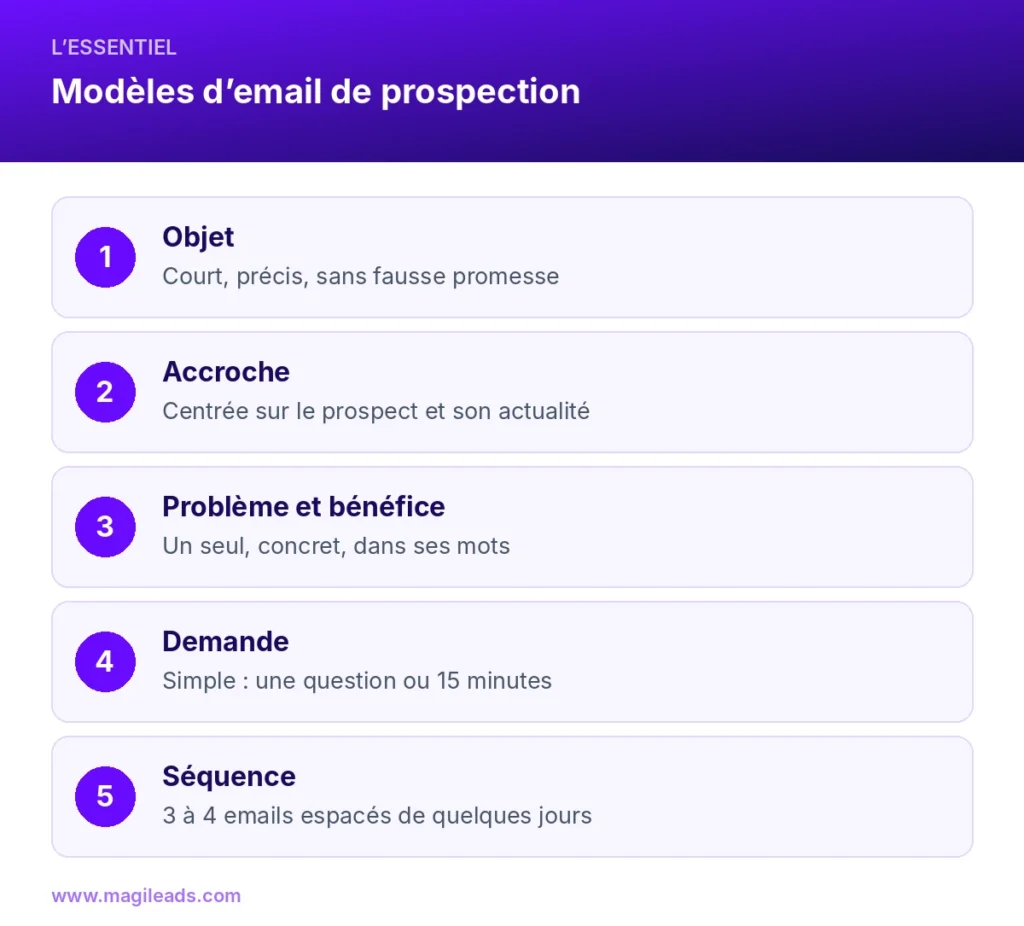
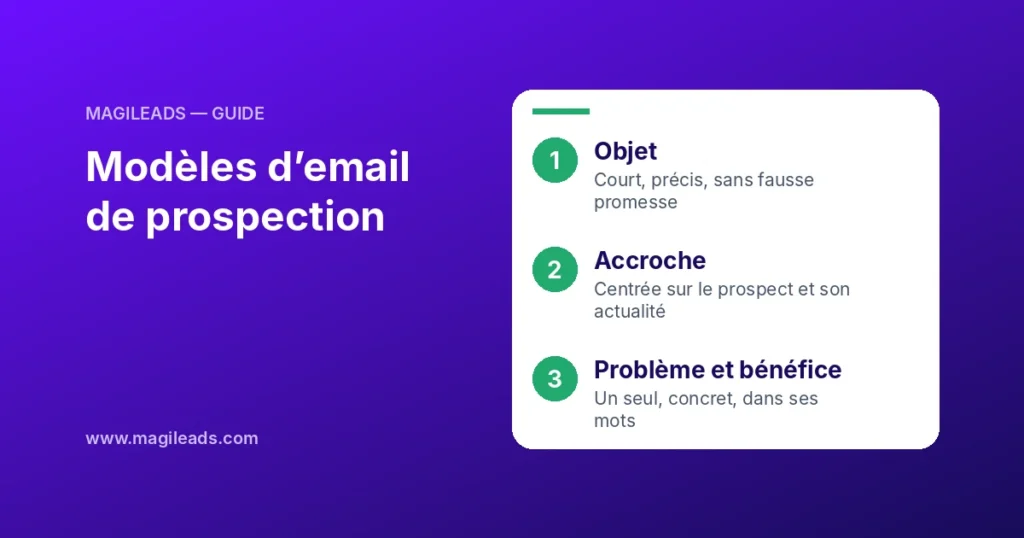
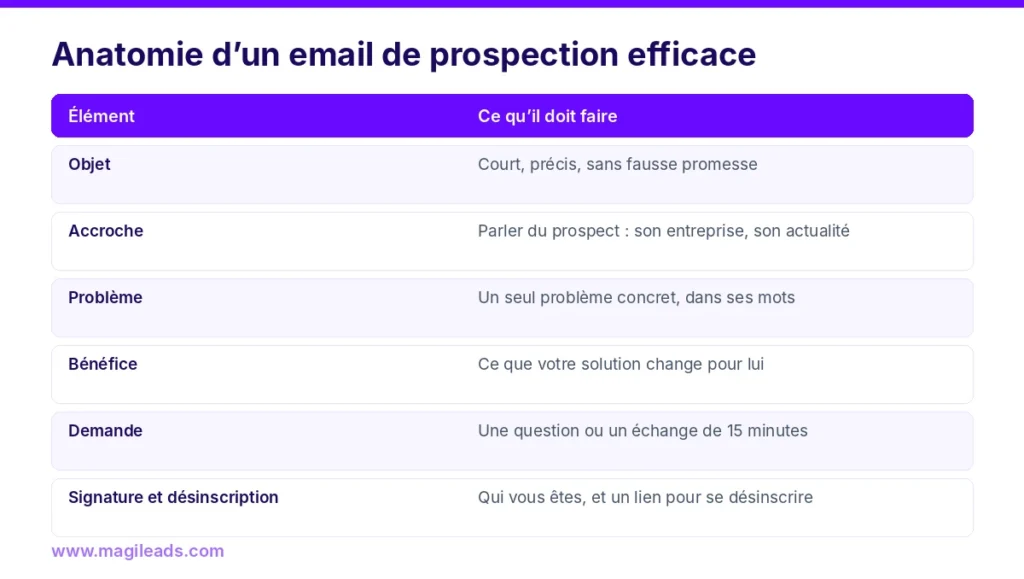
- Subject : short, precise, without false promises.
- Hook : focused on the prospect and their current situation.
- Problem and benefit : a single, concrete one, in his words.
- Request : simple: one question or 15 minutes.
- Sequence : 3 to 4 emails spaced a few days apart.
The rules for a good prospecting email
- A short and precise subject linethat makes you want to open it without promising what the email does not contain.
- A first sentence about the prospect, not about you: their company, their news, their profession.
- One problem, one benefit : don't try to present your entire offer.
- A simple request : a question, a 15-minute exchange, a resource to send.
- Less than 120 words : your prospect should be able to read the email on their phone in a few seconds.
- An unsubscribe link, mandatory in B2B prospecting.
In the models below, the elements between double curly braces are variables to be replaced: {{first name}}, {{company}}, {{position}}, {{trigger}}, {{benefit}}.
12 B2B prospecting email templates
1. The first contact focused on a problem
Subject: {{company}} and {{problem}} Hello {{first name}}, The {{positions}} we support often talk to us about {{problem}}: {{concrete consequence}}. We help them {{benefit}} by providing a {{one-sentence solution}}. Is this a current issue at {{company}}? {{signature}}
2. The news trigger
Subject: Congratulations on {{trigger}} Hello {{first name}}, I saw that {{company}} {{trigger: is recruiting, opening an office, launching a promotion…}}. During this type of period, teams often seek to {{objective}}. This is precisely what we facilitate with {{solution}}. Would you be available for a 15-minute chat next week? {{signature}}
3. Recommendation through a mutual contact
Subject: From {{contact's first name}} Hello {{first name}}, {{contact's first name}}, with whom I recently corresponded, suggested I write to you about {{subject}}. We help companies like {{company}} to {{profit}}. When would it be possible to discuss this for 15 minutes? {{signature}}
4. The open question
Subject: Quick question about {{process}} Hello {{first name}}, How does your team currently manage {{process}}? I'm asking because many teams in {{sector}} spend a significant amount of time on it and are looking for {{benefit}}. If this is the case for you, I can show you how others approach it. {{signature}}
5. The useful resource
Subject: A resource on {{subject}} Hello {{first name}}, As {{position}}, {{subject}} is undoubtedly one of your priorities. We have compiled {{guide, checklist, template}} which details {{content}}. Would you like me to send it to you? {{signature}}
6. The short recovery
Subject: Re: {{subject of the first email}} Hello {{first name}}, I am writing again regarding {{subject}}. Is this a matter for {{company}}, or should I contact one of your colleagues instead? {{signature}}
7. Relaunching with a new angle
Subject: Another approach to {{problem}} Hello {{first name}}, I'm back with a different angle: {{new argument, new use case}}. If this isn't a good time, just let me know and I won't contact you again. {{signature}}
8. The final message (break-up)
Subject: Closing this matter Hello {{first name}}, Without a response from you, I assume that {{subject}} is not a priority at the moment. I will not contact you again. If the situation changes, simply reply to this email. Best regards, {{signature}}
9. After a trade fair or event
Subject: Following {{event}} Hello {{first name}}, We met at {{event}} / I saw that {{company}} was present at {{event}}. You mentioned {{topic}}: this is exactly the type of topic we support teams like yours on. Would you like to discuss it again for 15 minutes next week? {{signature}}
10. After downloading content
Subject: Your {{guide}} on {{topic}} Hello {{first name}}, You recently downloaded {{guide}}. I hope you find it useful. Teams who read it often aim to {{objective}}. If this is the case for you, I can show you how other companies in your sector are approaching it. Is this a current topic at {{company}}? {{signature}}
11. The message that follows up on a LinkedIn invitation
Subject: Following up on our LinkedIn conversation Hello {{first name}}, Thank you for accepting my LinkedIn connection request. I'm writing to be more specific: {{problem}} often arises in {{position}} within {{sector}}, and we help them to {{benefit}}. Would you be open to a brief discussion? {{signature}}
12. Re-establishing contact with a former prospect
Subject: What's the status of {{project}}? Hello {{first name}}, We spoke a few months ago about {{project}}. You indicated that the timing wasn't right. What's the status now? Since then, we have {{verifiable update: new feature, new offer}}. {{signature}}
Which prospecting email template should I use, and when?
| Situation | Recommended model | Moment in the sequence |
|---|---|---|
| Cold prospect, known problem | 1. Initial contact focused on a problem | First email |
| Company News | 2. News Trigger | First email, as close as possible to the event |
| Common contact | 3. Recommendation | First email |
| The need is still unclear | 4. Open question or 5. Useful resource | First or second email |
| No response | 6. Short restart, then 7. New angle | A few working days after the previous one |
| Still no response | 8. Last message | End of sequence |
| Contact met at an event | 9. After a trade show | In the days following the event |
| Inbound lead (downloaded content) | 10. After a download | A few days after downloading |
| LinkedIn invitation accepted | 11. Extending a LinkedIn invitation | After acceptance |
| Former prospect "not now" | 12. Re-establishing contact | A few months later |
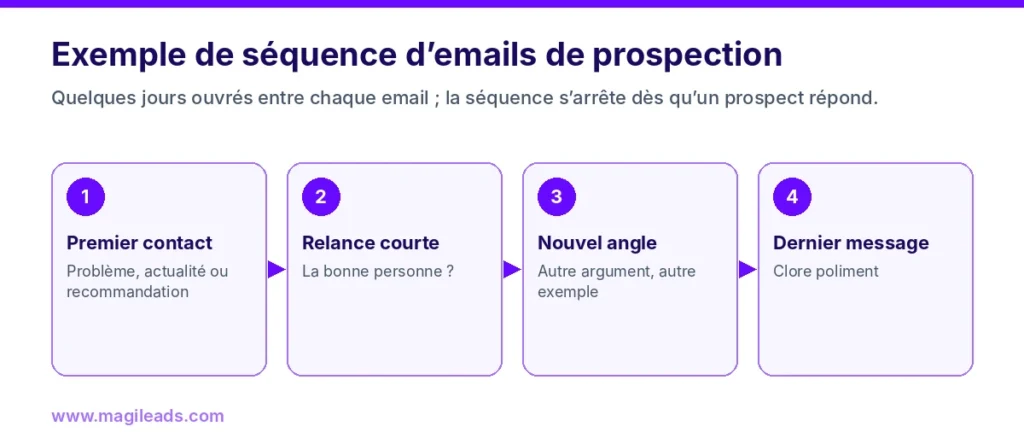
To determine the number of emails and their frequency, see our article on the number of emails to send in a prospecting sequence. To ensure a compelling open, draw inspiration from the best prospecting email introductions , and for follow-ups, consult our tips on effective follow-up emails.
Customize your models on a large scale
A template is only effective if it appears to be written specifically for its recipient. In your file, create a column for each variable (position, current event, likely issue), segment your lists by sector and function, and tailor the subject line to each segment. Avoid formulas that trigger spam filters and test two versions of the subject line on a portion of your list before sending to everyone. Our tips for getting more responses in email prospecting complement these best practices.
Mistakes that cause a prospecting email to fail
- Talking about yourself in the first sentence : "We are the leader in…" doesn't interest your prospect. Start by talking about them.
- Sending a brochure as an attachment makes the email larger and triggers spam filters. Instead, offer to send it directly.
- Multiply the links : a single link is enough, and often none in the first email.
- Requesting a one-hour appointment too early : a 15-minute question or exchange is easier to accept.
- Forgetting to check variables : an unreplaced "Hello {{first name}}" ruins the credibility of the entire campaign. Test each template on a few contacts before sending.
- Following up without adding anything : each follow-up should contain a new element or a simpler question.
Which object should be associated with each model?
The subject line determines the opening. Keep it short, without capital letters or excessive promises, and consistent with the message content:
| Model | Examples of objects |
|---|---|
| Initial contact focused on a problem | {{company}} and {{problem}}; Question about {{process}} |
| News trigger | Congratulations on {{trigger}}; Your new {{project}} |
| Recommendation | From {{contact's first name}} |
| Useful resource | A guide on a specific topic? |
| RELAUNCH | Re: {{subject of the first email}}; The right person? |
| After a trade show | Following {{event}} |
| Re-establishing contact | What is the status of {{project}}? |
Adapting these models to LinkedIn
On LinkedIn, messages should be even shorter: remove the subject line, keep it to a personal opening line, and ask only one question. The invitation note is limited in characters: simply explain why you want to connect, without presenting your offer. The detailed message will follow after acceptance, and email can be used if the prospect doesn't respond on LinkedIn.
Adapt your prospecting email templates
A template is just a starting point. Before each campaign, reread your prospecting email templates, asking yourself three questions: Does the first paragraph truly address the prospect? Is the problem mentioned theirs? Is the request easy to accept? If the answer is no, rewrite the opening line before sending.
Also keep track of the results for each template: response rate, appointments booked, objections received. After a few campaigns, you'll know which prospecting email templates to keep and which to rework.
Finally, don't reuse the same prospecting email templates indefinitely: your prospects receive numerous messages, and a prospecting email that looks like everyone else's loses its impact. Refresh your subject lines and examples with each new campaign, and maintain a library of prospecting emails categorized by target audience and stage of the sales sequence. Your best prospecting email templates are the ones you improve with each campaign.
Frequently Asked Questions
- How long should a prospecting email be? Aim for less than 120 words: a few sentences are enough to present a problem, a benefit and a request.
- Should you use "vous" or "tu"? In B2B in France, "vous" remains the norm for the first contact, unless your target and your brand have a more informal tone.
- How many reminders should I send? Two to three reminders spaced a few working days apart, then a final message, are usually sufficient.
- Can these prospecting email templates be used as is? No: at a minimum, personalize the subject line, the first sentence, and the benefit for each prospect segment.
These models are part of a broader approach: discover our complete outbound prospecting.
Automate your sequences without losing personalization
In Magileads, use your templates with personalization variables, spintax and AI prompts, A/B test your versions and chain email and LinkedIn with automatic follow-ups.