A B2B LinkedIn post isn't meant to go viral, but to showcase your expertise to the decision-makers you want to convince. Published regularly, it makes your name recognizable, prepares your prospecting messages, and sparks business conversations. This guide explains how to choose the right format, structure each LinkedIn post in four key areas, find content ideas, and turn engagement into meetings.
LinkedIn B2B Post: The Essentials
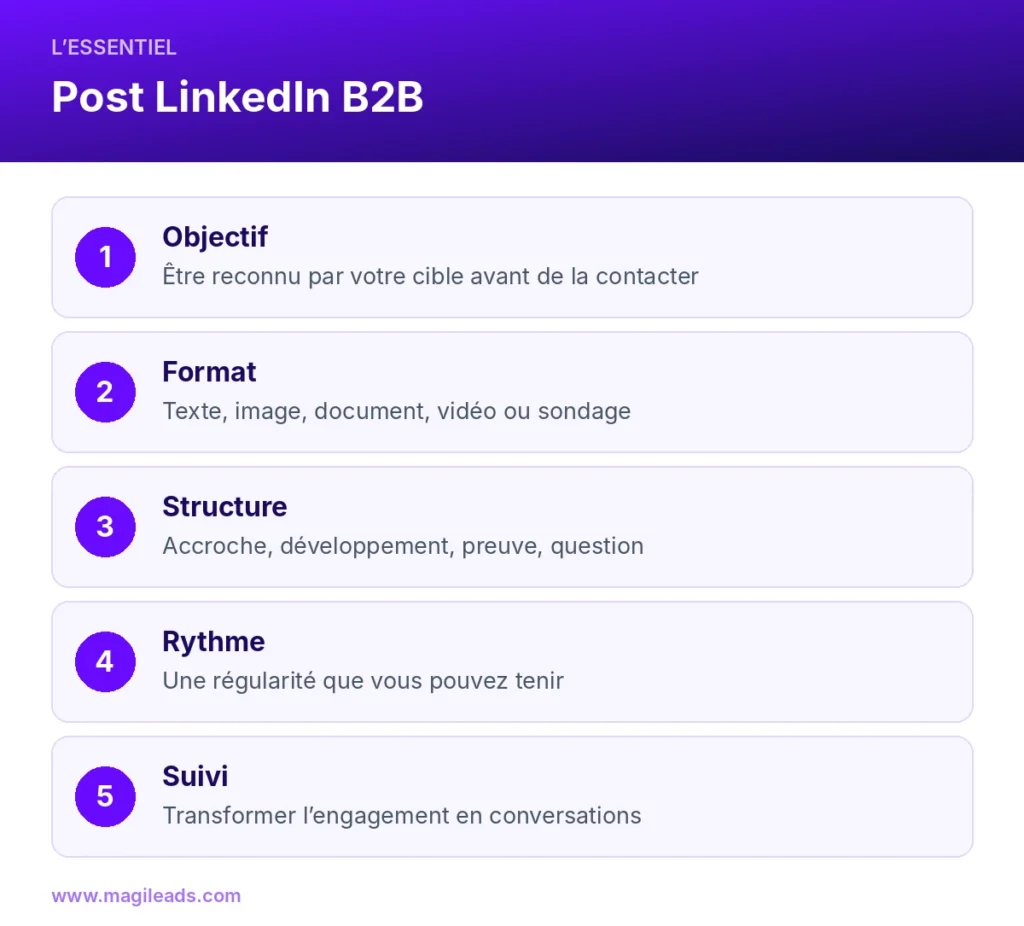
- Objective : to be recognized by your target audience before contacting them.
- Format : text, image, document, video or survey.
- Structure : hook, development, proof, question.
- Rhythm : a regularity that you can maintain.
- Follow-up : Turning engagement into conversations.
Why publish LinkedIn posts in B2B
LinkedIn is the network where professionals read, comment on, and share content related to their field. For a B2B company, it's where your prospects discover your ideas even before visiting your website. A well-targeted B2B LinkedIn post produces three complementary effects: it establishes your credibility on a topic, it creates brand awareness, and it generates signals of interest (reactions, comments, profile views) that you can then leverage.
LinkedIn posts are part of a social selling strategy: you publish, you interact with your prospects' content, and then you start a conversation. They complement your other lead generation activities on LinkedIn, such as targeted search and personalized messages. To measure this activity, LinkedIn offers the Social Selling Index.
A post is a short format, published in the news feed, designed to be read in a few seconds. Articles and LinkedIn newsletters are longer formats, which your subscribers receive and read separately. The two complement each other: posts attract attention daily, while newsletters build audience loyalty over time. If you'd like to launch this second format, consult our LinkedIn newsletter. This article focuses on posts.
Personal profile or company page?
In B2B, both are useful, but they don't play the same role. A manager's, expert's, or salesperson's personal profile conveys a voice, experience, and opinions: it's often what generates the most conversation. The company page provides a formal framework: announcements, job postings, branded content, and events.
The best approach is generally to publish from the profiles of people who speak to customers, and to share the most useful content from the company page. LinkedIn even offers an advertising format, Thought Leader Ads, which allows you to sponsor posts from your company's thought leaders, according to the Sponsored Content page on business.linkedin.com, accessed November 27, 2026.
LinkedIn B2B post formats
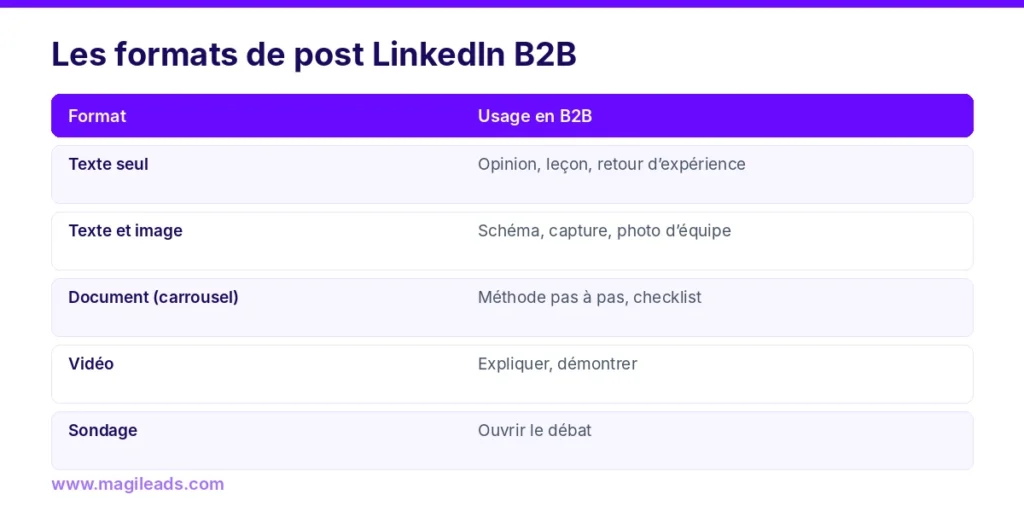
| Format | When to use it |
|---|---|
| Text only | Sharing an opinion, a lesson, a feedback experience |
| Text and image | Illustrate a point with a diagram, a screenshot, a team photo |
| Document (PDF in carousel) | Present a step-by-step method, a checklist |
| Video | Explain, demonstrate, and put a face to your expertise |
| Survey | Open the debate and find out what your target audience thinks |
No format is inherently superior to the others. Text alone is perfectly suited to sharing experiences, documents lend themselves to step-by-step methods, and video humanizes technical expertise. Vary the formats, observe what resonates with your audience, and keep those that generate the most meaningful conversations, not just the most reactions.
The structure of an effective LinkedIn post
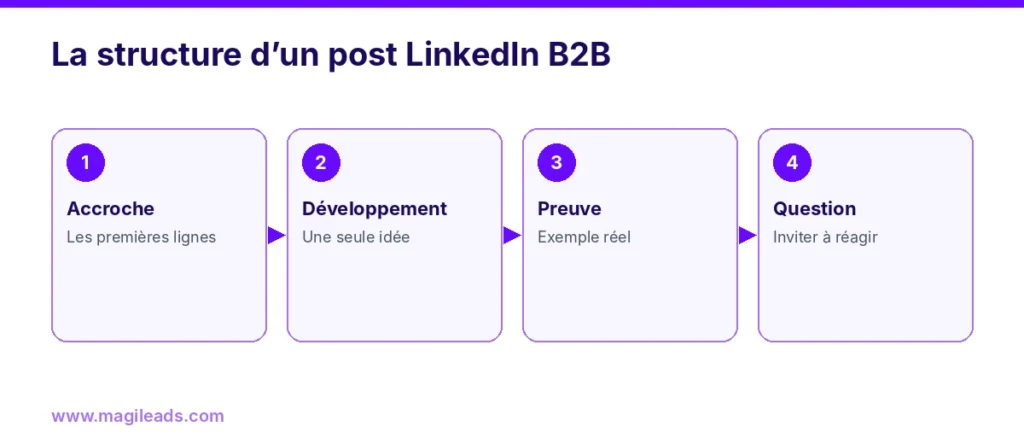
1. The hook
The first few lines appear before LinkedIn truncates the text: they determine whether the reader opens the post. State an observation, a question, or a statement that directly addresses your target audience's problem. Avoid empty phrases: a concise hook is better than a sensational one.
2. Development
Develop a single idea. Use short sentences, well-spaced paragraphs, and perhaps a list. A reader should be able to scan the post effortlessly on a mobile device.
3. The proof
Support your argument with a concrete example, a real-life situation, or a method you use. Never invent figures or testimonials: a real, modest example is more credible than a spectacular, unverifiable result.
4. The question or call to action
End with an open-ended question that invites comment, or a simple suggestion: download a resource, register for a webinar, or exchange messages. A LinkedIn B2B post that ends without an invitation leaves the reader without any interaction.
8 B2B LinkedIn Post Ideas
These ideas are accompanied by an example hook, which you can adapt to your sector and your writing style.
1. The lesson learned from failure
Share a mistake you made or observed, and what you changed afterward. This type of post often sparks genuine discussions.
Example of a hook: "For a long time, we sent the same message to all our prospects. Here's what we changed."
2. The step-by-step method
Outline in a few steps how you solve a common problem your clients face. A document format is well-suited for this.
Example of a tagline: "Prepare for a trade show in 5 steps, without spending your evenings on it."
3. The reasoned opinion
Take a stand on a practice within your sector, with supporting arguments. Remain respectful: the goal is to open a debate, not to create controversy.
Example of a headline: "The first prospecting message should never contain a link. Here's why."
4. The question to your audience
Ask a genuine question that your target audience will want to answer. Their comments will tell you a lot about their priorities.
Example of a hook: "Sales directors: which metric do you track first every Monday?"
5. Behind the Scenes
Show how your team works, how you design a product, how you support a client. This makes your business more tangible.
Example of a headline: "A day with our support team: what customers ask us most often."
6. Deciphering a news story
Explain what a regulatory, technical or commercial development concretely changes for your target audience.
Example of a headline: "What this tool's new feature changes for sales teams."
7. The checklist
A short checklist of points to verify before taking action. It is easy to read, save, and share.
Example of a tagline: "Before launching an email campaign, check these 6 points."
8. The authorized customer case
Present a client's approach, with their agreement and without unverified figures: the initial problem, the solution chosen, what changed in their organization.
Example of a headline: "How a team of three salespeople reorganized their prospecting."
Rhythm and regularity
Consistency matters more than volume. Choose a pace you can maintain over several months, such as one or two posts per week, and prepare your topics in advance using an editorial calendar. After publishing each LinkedIn post, remain available to respond to comments: the discussions that follow a post are often more valuable than the post itself.
From LinkedIn posts to prospecting
People who interact with a LinkedIn post have shown an interest in your topic. This is a valuable audience for prospecting. You can export the likers and commenters of your LinkedIn posts, filter those who match your target audience, and then send them a personalized invitation that references the post. Get inspired by our LinkedIn invitation note examples.
In Magileads, these contacts can be enriched with their professional contact information and then integrated into a multichannel campaign : email and LinkedIn, with SMS and voice options available for a fee. Lead scoring and PRM then help you identify the most engaged contacts and track each conversation.
Mistakes to avoid in a B2B LinkedIn post
The first mistake is talking about yourself rather than the reader's problem. A LinkedIn post that only presents your product or your successes holds little interest for your target audience; a LinkedIn post that helps them understand or solve a problem is read, saved, and commented on. Save your offering for last, and only when it truly addresses the topic at hand.
The second mistake is trying to say everything in a single post. An effective B2B LinkedIn post develops one idea, not five. If your topic is complex, break it down into a series of posts published over several weeks: this creates a regular appointment with your audience and provides enough content for multiple posts. The third mistake is adding an external link to each post without thinking: ask yourself if the reader really needs to leave LinkedIn to benefit from your content.
Finally, don't buy engagement or participate in feedback groups. These practices skew your statistics, make you visible to irrelevant profiles, and don't generate any sales conversations.
Measure the results of your LinkedIn posts
LinkedIn analytics shows the number of impressions, reactions, comments, and shares for each LinkedIn post, as well as information about the people who interacted with it. To learn more, see our article on LinkedIn analytics. In B2B, focus on who is interacting: the role and company of those commenting matter more than their number.
Add to these metrics your own business metrics: the number of conversations opened after a post, invitations accepted, and meetings secured with people who had responded to a B2B LinkedIn post. These results justify the time spent writing. For each post, note the topic, format, and the conversations it generated: after a few months, you'll know precisely what type of LinkedIn post resonates with your target audience.
Organizing writing as a team
In a B2B company, several people can publish content: managers, experts, and salespeople. To maintain consistency without homogenizing the voices, share a list of priority topics related to your offerings and your ideal client, and let each person address them based on their experience. A salesperson will describe what they hear in meetings, an expert will explain a methodology, and a manager will share their market vision.
Schedule regular time to gather ideas: questions from prospects, common objections, and customer success stories that are safe to share. Each LinkedIn post then becomes a natural extension of your sales activity, not an additional chore.
Frequently Asked Questions
- What makes a good LinkedIn B2B post? A post that addresses a specific problem for your target audience, with a clear hook, a single developed idea, a concrete example, and a concluding question.
- Should you post from your personal profile or from the company page? Both are useful: the personal profile more easily generates conversations, the company page carries official communication.
- How often should you post on LinkedIn? Choose a pace you can maintain over time, for example one or two posts per week, rather than a high volume followed by silence.
- How to turn a post into a date? Reply to comments, invite people who match your target audience by quoting the post, then continue the conversation via message and email.
Turn your post engagement into appointments
Enrich the contacts who react to your posts and launch email and LinkedIn campaigns: try Magileads free for 14 days.