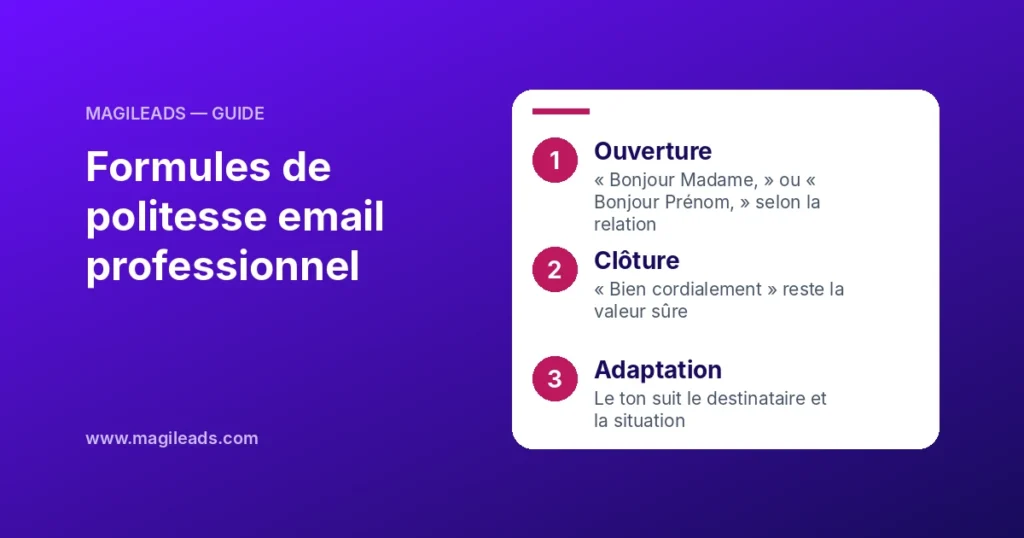
Professional email etiquette frames your message: an opening salutation to greet your recipient, a closing salutation to take your leave before signing. They may seem insignificant, but they set the tone from the very first line and influence the overall impression of your email, especially when you're writing to someone for the first time. This guide provides examples categorized by situation (initial prospecting contact, follow-up, client, manager, formal or informal exchange), common mistakes to avoid, and the specific rules for B2B prospecting emails.
Professional email etiquette: the essentials
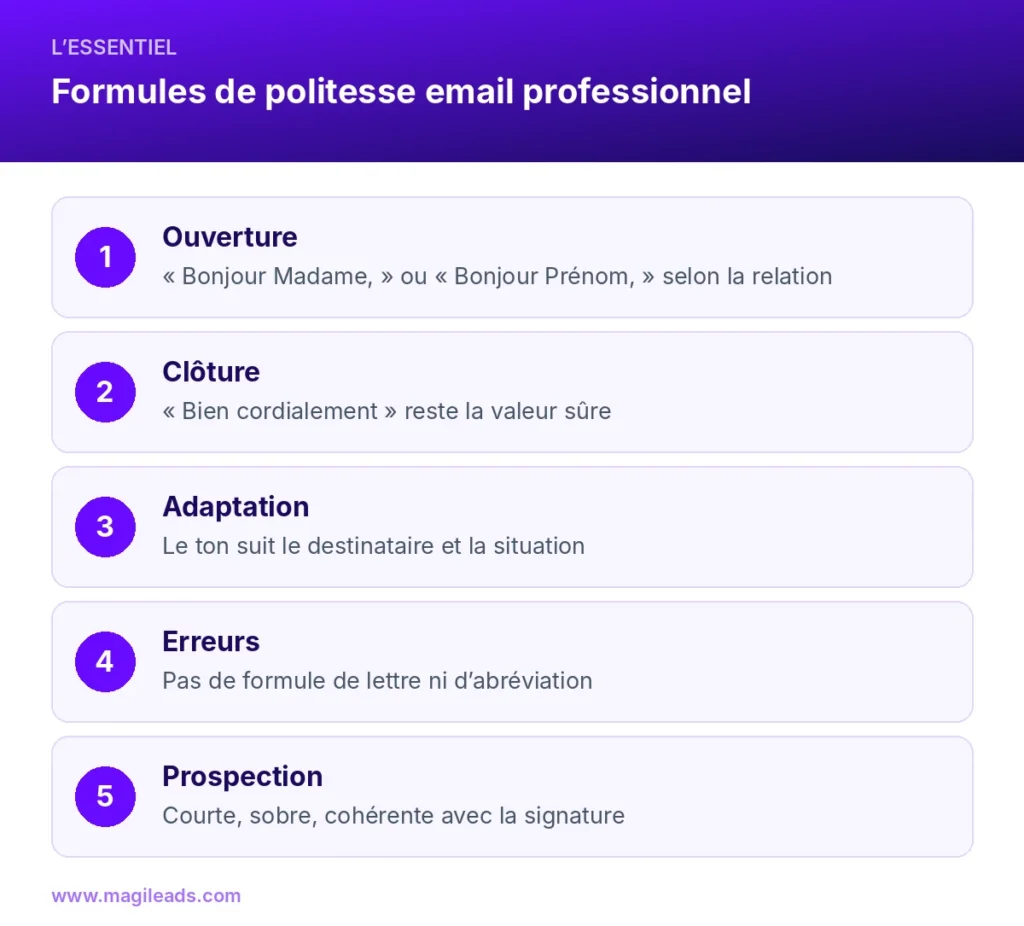
- Opening : "Good morning Madam," or "Good morning [First name]," depending on the relationship.
- Closing : "Best regards" remains the safe bet.
- Adaptation : the tone follows the recipient and the situation.
- Errors : no letter formula or abbreviation.
- Prospecting : short, concise, consistent with the brand signature.
Why polite formulas matter in an email
A professional email is read quickly, often on a mobile device, sometimes between meetings. The opening salutation is one of the first things your recipient sees, and the closing salutation precedes your signature, which contains your contact information. Together, they indicate the level of respect and familiarity you are offering: too informal, you seem casual; too formal, you seem distant or outdated.
The best closing salutation is therefore not necessarily the longest, but the most appropriate. It takes into account your relationship with the recipient (stranger, client, colleague, superior), the context (first contact, follow-up, complaint, thank you), and the conventions of their industry. A law firm and a startup in the tech sector don't use the same conventions, and it's helpful to adapt your tone to the register of the person you're addressing when they reply.
Opening phrases for a professional email
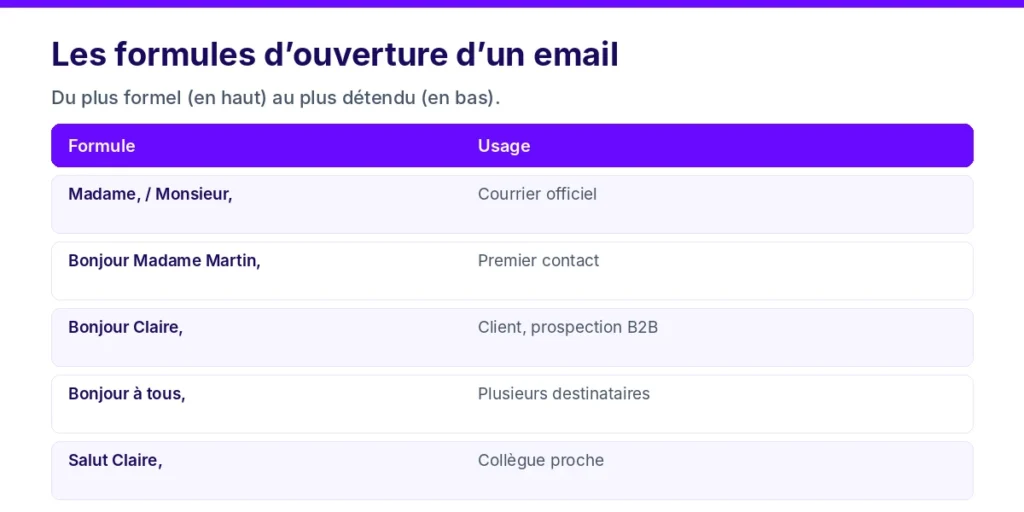
Opening an email is shorter than opening a letter. "Madame" or "Monsieur" are the only acceptable forms of address in formal correspondence, but "Bonjour" followed by the recipient's name or surname is now the most common greeting in professional email exchanges. Here are the main greetings, from the most formal to the most informal.
| Opening formula | When to use it |
|---|---|
| Madam/Sir, | Official correspondence, administration, formal complaint |
| Hello Mrs. Martin, / Hello Mr. Durand, | First contact, someone you don't know |
| Good morning Madam, / Good morning Sir, | Recipient identified but name uncertain |
| Hello Claire, | Client or partner with whom you already do business, B2B prospecting |
| Hello everyone, / Hello to all, | Email sent to a team or several people |
| Hello, / Good evening, | Generic mailbox (contact@, support@) or unknown recipient |
| Hi Claire, / Hello Claire, | Close colleague, only if the relationship allows it |
Here are a few practical rules for these polite formulas: put a comma after the opening, then start a new line; write "Madame" and "Monsieur" in full rather than abbreviated; check the spelling of the name, as a misspelling is the most noticeable error. If you don't know the person's gender, "Hello First Name Last Name," avoids guessing.
Closing phrases for a professional email
The closing often has two parts: a concluding sentence that sets the stage for what follows ("I remain at your disposal for any questions," "I look forward to your reply,") followed by the closing salutation itself, and then your signature. In email, formal closings like "Yours faithfully" are generally considered too formal, except for official correspondence sent by email.
| Closing formula | Register and usage |
|---|---|
| Please accept, Madam, the expression of my distinguished greetings. | Very formal: official letter, administrative notice, formal notice |
| Respectfully, | Formal: distant hierarchical superior, institution |
| Best regards, | A safe bet: most professional exchanges |
| Sincerely, | Neutral, slightly dry: common exchanges |
| Yours sincerely, | Courteous and staff: clients, partners |
| Have a nice day, / Have a good weekend, | Warm: established relationship |
| See you soon, / Thank you and see you very soon, | Relaxed: colleagues, familiar interlocutors |
Professional email greetings for every situation
The choice of professional email salutations depends primarily on the situation. Here are some opening and closing combinations that you can use as is or adapt to your style.
Initial prospecting contact
You are writing to someone who doesn't know you. Keep it professional and respectful, without resorting to a formal, bureaucratic letter. Opening: "Hello Ms. Martin," or "Hello Claire," if industry practice allows. Closing: "Best regards," or "Sincerely," preceded by a simple question such as "Would you be available for fifteen minutes next week to discuss this?".
RELAUNCH
A follow-up email should maintain the same tone as the initial message to ensure consistency. It should open with "Hello Claire," followed by a sentence that gently reminds you of the context ("I'm writing again regarding…"). The closing should be "Best regards," or "Have a lovely day." For structure and pacing guidelines for follow-up emails, please see our tips and examples.
Customer
With a client you regularly work with, a friendly approach is acceptable, but not overly familiar. Opening: "Hello Claire," Closing: "Best regards," "Have a lovely day," or "Please don't hesitate to contact me if you have any further questions. Sincerely," In case of a complaint or dispute, revert to a more formal tone: "Hello Ms. Martin," and "Sincerely,".
Hierarchical superior
It all depends on the company culture. In a company where everyone is on a first-name basis, "Hello Pierre," and "Thank you, have a good day," are appropriate. When dealing with a more senior manager, it's better to use "Hello Mr. Durand," and "Respectfully," or "Best regards." If in doubt, observe how your superior writes to you and follow suit.
Formal or less formal email
For a very formal exchange (administration, legal counsel, job application), use "Madame," or "Good morning, Madam," followed by a closing salutation: "Yours sincerely." For a less formal exchange between colleagues, "Good morning, Julie," and "Thank you, see you later," are sufficient. In between, "Good morning, Julie," and "Best regards," cover the vast majority of situations.
Mistakes to avoid with polite formulas
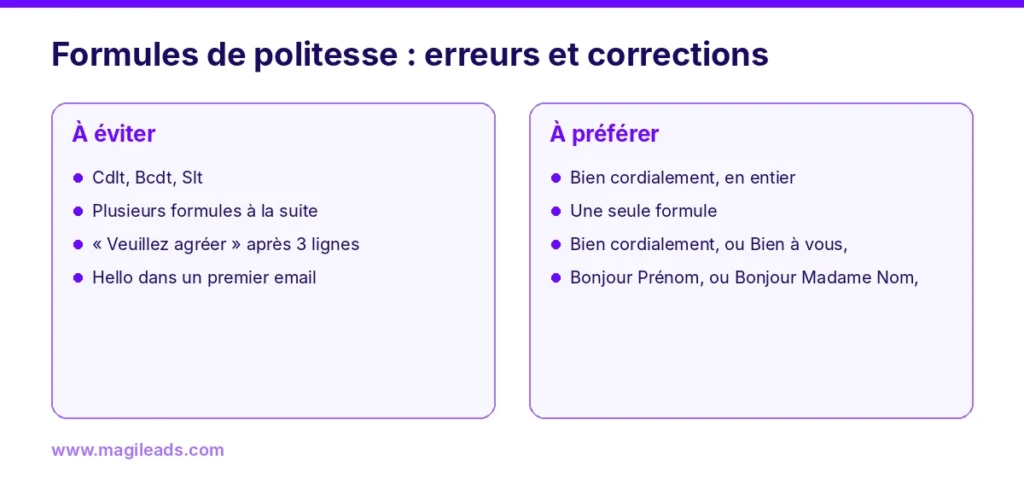
- The abbreviations "Cdlt", "Bcdt" or "Slt" give an impression of haste. Write the full formula.
- Using multiple forms of address , such as "Sincerely," "Best regards," or "Greetings," muddles the message. A single form of address is sufficient.
- The closing salutation in a short email : "Please accept…" after three lines seems disproportionate.
- Wrong name or wrong gender : check the spelling, and use "Hello First Name Last Name," if in doubt.
- Contradictory phrases such as "Sincere greetings" after a curt message, or "Kisses" to a client, create a disconnect.
- Premature familiarity : "Hello" or using the informal "tu" form in a first prospecting email, unless your target uses it themselves.
These errors are similar to those found in the body of the message. To learn more, consult the list of phrases to avoid in your prospecting emails.
The case of B2B prospecting emails
In a prospecting email, the closing salutation plays a crucial role: it must inspire confidence without slowing down the reading process. Your recipient hasn't asked for this; every unnecessary line reduces the chances of them reading to your proposal. Therefore, choose a personalized opening with their first or last name, a conclusion focused on a clear action, and a short closing such as "Best regards,". The tone of a B2B prospecting email should remain consistent from the subject line to the closing salutation.
The closing salutation is immediately followed by your signature: name, job title, company, phone number, and optionally a link to your LinkedIn profile. A well-crafted signature reinforces your courtesy and reassures your prospect of your identity. You can create a free email signature in minutes. For the complete message structure, refer to our prospecting email templates and our tips for writingeffective subject lines.
Finally, when sending sequences to multiple prospects, personalization variables allow you to automatically insert their first name or title into the opening salutation. Check the quality of your data before sending: an empty or incorrectly filled-out field will produce a generic "Hello," which ruins the intended effect. In Magileads, multichannel campaigns combine emails and LinkedIn steps, with SMS and voice steps available as paid options, and contact enrichment helps ensure you have the right fields to personalize your greetings.
Choosing your polite phrases: a simple method
To choose your polite phrases with confidence, ask yourself three questions before writing. Do you already know this person? What is the context of the exchange: request, response, follow-up, complaint, or thank you? What register does your correspondent use? If you don't know the person, remain courteous and neutral. If they have already written to you, match their level of formality, without being more familiar.
A good closing salutation should also be consistent with the body of the message. A friendly email ending with a formal, businesslike closing, or a very formal message concluding with "See you later," creates a disconnect that the reader will notice. Proofread everything before sending: the opening, the tone of the text, and the closing should all form a cohesive whole.
In a sales team, it's helpful to share a few standard closing salutations for each situation: initial contact, follow-up, customer follow-up, and responding to a complaint. While everyone maintains their own style, prospects receive consistent messages regardless of which salesperson is writing. These standard salutations can be directly integrated into your email templates, so you don't have to think about them for each email.
Polite phrases and exchanges in English
If you're prospecting internationally, adapt your salutations to the language. In English, "Dear Ms. Martin," or "Hi Claire," open most business emails, and "Best regards," "Kind regards," or "Best," close them. These closings are generally shorter and less formal than in French. Avoid translating a French phrase word for word: "Please accept my distinguished salutations" sounds strange to an English-speaking reader. When your contact writes in a language other than your own, reply in their language if you are fluent; otherwise, keep it simple and clear.
Remember the essentials: a polite closing appropriate to the recipient, written in full, consistent with the message, and followed by a complete signature. These few words won't sell your offer for you, but they prevent a clumsy touch from overshadowing the substance of your email.
Frequently Asked Questions
- What is the most commonly used closing salutation in a professional email? "Best regards" is the most versatile closing salutation: courteous without being ceremonious, it is suitable for most professional exchanges.
- Is "Cordially" impolite? No, but it can seem a bit abrupt. "Best regards" or "Yours sincerely" soften the end of the message, especially during a first contact.
- Should you write "Madame, Monsieur" in an email? Only if you don't know who will read the message and the context is formal. Otherwise, "Bonjour Madame Martin," is more personal and natural in an email.
- What is the correct closing for a prospecting email? A personalized opening ("Hello Claire," or "Hello Mrs. Martin,") and a short closing ("Best regards,"), followed by a full signature.
Personalize each prospecting email
Enhanced contact data, personalization variables, email and LinkedIn sequences: try Magileads free for 14 days.