Theideal customer profile (ICP) describes the type of business that derives the most value from your offering and brings you the most value in return. It doesn't describe a person, but an organization: its sector, size, situation, and needs. A well-defined ICP guides all your prospecting efforts: who to target, what messages to send, and which opportunities to decline.
Ideal customer profile: the essentials
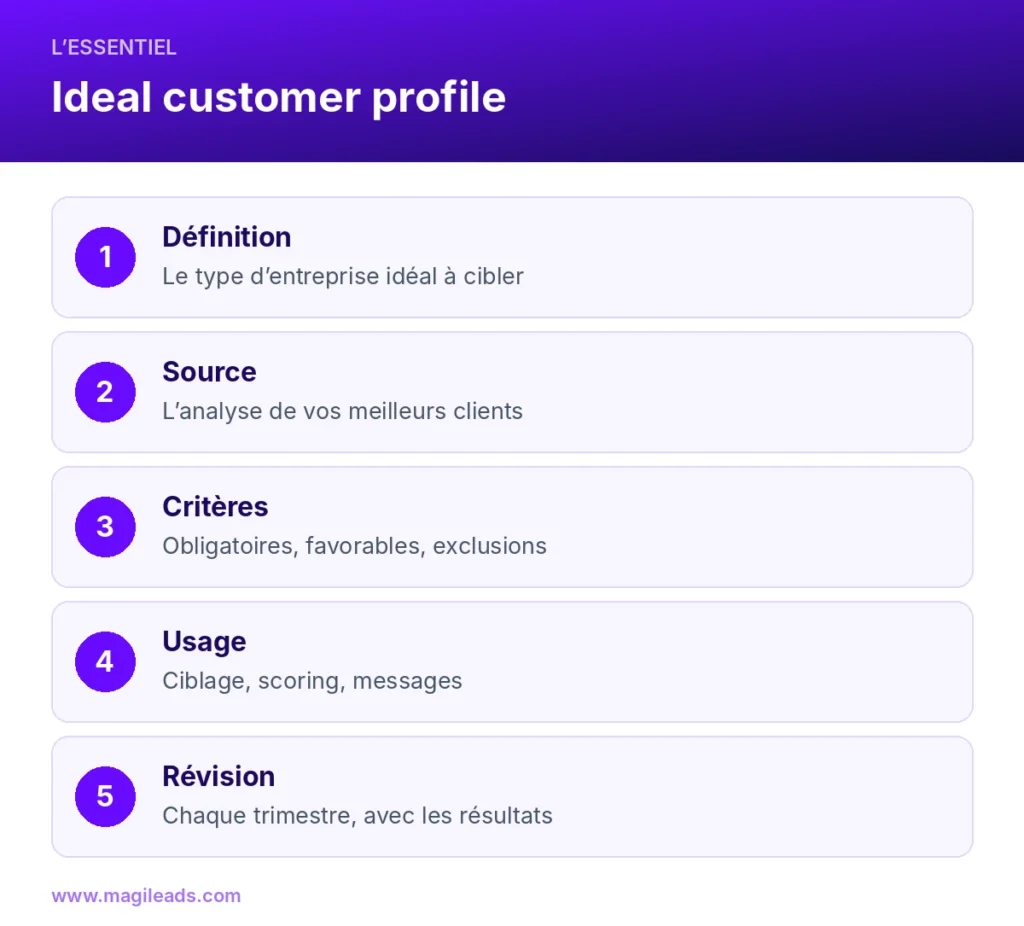
- Definition : the ideal type of company to target.
- Source : analysis of your best customers.
- Criteria : mandatory, favorable, exclusions.
- Usage : targeting, scoring, messaging.
- Review : every quarter, with the results.
Ideal customer profile: definition
The ideal customer profile (ICP) compiles the common characteristics of your best customers: those who buy easily, remain loyal customers for a long time, truly use your product, and recommend you. It acts as a filter: a company that matches your ICP is more likely to become a good customer than a randomly selected one.
Beware of the common confusion: in B2B prospecting, ICP refers to the ideal customer profile, and not to key performance indicators (KPIs).
ICP and persona: what's the difference?
| Ideal customer profile (ICP) | Buyer persona | |
|---|---|---|
| Describe | A company | A person in the company |
| Criteria | Sector, size, area, technology, situation | Position, responsibilities, objectives, obstacles |
| Used to | Choose the accounts to target | Choosing the people to talk to and the message |
| Order | To be defined first | Next, to be defined for each ICP |
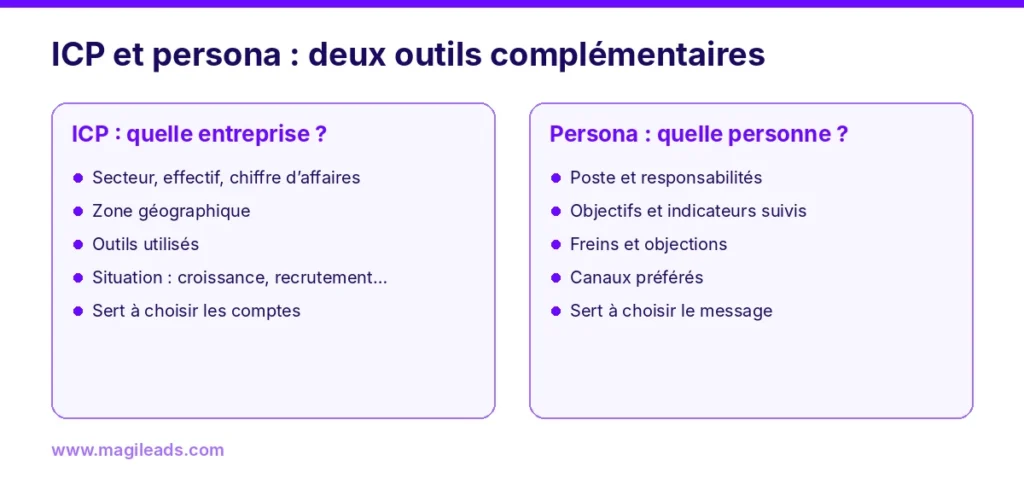
To learn more about the people you'll be speaking to, see our article on prospecting channels tailored to your persona and our article ondecision-maker engagement (DMU).
Why define your ideal customer profile?
- More precise targeting : you focus your efforts on the accounts most likely to sign.
- More relevant messages : you are familiar with the typical problems these companies face.
- Better marketing and sales alignment : both teams work on the same definition of a good prospect.
- Less time wasted : you eliminate unsuitable opportunities more quickly.
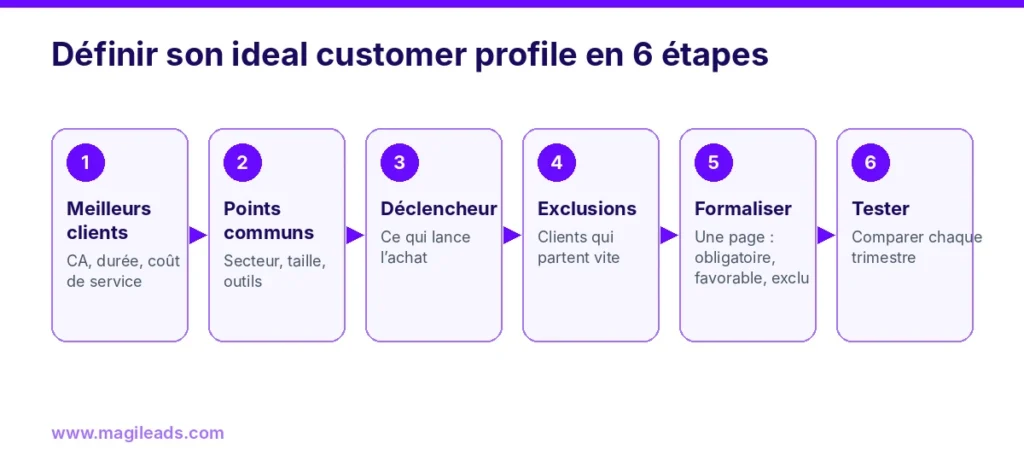
Defining your KPI in 6 steps
- List your best customers : those who generate the most revenue, stay the longest, and cost you the least to serve.
- Identify their common characteristics : sector, workforce, turnover, geographical area, tools used, sales organization.
- Identify the purchase trigger : what prompted them to contact you? Recruitment, growth, new regulations, change of tool…
- Identify exclusion signals : the characteristics of customers who leave quickly or do not find what they are looking for.
- Formalize the ICP on one page : mandatory criteria, favorable criteria and exclusion criteria.
- Test and adjust : compare your results on accounts within and outside the ICP every quarter.
Criteria grid for your ICP
| Family of criteria | Examples | Where to find the information |
|---|---|---|
| Firmographic | Sector, workforce, revenue, location | B2B database, company registers |
| Technographics | CRM used, marketing tools, website | Company website, technology analysis tools |
| Organization | Size of the sales team, presence of a marketing department | LinkedIn, job offers |
| Situation | Growth, recruitment, fundraising, new offering | News, job offers, business signals |
| Exclusion | Too small, out of area, competitor, existing customer | CRM, exclusion lists |
ICP form to be completed
Copy this template into a shared document and complete it with your sales team. Each line should be based on customer analysis, not intuition.
| Section | To be completed | Example answer |
|---|---|---|
| Target sectors | The 2 or 3 sectors where your best customers are concentrated | B2B services, software |
| Company size | Staff size or revenue bracket | 20 to 500 employees |
| Geographic area | Countries, regions | France, Belgium |
| Organization | Teams and functions present | Sales team of at least 3 people |
| Tools already used | Software that facilitates the adoption of your offering | A CRM in place |
| Purchase triggers | Events that create the need | Sales representative recruitment, new market |
| Exclusion criteria | What disqualifies an account | Sale to private individuals only |
| Interlocutors | Functions to contact (personas) | Sales Director, Executive |
Example of ideal customer profile
An illustrative example for a prospecting software publisher: "SMEs and mid-sized B2B service companies in France, with 20 to 500 employees, having a sales team of at least three people, who are recruiting salespeople or opening a new market, and who already use a CRM. Exclusion: companies that sell only to individuals."
This example is not a universal recommendation: your KPI should come from the analysis of your own customers.
Examples of ICPs (Integrated Care Pathways) based on your activity
These examples are illustrative: they show the form of a well-written ICP, not a target to be copied.
B2B Marketing Agency
Software publishers and B2B service companies with 10 to 200 employees, without a full internal marketing team, who are launching a new offering or seeking to generate more inbound leads.
Consulting firm
Industrial SMEs with 250 to 2,000 employees, in a phase of transformation (new management, reorganization, acquisition), with a consulting budget and an identified sponsor in general management.
HR software publisher
Companies with 50 to 1,000 employees that regularly recruit, with a structured HR function but still equipped with spreadsheets, and a digitalization project underway.
Measure the relevance of your KPI
A performance indicator (PI) is judged based on results. Each quarter, compare the accounts that meet your PI with those that do not, using a few simple indicators:
- Response rate to your prospecting campaigns;
- Opportunity-to-customer conversion rate ;
- Sales cycle length ;
- Value and duration of the customer relationship.
If the accounts "within the KPI" aren't performing significantly better, your criteria are either too broad or poorly chosen: refine them using data from your best customers. Our advice on B2B lead generation KPIs will help you structure this tracking.
Transform your ICP into a prospect list
Once you've defined your Key Performance Indicator (KPI), translate each criterion into a search filter: activity code or sector, employee size, geographic area, and contact roles. You can then build your list in a B2B contact database, enrich it, and segment it into subgroups to tailor your messages. To structure the next steps, refer to our sales prospecting plan guide.
Common mistakes in defining one's ICP
- A broad target audience (CAI) such as "all French SMEs" doesn't help with selection. A well-defined target audience allows you to decline certain prospects.
- An impression-based KPI : rely on your customers' data (revenue, relationship length, satisfaction), not just your favorite customers.
- Confusing ICP and persona : the ICP chooses the companies, the persona chooses the stakeholders. You need both.
- Never share it : a KPI known only to marketing won't guide prospecting. Share it with the sales team and integrate it into your tools.
- Never review it : your offer and your market evolve; your KPI must follow.
Use ICP to prioritize your leads
Your KPI can also be used to score inbound leads. Assign points for each met criterion (target sector, appropriate size, presence of a purchase trigger) and deduct points for exclusion criteria. Leads with the highest scores are prioritized by sales representatives, while others enter a nurturing process. This lead scoring approach makes your KPI operational on a daily basis, not just for strategic documents.
Bringing the ICP to life throughout the entire team
An ideal customer profile is only effective if it's used daily. To ensure it doesn't become a forgotten document:
- Present it to the entire sales and marketing team, with examples of clients who fit it.
- Integrate it with your tools : saved search filters, fields in the CRM, lead scoring rules.
- Qualify each opportunity against the ICP from the first exchange.
- Gather feedback from the field : salespeople quickly identify the criteria that are not working.
- Schedule a service appointment once or twice a year to adjust it.
When shared widely, ICP becomes a common language: everyone knows which accounts to target, and why.
The ideal customer profile for everyday use
An ideal customer profile is only valuable if it's used. Share it with your marketing and sales teams, apply it to your prospect search filters and lead scoring, and compare the results of accounts that match your ideal customer profile with those that deviate from it every quarter.
If the discrepancies are small, your criteria are too broad; if they are large, you can focus more of your efforts on priority accounts.
Finally, remember to update your ideal customer profile to reflect your offering: a new product, a new market, or a new pricing structure can change the type of business that derives the most value from it. An up-to-date ideal customer profile remains the best starting point for any prospecting campaign.
Frequently Asked Questions
- What does ICP mean in B2B marketing? Ideal Customer Profile: the description of the type of company that best matches your offer.
- Can you have multiple KPIs? Yes, if you're selling to very different segments. However, limit yourself to two or three to maintain clear messaging.
- How often should you update your ideal customer profile? Review it at least once a year, or whenever your offer or market evolves.
- Do you need a KPI when starting without customers? Yes: start with assumptions about the companies that need your solution the most, then adjust with your first customers.
Move from theory to practice
To delve deeper into the subject, consult our comprehensive guide to B2B lead generation. And to transform your ICP into campaigns, Magileads allows you to target your B2B prospects, contact them via email and LinkedIn, and track their responses, all from a single platform.