The SDR, or Sales Development Representative, is the salesperson responsible for opening doors: they identify companies to contact, initiate conversations, and qualify leads before passing them on to the sales representatives who close the deals. This role has grown significantly in B2B companies, particularly in the software sector. Here's what an SDR does on a daily basis, the skills required, the tools used, and the metrics that measure their performance.
SDR: the essentials
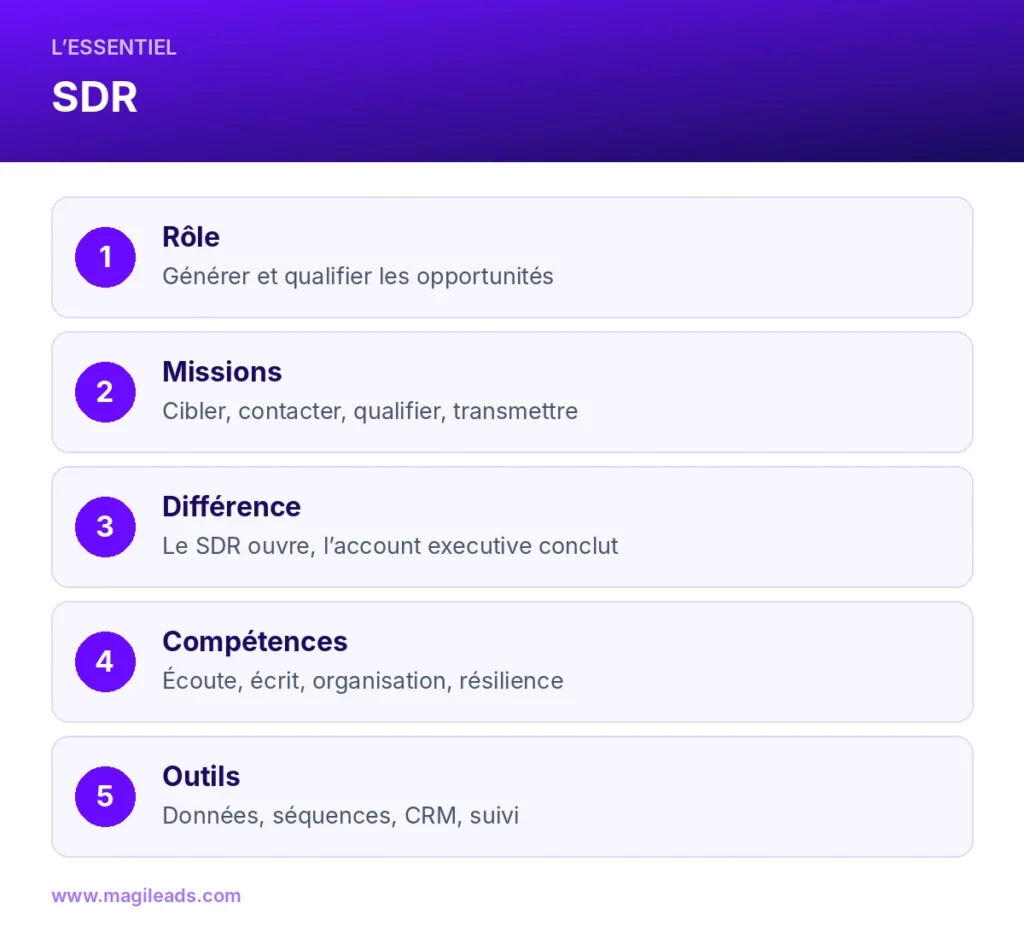
- Role : to generate and qualify opportunities.
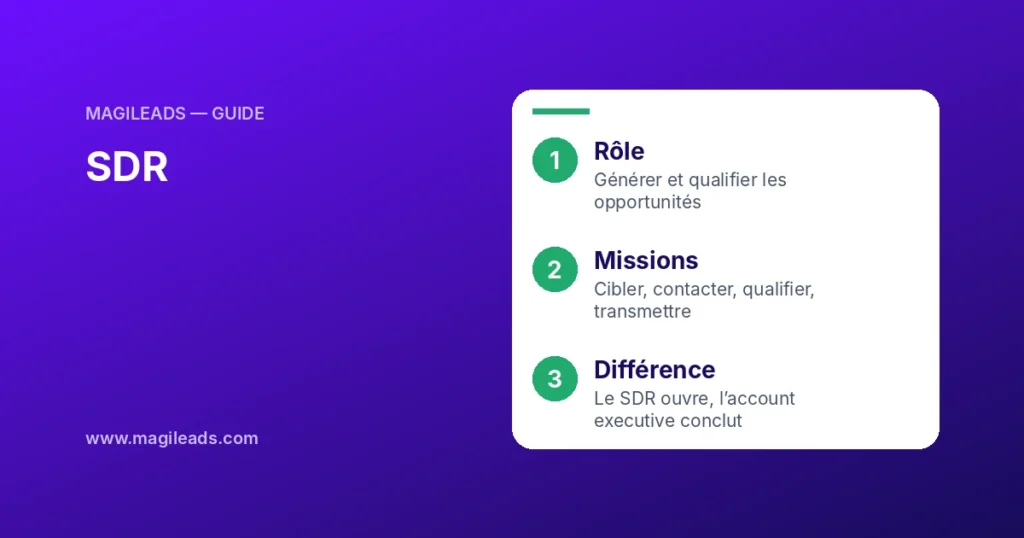
- Missions : target, contact, qualify, transmit.
- Difference : the SDR opens, the account executive closes.
- Skills : listening, writing, organization, resilience.
- Tools : data, sequences, CRM, tracking.
SDR: Job Definition
This role is for a sales professional specializing in the upper sales funnel. Their primary mission is to generate qualified leads: they don't typically close deals, but they secure appointments that feed the sales team's pipeline. They are also known as a business development manager, junior business developer, or, when handling only inbound leads, a BDR or lead qualifier, depending on the organization.
This specialization is based on a simple idea: prospecting and closing are two different jobs. By entrusting prospecting to dedicated profiles, the salespeople who conduct the meetings can focus on discovery, demonstration, and negotiation.
The daily tasks of an SDR
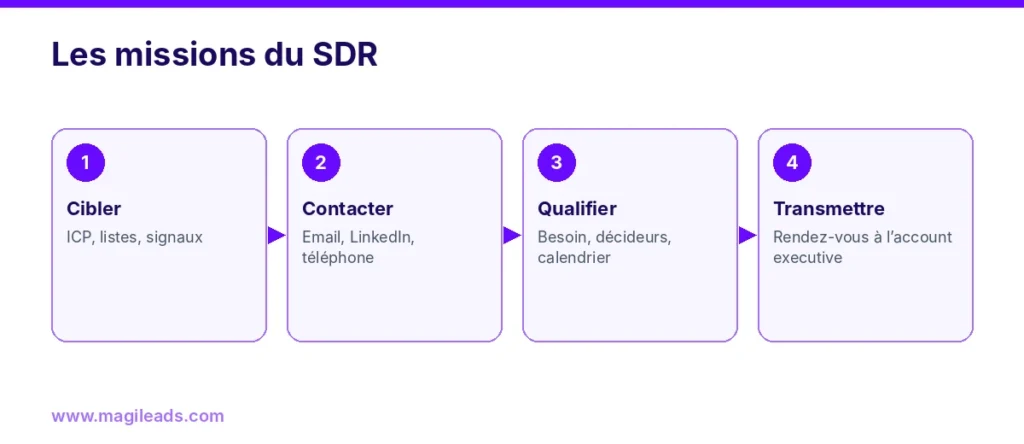
1. Target the right accounts
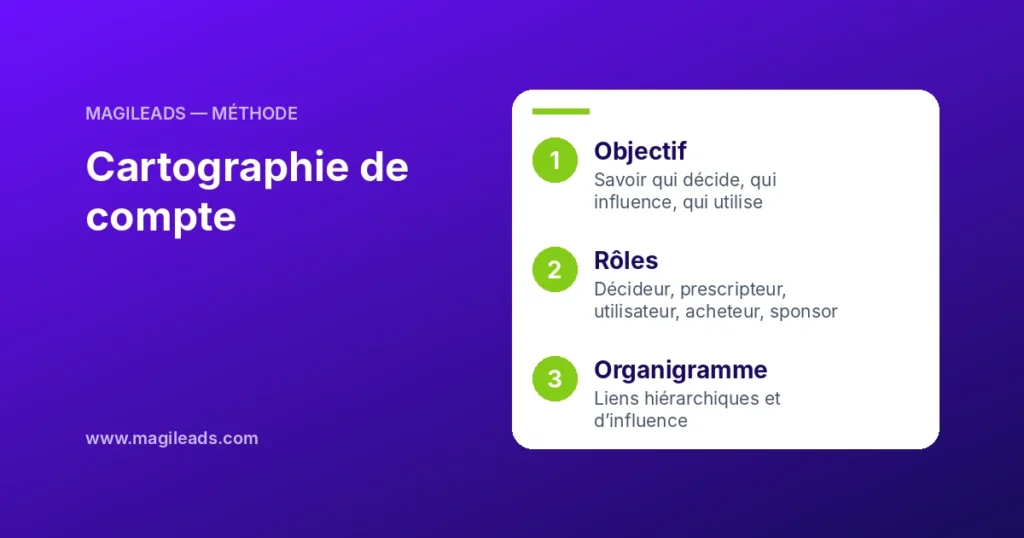
He starts with theideal customer profile to build his lists: sectors, company sizes, and roles to contact. He relies on B2B databases, LinkedIn, and business signals (recruitment, fundraising, job changes) to choose the right moment.
2. Start the conversation
He contacts prospects via email, LinkedIn, and phone, most often through multichannel strategies. His goal isn't to sell, but to get a response and engage in conversation. See our guide to outbound prospecting.
3. Qualify prospects
During initial discussions, he verifies that the prospect matches the target audience and that there is a genuine need: stakes, decision-makers, timeline, budget. This qualification prevents the sales team's schedules from being cluttered with appointments that have no potential.
4. Forward to the account executive
Once the prospect is qualified, the salesperson schedules a meeting with the account executive (the salesperson who closes the deal) and hands over all the information gathered. A smooth handover prevents the prospect from repeating what they've already explained.
SDR, BDR, business developer, account executive: what are the differences?
| Role | Main mission | Key indicator |
|---|---|---|
| SDR (Sales Development Representative) | Prospecting and qualifying leads, especially by going outbound | Qualified appointments secured |
| BDR (Business Development Representative) | This varies from company to company: often it's outbound prospecting, sometimes it's processing inbound requests | Opportunities created |
| Business developer | Developing the portfolio, sometimes from prospecting to signing | Revenue signed |
| Account executive | Conducting appointments and closing sales | Contracts signed |
The titles vary greatly from one company to another: the important thing is to clearly define who prospects, who qualifies and who closes, and at what point the prospect changes hands.
The skills of a good SDR
- Listening : quickly understanding the prospect's situation and what might interest them.
- Writing : Write short, personalized messages without jargon. Get inspired by our prospecting email templates.
- Telephone skills : presenting the topic in a few sentences and handling objections.
- The organization : tracking hundreds of prospects at different stages without missing any.
- Resilience : the majority of messages remain unanswered; consistency must be maintained.
- Curiosity : taking an interest in the sectors, professions and current events of prospects.
Handling refusals is part of the daily routine: a good sales representative knows how to address concerns without being pushy. See our guide to handling sales objections.
SDR tools
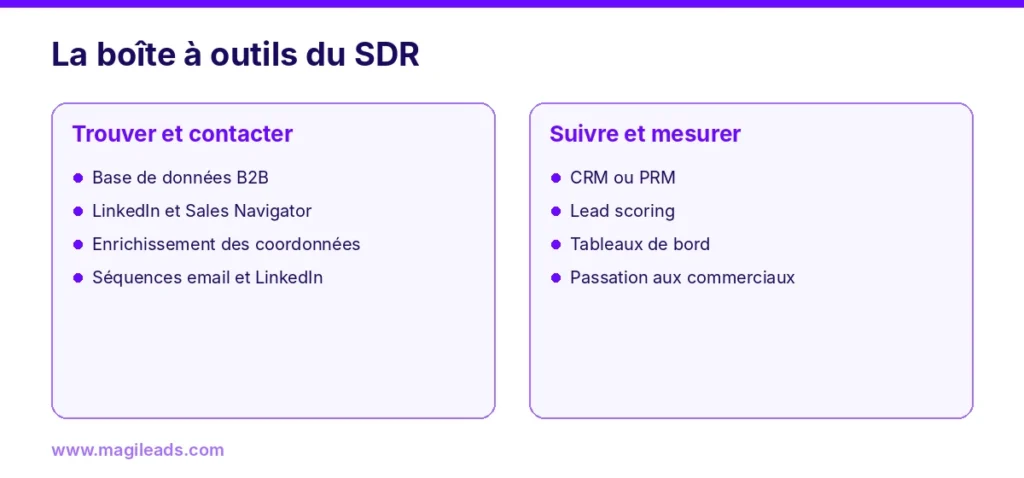
He works with a stack of tools that covers the entire prospecting chain:
- A data source : B2B database, LinkedIn and Sales Navigator, enrichment of contact details.
- A sequencing tool to link emails, LinkedIn actions and calls, with automatic follow-ups.
- A CRM or PRM to track each prospect and pass on opportunities.
- Dashboards to track your indicators and adjust your messages.
A platform like Magileads brings together a dynamic and global B2B database of decision-makers, contact enrichment and verification, multi-channel email and LinkedIn campaigns (SMS and voice as a paid option), and a PRM with lead scoring: the salesperson spends less time juggling between tools and more time interacting with their prospects.
SDR performance indicators
| Indicator | What it measures |
|---|---|
| Number of prospects contacted | The activity |
| Response rate | The relevance of the targeting and the messages |
| Appointments obtained | The effectiveness of prospecting |
| Qualified appointments accepted by sales representatives | The quality of the qualification |
| Opportunities and revenue generated | The contribution to the pipeline |
These indicators are read together: a salesperson who gets a lot of unqualified appointments does not help the team any more than another who gets fewer, but with a high conversion rate.
Organize an SDR team
For an SDR team to function effectively, three elements are essential: a shared definition of a qualified appointment, a clear handover procedure between SDRs and account executives, and a common tool for tracking each account. Without these rules, interested prospects risk waiting too long or being contacted twice.
In a small business, the role of Sales Development Representative (SDR) can be filled by the owner or a salesperson who sets aside specific time slots for prospecting. The key is consistency: prospecting every week yields more results than an intense campaign followed by several weeks of inactivity.
Becoming an SDR
The role of Sales Development Representative (SDR) is often a gateway into B2B sales. It suits individuals who enjoy interacting with people, writing, and working with measurable objectives. After a few years, these professionals frequently progress to account executive positions, lead sales teams, or move into marketing roles. They develop a deep understanding of clients, their challenges, and their objections, which is invaluable for their future careers.
A typical day for a sales development representative
A sales development representative's day is generally structured in blocks. The morning is often dedicated to making calls, when decision-makers are most available, and processing responses received the previous day. Part of the day is spent preparing new lists and researching information on priority accounts: news, recruitment, publications. The remaining time is devoted to writing personalized messages, following up, and updating the CRM.
Consistency matters more than intensity. Maintaining a consistent daily rhythm, with fixed time slots for each activity, produces more stable results than alternating between very busy and quiet weeks. Many teams therefore set daily action targets (contacts, follow-ups, calls) in addition to appointment targets, to maintain a steady level of activity even when responses are delayed.
This block-based organization prevents scattering attention across very different tasks. It also allows for precise measurement of the time spent on each activity and identification of what can be automated: creating lists, enriching contact information, and sending reminders are the first tasks that teams entrust to their tools.
Train and support a new sales development representative
A new sales development representative needs to quickly understand the product/service offering, the customers, and their challenges. The first few weeks can be spent listening to calls from colleagues, reviewing conversations that led to appointments, and learning about common objections. A shared repository (target audience, key messages, objection responses) significantly accelerates this learning process.
Regular monitoring by a manager is equally important: weekly review of indicators, listening to a few calls, and proofreading messages. Concrete feedback from real-life cases is more helpful than theoretical training. It also allows for the early identification of difficulties and adjustments to targeting or messaging before motivation wanes.
Finally, collaboration with the sales representatives who receive the appointments is essential. Regular check-ins to discuss the quality of the opportunities passed on help refine the definition of a qualified appointment and strengthen trust between the two teams. A Sales Development Representative (SDR) who is well integrated into the sales team better understands what constitutes a good appointment, and the sales representatives know what to expect from them. This relationship of trust is built over time, with shared objectives and regular feedback.
Frequently Asked Questions
- What does SDR mean? Sales Development Representative: the salesperson responsible for prospecting and qualifying prospects before passing them on to the salespeople who close the deal.
- What is the difference between an SDR and an account executive? The SDR opens opportunities (prospecting, qualification); the account executive conducts meetings and closes sales.
- What tools does an SDR use? A B2B data source, LinkedIn, a multi-channel sequencing tool, a CRM or PRM and dashboards.
- How do you measure the performance of an SDR? By the response rate, the number of qualified appointments accepted by salespeople, and the opportunities generated.
Equip your SDRs with an all-in-one platform
Data enrichment, email and LinkedIn sequences, PRM: try Magileads free for 14 days.