Sales objections are n't refusals: they're questions, doubts, or priorities expressed by the prospect. When handled well, they move the discussion forward. When handled poorly, they shut it down. This guide provides a four-step method, the ten most common B2B objections with sample responses, and the specific characteristics of objections encountered during prospecting.
Trade objections: the essentials
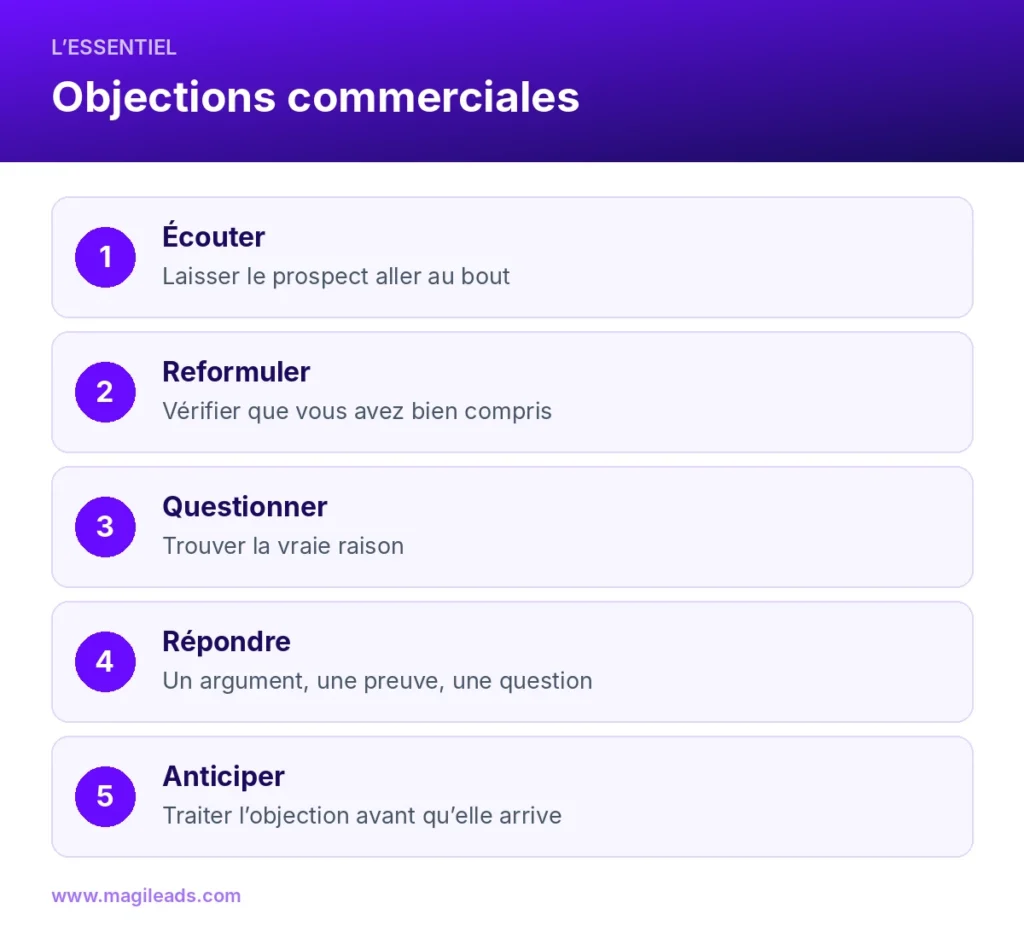
- Listen : let the prospect finish.
- Rephrase : check that you have understood correctly.
- Questioning : finding the real reason.
- Answer : an argument, a piece of evidence, a question.
- Anticipate : address the objection before it arises.
Why sales objections are good news
A prospect who objects is a prospect who is considering your proposal. Silence is much harder to deal with. An objection tells you what the obstacle is: price, timing, trust, priority, or who makes the decision. Your job is to identify which one, then address it without being pushy.
Sales objections fall into two categories: genuine objections (a concrete obstacle, such as a budget already committed) and superficial objections (a polite way to end the conversation). Questions help distinguish between the two.
The 4-step method for handling sales objections
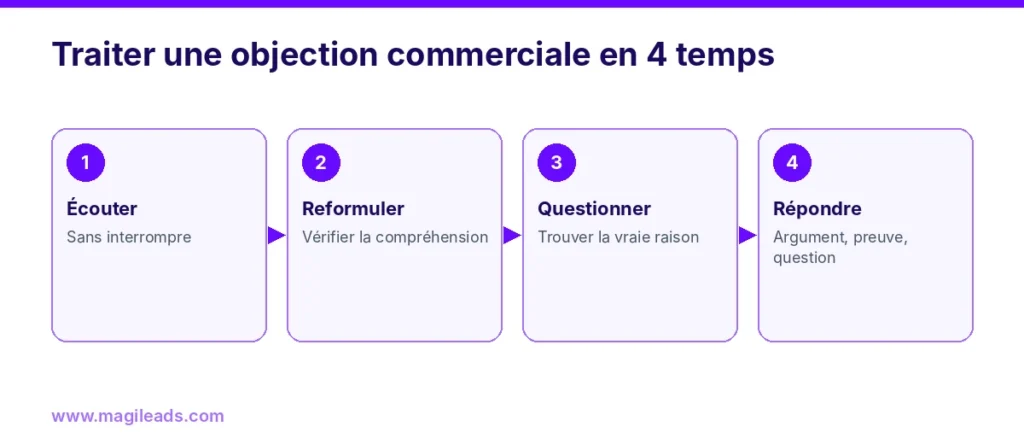
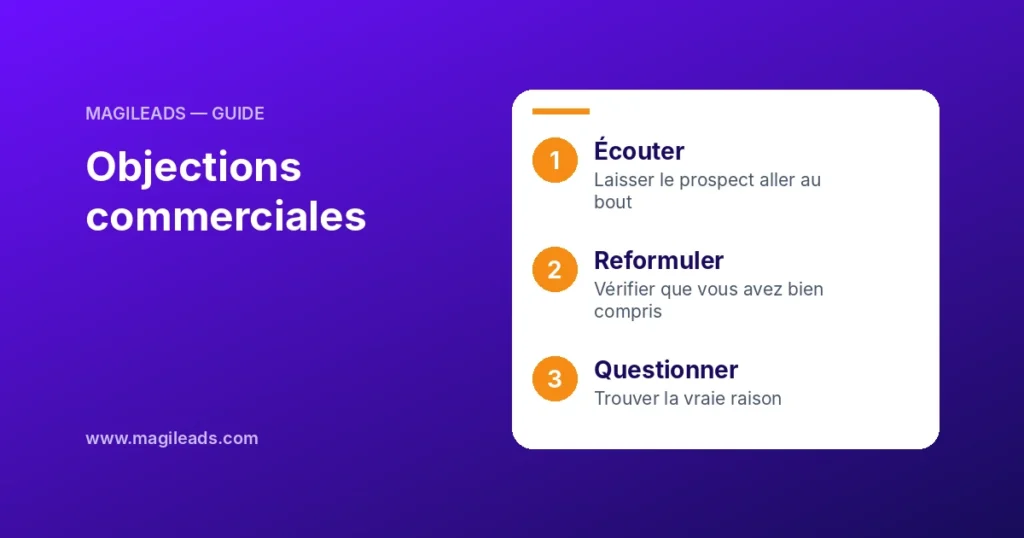
- Listen without interrupting. Interrupting gives the impression that you had a ready answer and didn't really hear.
- Rephrase : "If I understand correctly, what's making you hesitate is…". Rephrasing shows that you understand and allows the prospect to elaborate.
- Ask questions to find the real reason: "Compared to what do you find it expensive?", "What would need to change to make it the right time?".
- Answer briefly: one argument, one concrete proof, then a question to verify that the answer is suitable.
This method works on the phone as well as in meetings, and adapts to writing when the objection comes in response to an email or a LinkedIn message.
The 10 most common sales objections
1. "It's too expensive"
What it often hides : a poorly perceived value, an unforeseen budget, or a comparison with a less comprehensive solution.
How to respond : bring the discussion back to the cost of the current problem and what your solution changes, then check what the prospect is comparing your price to.
Example response : "I understand. To make sure we're comparing correctly: what does this amount represent today?"
2. "This is not the right time"
What it often hides : a competing priority, a busy period, or a lack of polite interest.
How to respond : ask what is occupying the prospect's mind and when the situation might change, then suggest a specific date for a follow-up call.
Example response : "What needs to be completed before the issue becomes a priority again? I'll contact you again then."
3. "Send me some documentation"
What she often hides : often a way to end the call.
How to respond : accept, but first qualify what interests the prospect, in order to send a targeted document and set up a follow-up appointment.
Example response : "With pleasure. To send you what will be useful to you: which point would you like to explore in more depth first?"
4. "We already have a supplier"
What it often hides : a real satisfaction, or a habit that no one questions.
How to respond : Don't criticize the competitor. Ask what works and what could be improved.
Example response : "Very well. What satisfies you most today, and if there were one point to improve, what would it be?"
5. "I'm not the right person"
What it often hides : valuable information, provided you can capitalize on it.
How to respond : ask who is in charge of the topic and if you can mention your exchange.
Example response : "Thank you for letting me know. Who would be the right person, and can I tell them that we've been in contact?"
What it often hides : a budget already allocated, or a value that does not yet justify the expense.
How to respond : ask when budgets are decided and what would need to be demonstrated for the subject to be included.
Example answer : "When do you prepare your budgets for the next period, and what would allow you to include this item?"
7. "I need to talk to my management about this."
What it often hides : a collective decision, or a need for arguments to convince.
How to respond : offer to help the prospect present the topic, and identify the decision-makers.
Example response : "Of course. What will be most important for your department? I can prepare a summary for you."
8. "It won't work here."
What it often hides : a past failure or a poorly understood specificity.
How to answer : have the situation and previous experience described before answering.
Example response : "What makes you think that? Have you tried a similar approach before?"
9. "We already do that internally."
What it often hides : a competent team, or an underestimated workload.
How to answer this : look at the current organization and the time it requires.
Example answer : "How much time does your team spend on this each week today?"
10. "I don't have time"
What she often hides is that the timing is wrong, or the interest isn't there yet.
How to respond : respect the prospect's time: a contextual sentence, a question, and suggest another time slot.
Example response : "I'll be brief: just one point and you tell me if it warrants a 15-minute discussion later."
Sales objections in prospecting
In prospecting, objections often come in writing, in response to an email or a LinkedIn message. They are shorter and more direct: "not interested," "not a good time," "remove me from your list." Always respond briefly and politely.
| Response received | What to do |
|---|---|
| "Not interested" | Thank you, ask a single open-ended question, then close the conversation if there's no follow-up |
| "Not the right time" | Ask when to return, schedule a follow-up for that date |
| "Not the right person" | Ask for the correct contact person and update your file |
| "Remove me from your list" | Immediately remove the contact from all your campaigns and confirm |
A request to unsubscribe is not an objection; it is an objection to marketing communications, which must be respected without question. For reminders, see our article on reminder emails.
Anticipate objections in your messages
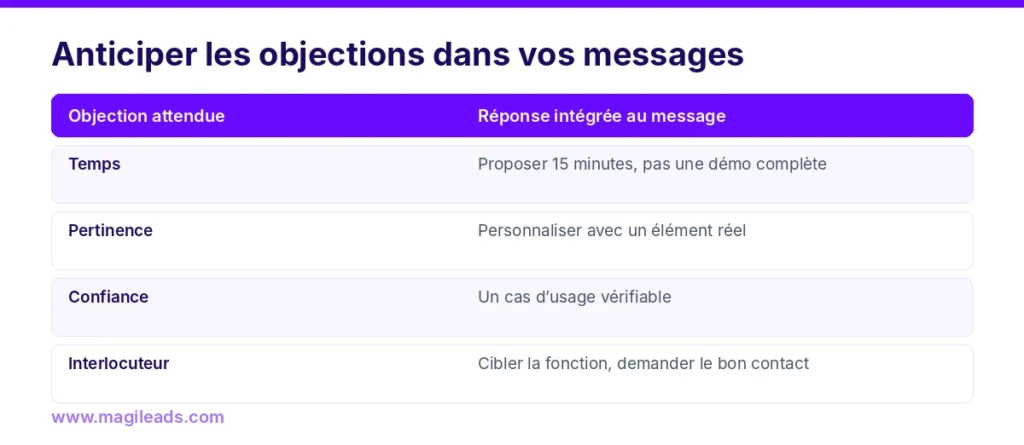
The best way to handle sales objections is to anticipate them. List the ones you receive most often, then incorporate a response into your messages: proof for the trust objection, a result example for the interest objection, a gentle request for the time objection.
- Time objection : propose a short exchange (15 minutes) rather than a full demonstration.
- Relevance objection : personalize the beginning of the message with an element specific to the company.
- Trust objection : cite a verifiable use case or useful resource, without an unverifiable encrypted promise.
- Interlocutor objection : target the functions precisely, and ask the right person if you are not sure.
Your prospecting email templates can incorporate these responses from the very first contact. Also, avoid phrases that trigger objections.
Build your library of sales objections
Record each objection received, the context (target audience, channel, stage), and the response that moved the conversation forward. Share this document with the team and review it quarterly. Over time, you'll notice that some sales objections recur for the same target audience: this is often a sign that you need to adjust the targeting or the message, not just the response.
In Magileads, lead tracking categorizes responses received (positive, negative) and allows you to see which campaigns generate the most objections. To strengthen your team's skills, also read our article on key B2B sales skills.
Practice responding to objections
Handling sales objections is a skill that can be learned. Regularly organize role-playing exercises in teams: one person plays the prospect and raises an objection, another responds, and then the group discusses the response. Recording a few calls, with the participants' consent, also helps identify which responses are effective and which ones end the conversation.
With practice, the answers become natural and the stress decreases. The salesperson no longer seeks to win a debate: they seek to understand what the obstacle is and to help the prospect make the right decision, even if that decision is not to buy now.
Every sales objection addressed becomes an opportunity to learn: about your target audience, your offer, and how you present it. A recurring sales objection deserves to be addressed proactively, either in the targeting process or in the messaging. And a well-understood sales objection often allows you to reassess the prospect's true needs.
Once the objections have been addressed, it remains to conclude: discover our closing techniques to obtain a commitment without forcing.
Sales objections and lead follow-up
A sales objection isn't the end of the conversation: note it in your tracking tool, along with the agreed-upon follow-up date. A prospect who said "not now" three months ago might be ready today. Diligently following up on sales objections transforms some of these temporary refusals into appointments when the prospect is available.
Frequently Asked Questions
- What is a sales objection? It's a reservation expressed by a prospect: price, timing, trust, priority, or contact person. It's not a definitive refusal.
- What is the best technique for dealing with an objection? Listen, rephrase, ask a question to find the real reason, then respond briefly with an argument and evidence.
- How do you respond to "it's too expensive"? Ask the prospect what they're comparing your price to, then steer the conversation back to the cost of the current problem and how your solution changes things.
- Should you respond to an "not interested" email? Yes, briefly: thank them, ask a single open question, then stop the sequence if the prospect does not follow up.
Track each response from your prospects
With Magileads, your email and LinkedIn campaigns and response tracking are all in one tool. Try it free for 14 days.