Closing techniques encompass the methods that help a salesperson close a deal: obtaining an agreement, a signature, or a commitment to the next step. In B2B, closing isn't just about a "final blow" at the end of a meeting; it's prepared from the very first interactions. Here are ten closing techniques, when to use them, examples of wording, and mistakes to avoid.
Closing techniques: the essentials
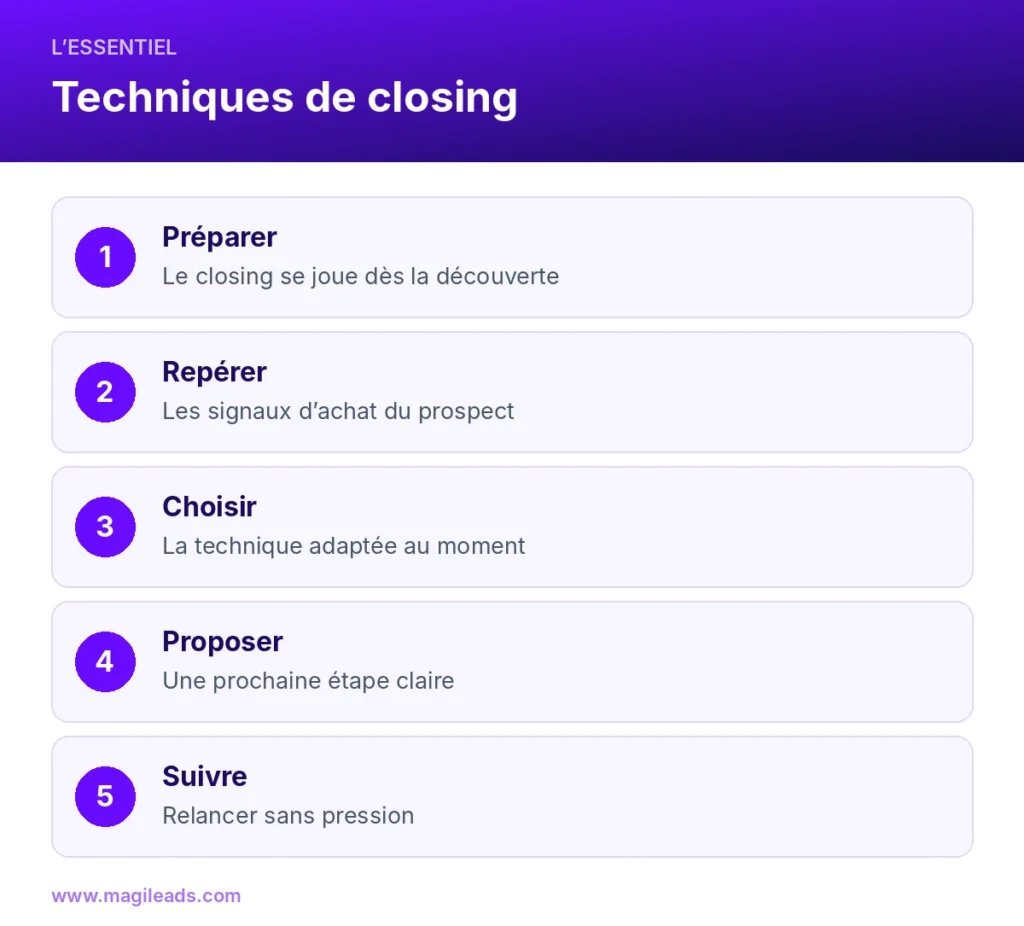
- Prepare : the closing happens from the moment of discovery.
- Identify : the prospect's buying signals.
- Choose : the technique best suited to the moment.
- Propose : a clear next step.
- Follow up : relaunch without pressure.
What is closing in B2B sales?
Closing is the stage where the prospect moves from interest to decision. In a B2B sales cycle, several people are often involved in the decision, and closing takes the form of successive commitments: a demonstration appointment, a trial, a validated sales proposal, and then the signing. Each step is a "mini-closing" that brings the deal closer to the final agreement.
The best closing techniques don't involve forcing a decision, but rather helping the prospect decide by addressing their remaining doubts and simplifying the next step. This is why closing is inextricably linked to handling sales objections.
Prepare for the closing from the moment of discovery
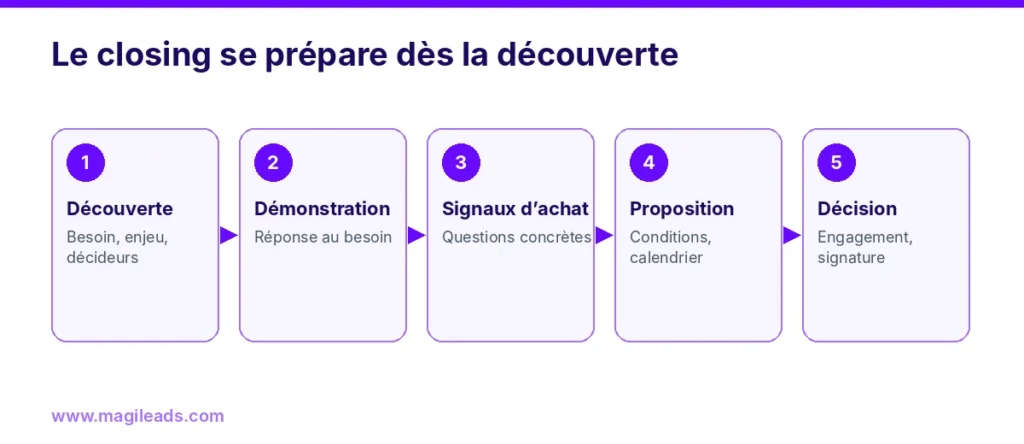
A successful closing hinges on solid discovery. Before attempting to close the deal, ensure you understand the prospect's true needs, the stakes for their business, the decision-makers, the available budget, and the timeline. Without this information, any closing technique feels like pressure tactics.
- The need : what problem is the prospect trying to solve, and what happens if they do nothing?
- The decision-makers : who approves, who signs, who can block?
- The budget : is it planned, and according to what process?
- The timeline : when does the prospect want a solution in place, and why?
- The selection criteria : what will he compare the solutions on?
Buy signals to look out for
Before using a closing technique, look for signs that the prospect is ready: questions about implementation timelines, payment terms, or support; rephrasing that anticipates use ("when we use it…"); involvement of new contacts; requests for references or contractual documents. These signs indicate that it's time to offer a decision.
10 Effective B2B Closing Techniques
1. Closing by summary
When to use it : after a demonstration or a full exchange.
How to do it : summarize the needs expressed and how your solution addresses them, then propose the next steps.
Example : "To summarize: you want to reduce the time spent creating your lists and track your follow-ups in one place. We've seen how the platform addresses both of these points. Would you like me to prepare the proposal?"
2. Closing by the next step
When to use it : at the end of each exchange, regardless of the stage.
How to do it : never leave a meeting without a next step that has been dated and agreed upon.
Example : "I suggest we meet with your sales director on Thursday at 10 a.m. Is that time slot convenient for you?"
3. Closing through the alternative
When to use it : when the prospect is convinced of the substance but hesitates on the form.
How to do it : offer two positive options rather than a yes or no.
Example : "Do you prefer to start with just the sales team, or include marketing from the outset?"
4. Closing with a test question
When to use it : to verify membership before concluding.
How to do it : ask a question that measures the prospect's conviction.
Example : "On a scale of 1 to 10, where are you in your decision-making process? What would you need to reach a 10?"
5. Closing by trial
When to use it : when there is doubt about the suitability of the solution.
How to do it : propose a structured trial, with objectives and a review date.
Example : "I propose a 14-day trial on a list of 100 prospects; we will review the results together at the end."
6. Closing by the cost of inaction
When to use it : when the prospect postpones without a clear reason.
How to do it : have the prospect themselves calculate what the status quo costs them.
Example : "How much time does your team spend on these tasks each week? What does that represent over a quarter?"
7. Closing by overcoming the last objection
When to use it : when a single reservation is blocking the decision.
How to do it : Isolate the objection and obtain the commitment if it is lifted.
Example : "If we resolve the issue of integration with your CRM, is there anything else that would prevent you from moving forward?"
8. Closing through the deployment plan
When to use it : for complex sales, with multiple decision-makers.
How to do it : build the implementation schedule with the prospect, from signing to start-up.
Example : "To start in early March, the proposal would need to be approved by February 15th. Is that realistic on your end?"
9. Direct closing
When to use it : when all buy signals are present.
How to do it : simply ask the question about the decision, without beating around the bush.
Example : "Everything seems to be in place: would you like us to launch the project?"
10. Closing by written summary
When to use it : after an important meeting.
How to do it : send an email during the day that includes the needs, the solution, the conditions and the next step.
Example : "As agreed, here is a summary of our exchange and the proposal; I will call you on Tuesday to discuss it."
Choosing the right closing technique
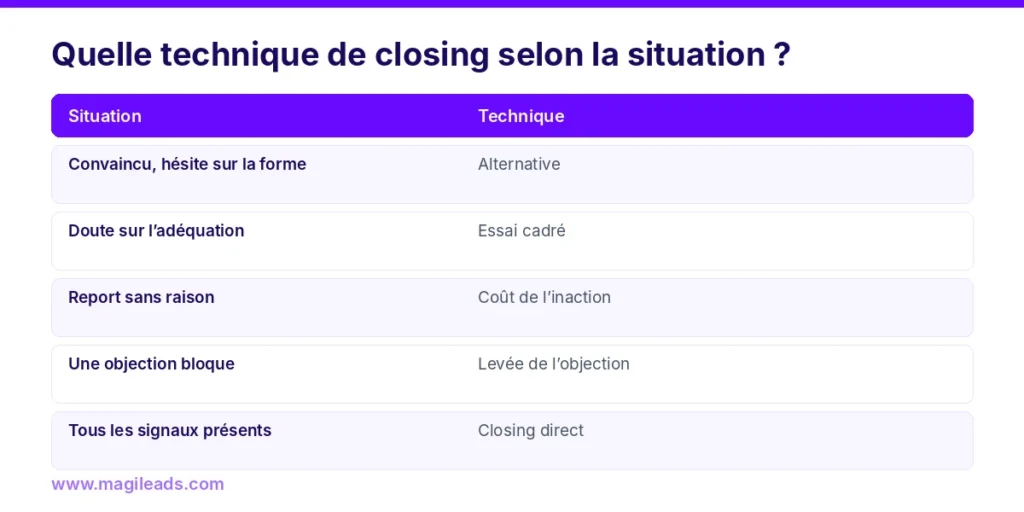
| Situation | Appropriate closing technique |
|---|---|
| The prospect is convinced but hesitant about the format | Alternative |
| There is doubt about the suitability | Shot on target |
| The prospect is postponing for no reason | Cost of inaction |
| A single objection is blocking | The last objection has been lifted |
| Several decision-makers, long cycle | Deployment plan |
| All signals are present | Closing immediately |
Mistakes to avoid
- To conclude too soon, before understanding the need and identifying the decision-makers.
- Creating a false sense of urgency ("offer valid today only"): trust is quickly lost.
- Speaking instead of listening at the moment when the prospect expresses their last doubts.
- Leave the appointment without a dated next step.
- Giving up after a "not now" : ask when to come back, and come back.
Closing the deal after the meeting: the follow-up
Many sales are closed after the initial meeting, during the follow-up. A well-thought-out follow-up, one that introduces something new, often makes all the difference. Check out our tips on follow-up emails and LinkedIn follow-up messages.
Rigorous follow-up requires knowing where each prospect stands. In Magileads, the integrated PRM categorizes your leads, follow-ups are scheduled, and lead scoring helps prioritize the most advanced prospects. To fuel your pipeline from the outset, combine multichannel prospecting with closing techniques: effective outbound prospecting generates appointments, and skillful closing converts them into customers.
Finally, practice: closing techniques are learned through practice. Team role-playing, listening back to calls with participants' consent, and sharing effective phrasing allow everyone to find their own style. The best closing technique is the one you master and that suits your prospect.
Closing techniques and complex sales
In a complex sale, involving multiple decision-makers and a multi-month cycle, closing techniques change. The goal is no longer simply to secure a signature at the end of a meeting, but to advance the decision-making process with each interaction. Identify who needs to be convinced, what information each person expects, and what obstacles could slow the project down: legal approvals, IT security, the following year's budget.
Help your key contact to persuade internally: prepare a summary they can share, offer to participate in a meeting with other decision-makers, and anticipate questions from the purchasing or IT departments. Closing the deal then becomes a support process: you make the decision simpler for the entire purchasing group.
Finally, keep a written record of every commitment secured. In a long sales cycle, stakeholders change and priorities evolve: a shared summary after each step avoids having to start all over again and shows the prospect that you are a reliable partner. In this context, the most effective closing techniques are those that reduce the prospect's decision-making effort: a clear document, a realistic timeline, and a clearly defined next step.
Frequently Asked Questions
- What is a closing technique? A method that helps the salesperson obtain a commitment from the prospect: a next step, a trial, a proposal validation or a signature.
- What is the best closing technique? There isn't one: the right technique depends on the situation (doubt about suitability, remaining objection, collective decision, etc.). Closing by moving to the next step applies to all meetings.
- When should a sale be closed? When the buying signals are present: questions about implementation, conditions, support, or involvement of new decision-makers.
- How to close without seeming pushy? By focusing on the prospect's expressed needs, proposing a simple step, and respecting their decision timeline.
Fill your pipeline to close better
B2B database, email and LinkedIn campaigns, PRM and lead scoring: try Magileads free for 14 days.