Initial contact with a prospect is the first interaction between your company and a decision-maker who isn't expecting you. In just a few lines or a few seconds on the phone, you need to explain who you are, why you're contacting them, and make them want to respond. This guide shows you how to prepare for this first contact, write a relevant opening line, choose between email, LinkedIn, and phone, and follow up without being pushy, with examples of messages and introductory phrases for each channel.
Initial contact with a prospect: the essentials
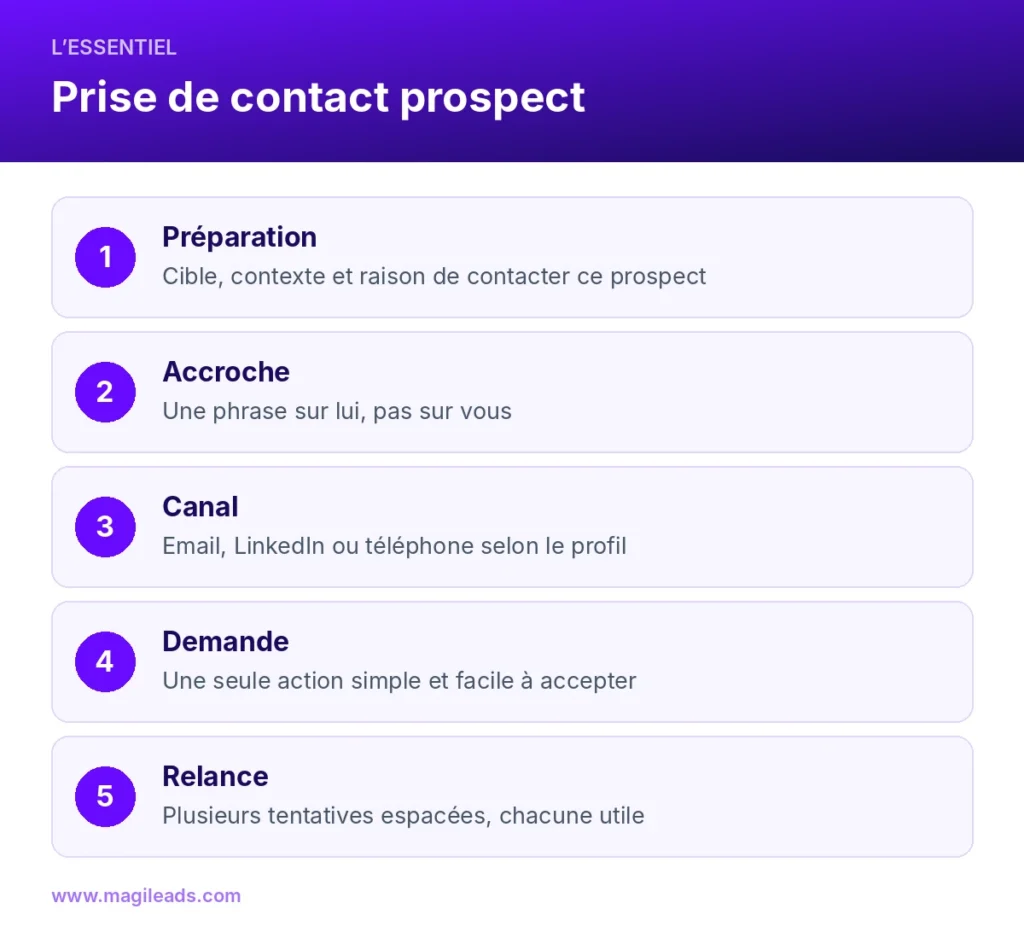
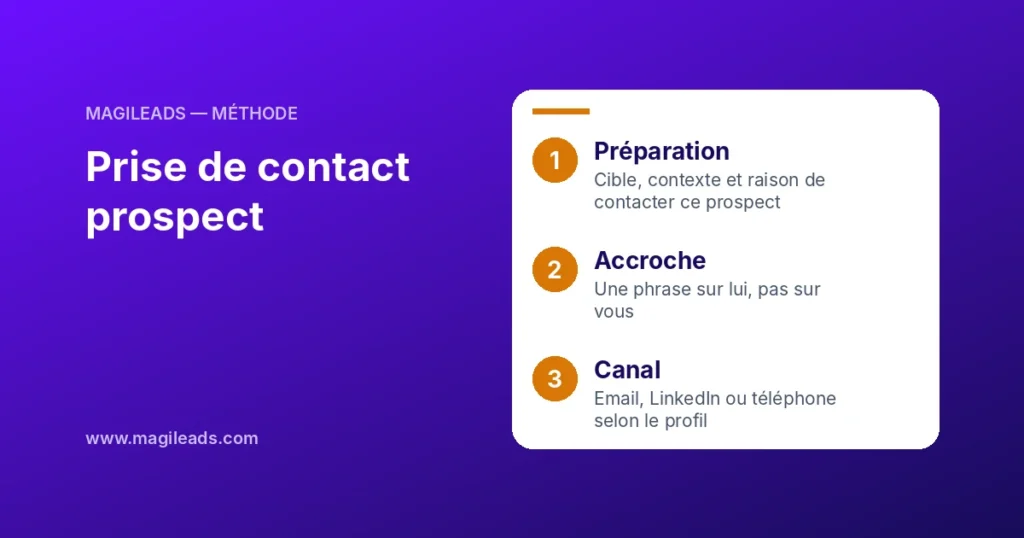
- Preparation : target, context and reason for contacting this prospect.
- Hook : a sentence about him, not about you.
- Channel : email, LinkedIn or telephone depending on the profile.
- Request : a single, simple action that is easy to accept.
- Retry : several spaced-out attempts, each useful.
What is a prospect contact?
In B2B prospecting, initial contact refers to the moment you initiate a relationship with someone who doesn't yet know you, or knows very little about you. This could be a first email, a LinkedIn invitation with a note, a phone call, or a message after an event. The goal isn't to sell immediately, but to elicit a response: an answer, a question, a discovery meeting, or a referral to the right person.
This step sets the tone for the entire sales cycle. A prospect who receives a generic and clumsy message will associate your name with just another solicitation. Conversely, a well-crafted initial contact, demonstrating that you understand their situation, opens a conversation on equal footing. It's part of a outbound prospecting , with a defined target audience, prepared messages, and rigorous follow-up.
Initial contact at a cold temperature or "warm" contact
We often distinguish between cold contacts, where the prospect has had no interaction with you, and warm contacts, where a signal already exists: they've downloaded a guide, visited your website, commented on a post, attended a webinar, or been referred by a client. Warm contacts are easier because you have a natural reason to contact them. With cold contacts, it's up to you to find that reason by researching the company and the individual.
Prepare your initial contact with the prospect
A successful initial contact with a prospect requires preparation before writing the first line. Preparation allows you to choose the right person, the right approach, and the right channel. Most importantly, it avoids the most common pitfall in prospecting messages: talking about yourself instead of the prospect.
- Verify that the prospect matches your target : sector, size, function, maturity. Your ideal customer profile acts as a filter.
- Identify the right person to talk to : the person who is experiencing the problem you are solving, or the person who can refer you to them.
- Look for a contextual element : ongoing recruitment, opening of a site, new offer, recent publication, change of position.
- Formulate a hypothesis about the problem : what is likely holding this type of business back? Our guide to identifying a prospect's pain points will help you develop it.
- Decide on your request : a fifteen-minute exchange, a question, sending a resource, or simply the name of the right person to talk to.
- Check your contact details : valid email, up-to-date LinkedIn profile, professional phone number.
This preparation doesn't need to be lengthy for each prospect. For strategic accounts, a few minutes of individual research is justified. For a larger list, work by segment: the same problem hypothesis and the same opening line can be suitable for a group of comparable companies, provided you personalize at least the first sentence.
Crafting the opening line for initial contact
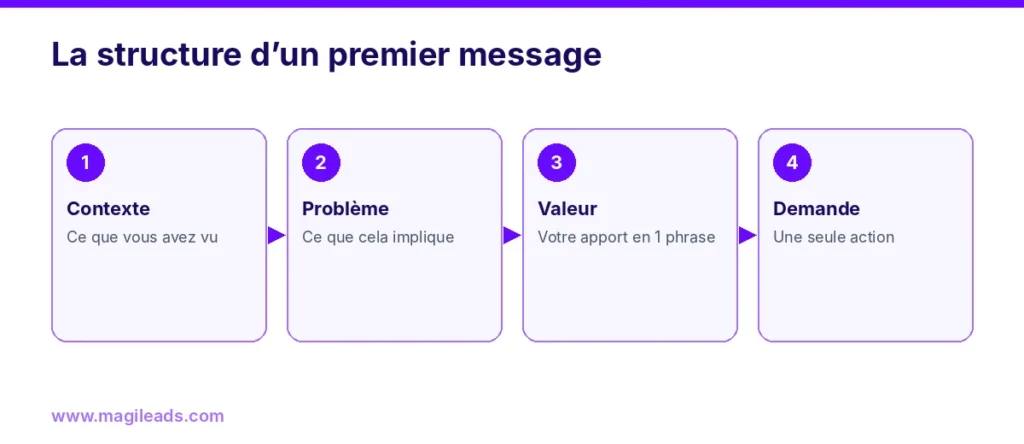
The hook is the first sentence your prospect reads or hears. It must answer an implicit question: "Why me, and why now?" An effective hook starts with a verifiable fact about the prospect or their company, then connects it to a challenge they are likely to recognize. It avoids empty phrases like "I'm contacting you because…" or "I hope you're doing well.".
The rest of the message typically follows four parts: context (what you've noticed), the problem (what this context often implies), the value (what you bring to the table, in one sentence), and then the request (a single, simple action). This structure works across all channels; only the length changes.
Examples of introductory sentences
- "I saw that you were recruiting three field sales representatives in the Greater West region; this is often the point at which the question of appointment generation arises."
- "Your post about the overhaul of your onboarding process caught my attention, particularly the section on monitoring the first few weeks."
- "You downloaded our lead qualification guide last week; I wanted to know if it answered your question."
- "Claire Martin, with whom we work, suggested I contact you regarding the organization of your sales team."
- "I'm contacting a few sales directors of software publishers in Lyon about multichannel prospecting, and your profile matches."
These sentences are examples to be adapted: the names, places, and situations are fictional. What matters is the mechanism. Each introduction mentions a specific fact and shows that the message was not sent randomly.
Initial contact with prospective clients via email
Email remains the most widely used channel for initial contact in B2B. It allows prospects to read your message at their convenience and forward it internally. Its limitation: the competition in the inbox. The subject line, the first line, and the overall length of the message make all the difference. For the subject line, refer to our tips for writing effective prospecting email subject lines.
Example of an initial contact email
Subject: Recruitment of your field sales representatives
"Hello Thomas,
I saw that you are recruiting three field sales representatives in Western France. In companies of your size, the arrival of new salespeople often raises a question: how to quickly provide them with qualified appointments while they are onboarding?
We help B2B sales teams organize their prospecting via email and LinkedIn using a targeted database of decision-makers.
Would you be available for a fifteen-minute chat next week to see if this is relevant to your situation?
Best regards,
Julie"
This message is a generic example. It's concise, focuses on the prospect before the offer, and ends with a simple, easy-to-answer closed question. For other structures depending on the situation, consult our prospecting email templates, and pay close attention to the opening and closing with appropriate closing salutations.
Initial contact with a prospect on LinkedIn
On LinkedIn, initial contact typically happens in two stages: an invitation, possibly accompanied by a note, followed by a first message once the invitation is accepted. A common mistake is to send a sales pitch immediately after acceptance. The invitation note should remain concise: explain why you'd like to connect, without making a sales pitch. Our article on LinkedIn invitation notes details possible wordings.
Example of a note and first message
Invitation note : "Hello Sophie, I follow your publications on sales team organization in the industry. I work on the same topics on the prospecting side: delighted to exchange ideas with you."
First message after acceptance : "Thank you Sophie for the connection. Your post on tracking leads from trade shows made me think of a question: how do your sales team prioritize contacts after an event? I'm curious about your approach."
The first message asks a question related to a topic the prospect has already brought up. It opens a conversation instead of immediately requesting a meeting. The proposal to discuss the matter will come more naturally after one or two replies.
Initial contact with prospective clients by telephone
The telephone offers a direct and immediate exchange, but it interrupts the other person. Therefore, the opening lines must allow them to quickly understand who you are and why you're calling, and then give them the option to postpone the conversation. A short outline is better than a recited script. The CROC method offers a simple structure for these calls.
Examples of introductory phrases for a phone call
- "Hello Mr. Durand, this is Julie Bernard from company X. I'm calling about your sales recruitment; do you have two minutes, or would you prefer I call you back?"
- "I'm contacting you because you're recruiting field sales representatives, and we work with teams looking to provide them with appointments more quickly."
- "How do your new salespeople get their first appointments today?"
- "I suggest we talk for fifteen minutes on Thursday or Friday; which time suits you best?"
These formulations are generic examples to be adapted to your offer and style. Also prepare responses to common objections ("Send me an email," "We already have a provider," "It's not the right time"), using our guide on sales objections.
Mistakes that cause a failed initial contact
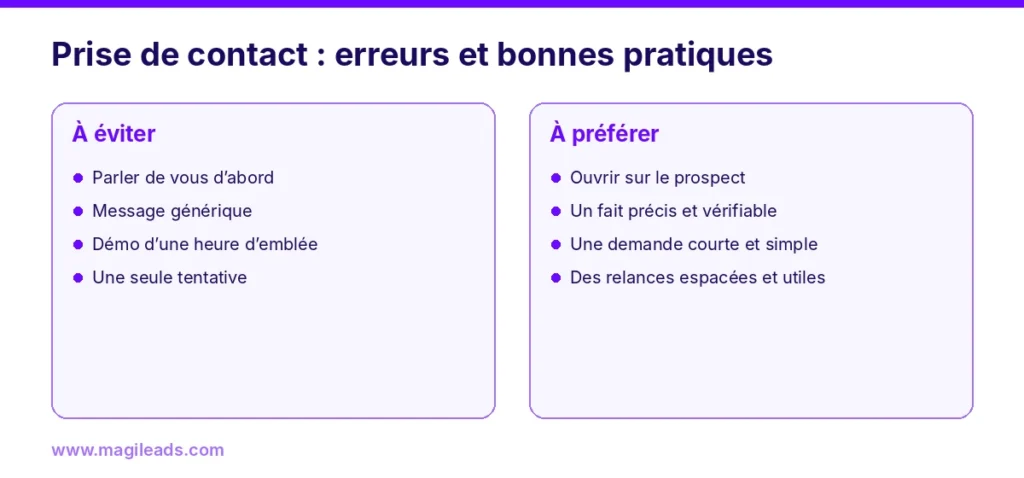
- Talk about yourself first : company presentation, history, list of references before even mentioning the prospect.
- Send a generic message : no mention of the company, position or context of the recipient.
- Asking for too much, too soon : a one-hour demonstration in the first message, without having established the interest.
- Multiplying requests : several links, several questions and an attachment in the same message.
- Avoid using overused phrases like "I'd like to take this opportunity to ask," "I'll get back to you," or "Did you receive my previous email?" See the phrases to avoid in your prospecting emails.
- Giving up after one attempt : without a response, most prospects simply didn't have time to read.
Follow up after initial contact
A lack of response doesn't necessarily mean a rejection. A prospect might be unavailable, busy, or interested but not a priority at that moment. Therefore, plan several follow-ups spaced a few days apart, each introducing something new: a resource, a different question, a use case example, or a different channel. On LinkedIn, refer to our LinkedIn follow-up message ; for email, consult our follow-up email tips.
Alternating channels is often more effective than repeating the same message. An initial email, a LinkedIn invitation a few days later, and then a targeted call allow the prospect to recognize you across different channels. Set a clear boundary, then end the sequence with a final, courteous message that leaves the door open.
In Magileads, you can build this type of multichannel sequence: email and LinkedIn, with SMS and voice steps available as paid options. The dynamic, global B2B database of decision-makers and contact enrichment help you find the right person and their contact information, the PRM centralizes responses, and lead scoring highlights the most engaged prospects. Data synchronizes with HubSpot, Pipedrive, or other tools via Zapier, Make, or the API.
Organize prospect contact on a team scale
When several salespeople are prospecting simultaneously, initial contact must follow common guidelines. Without them, the same decision-maker could receive two different messages from the same company, or be contacted again after having already responded to a colleague. Define who is responsible for each account, log every exchange in a shared tool, and agree on a minimum timeframe before contacting someone who has declined.
Also, formalize your reference messages: an initial contact email, a LinkedIn invitation note, a call outline, and two or three follow-ups. Each salesperson personalizes them, but the structure remains the same, allowing you to compare the results from one message to another and progressively improve your copy.
Finally, comply with the regulatory framework for B2B prospecting: a message linked to the function of the recipient, a clear identification of the sender and a simple possibility to no longer be contacted.
Frequently Asked Questions
- How to successfully make initial contact with a prospect? Prepare yourself on the company and the person, open with a relevant contextual element, present your value in one sentence and end with a single simple request.
- Which channel should you choose for initial B2B contact? The one your prospect uses: email is suitable for most decision-makers, LinkedIn for active profiles on the network, and the telephone for direct communication. Combining them often yields better results.
- What to say in the first sentence? A specific fact about the prospect or their company (recruitment, publication, news, recommendation), linked to an issue they are likely to recognize.
- How many times should you follow up with a prospect? Several times, spacing the follow-ups out by a few days and bringing something new each time, then conclude with a final polite message.
Prepare and automate your initial contacts
Find your decision-makers, enrich their contact details and launch personalized email and LinkedIn sequences: try Magileads free for 7 days.