A lead generation tool is a tool, or set of tools, that produces actionable sales leads: people who match your target audience and whom your team can contact. Behind this term, however, lie very different solutions: forms, chatbots, B2B databases, prospecting automation, or website visitor identification. This guide helps you understand what each type of lead generation tool does, choose the one that's right for your organization, and avoid the most common pitfalls.
Lead generator: the essentials
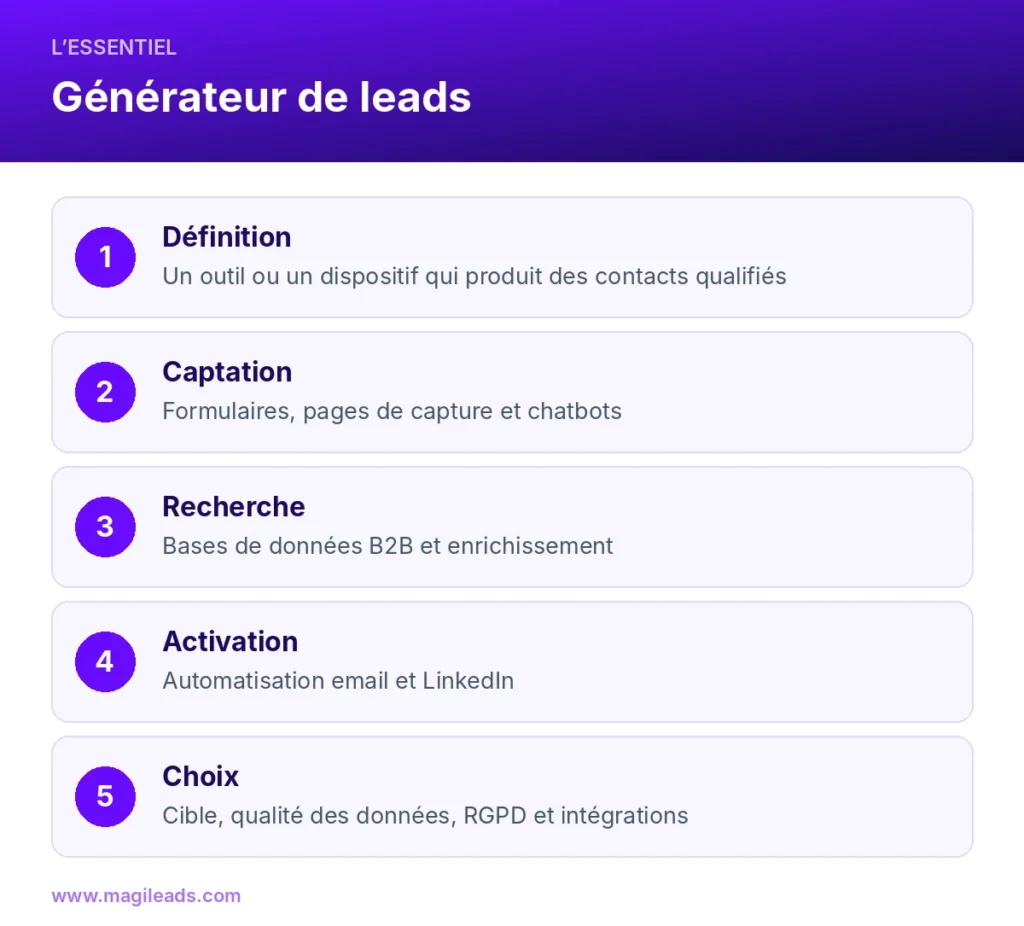
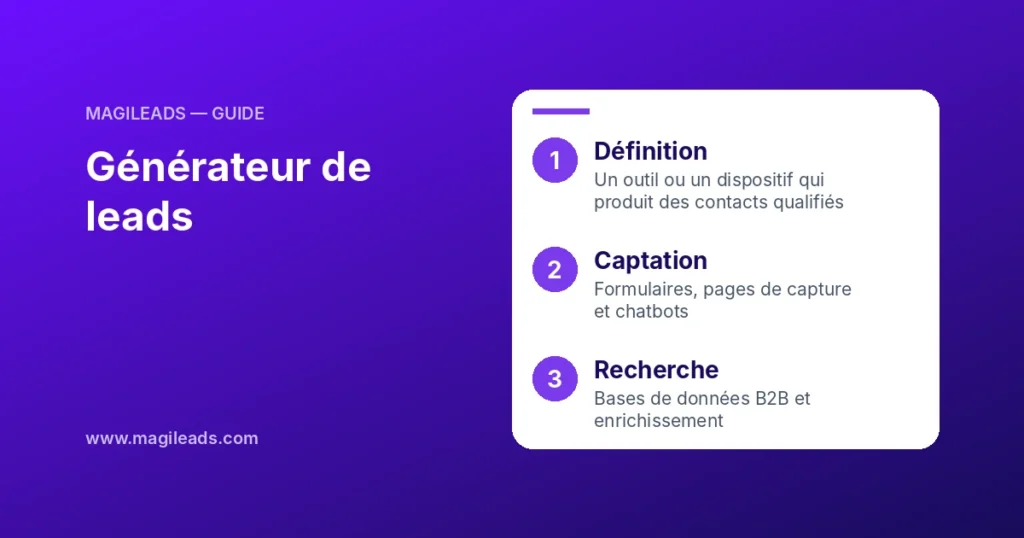
- Definition : a tool or device that produces qualified contacts.
- Capture : forms, capture pages and chatbots.
- Research : B2B databases and enrichment.
- Activation : email and LinkedIn automation.
- Choices : target audience, data quality, GDPR and integrations.
What is a lead generator?
A lead is a contact who has shown interest in your offer or who closely matches your ideal customer profile to warrant contact. A lead generation tool is what generates these contacts and passes them on to your sales team. It can be a single software application or a comprehensive system comprised of several interconnected components: a lead capture page, a form, a lead enrichment tool, and a CRM, for example.
It's important to distinguish between the tool and the strategy. Lead generation encompasses the entire process: target audience selection, content creation, channel selection, qualification, and follow-up. The lead generator is simply the technical engine. An excellent tool won't compensate for a vague target audience or a poorly formulated offer; however, a suitable tool can save considerable time for a team that already knows who they're addressing.
Inbound or outbound: two families of tools
The tools fall into two main categories. Inbound lead generation tools capture people who come to you: a visitor downloads a guide, fills out a form, or chats with a chatbot. Outbound lead generation tools help you reach decision-makers who don't yet know you: searching a database, enriching contact information, and then sending sequences of messages via email and LinkedIn. Most B2B companies combine both approaches.
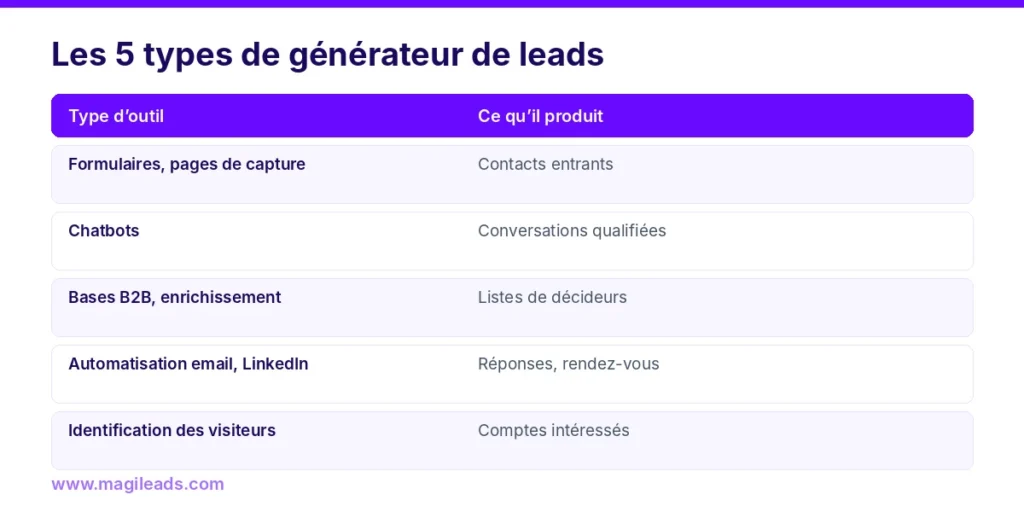
The 5 types of lead generators
1. Forms and capture pages
This is the most widespread tool. A dedicated page presents an offer (a guide, a webinar, a trial, a demo), and a form collects the visitor's contact information. Effectiveness depends primarily on the value of the offer and the number of fields requested: each additional field improves lead qualification but discourages some visitors. Our tips for optimizing your B2B lead generation forms and designing a B2B lead magnet detail these trade-offs.
2. Chatbots and conversations on the site
A chatbot engages visitors in conversation, answers simple questions, and suggests an appointment or relevant content when the need becomes clearer. It becomes truly useful when it asks the right qualifying questions (job title, company size, project) and forwards the answers to your CRM. It doesn't replace a salesperson, but it prevents an interested visitor from leaving without leaving a trace. To learn more, see our article on customer service chatbots.
3. B2B databases and enrichment
This type of tool focuses on your target audience rather than your traffic. You filter a database of decision-makers by sector, function, company size, or geographic area, then enrich the profiles with verified professional contact information. The quality of the source is crucial: data freshness, collection method, and GDPR compliance. Our guide to choosing a B2B data provider lists the questions to ask before signing.
4. Automating email and LinkedIn prospecting
Once you have your list, you need to contact them. Automation tools chain together steps (profile visit, LinkedIn invitation, email, follow-up) according to a scenario you define. They transform a cold list into conversations, provided the targeting and message are well-crafted. This topic is covered in detail in our guide to automating lead generation ; here, remember that automation amplifies whatever you feed it, for better or for worse.
5. Identification of website visitors
Some visitors to your site never fill out a form. Certain tools can identify the company behind a visit, based on the IP address, and show which pages were viewed. This tool doesn't usually reveal the individual's identity, but it does flag an account that's interested in you. Before adopting it, read our article on identifying website visitors, which explains what's possible and the limitations to respect.
Lead generator: how to choose the right tool
The best lead generation tool is the one that aligns with your sales cycle, traffic, and resources. A company that already receives a lot of visitors will benefit from optimizing its forms and chatbot. A company targeting a specific market of a few thousand accounts will need a more robust database and a multichannel prospecting tool.
| Criteria | Question to ask yourself |
|---|---|
| Target | Does the tool cover your target sectors, functions, and countries? |
| Data quality | Where do the contacts come from, and how often are they updated? |
| Canals | Email only, or also LinkedIn, phone, SMS? |
| Qualification | Does it offer scoring or filters to sort leads? |
| Integrations | Does it connect to your CRM and other tools? |
| Compliance | Where is the data hosted, and how is the GDPR respected? |
Always test the tool on a real sample of your target audience before committing. Manually verify some of the suggested contacts: does the person actually hold that position? Is the email address valid? This simple check will tell you more than any sales pitch. Our lead generation platform comparison will help you compile an initial list of solutions.
Pitfalls to avoid
Confusing volume and quality
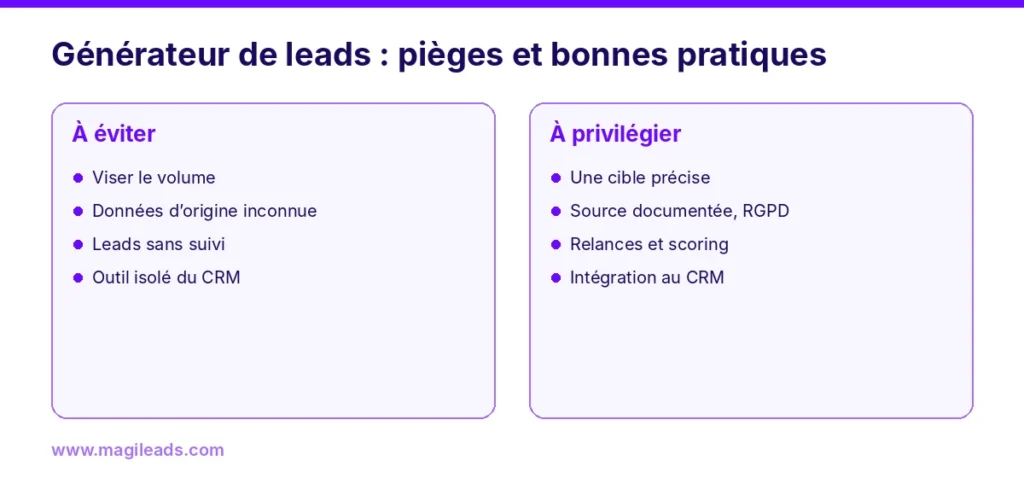
A tool that promises thousands of contacts is only useful if those contacts match your target audience. An overly large list dilutes the work of your sales team, damages your email deliverability, and tires out prospects who aren't relevant to you. A shorter, well-targeted, and enriched list is far better.
Neglecting the GDPR
In B2B, email marketing to professionals is possible under certain conditions: the message must be relevant to the recipient's role, they must be informed about how their data will be used, and they must be able to easily opt out. Choose a tool that documents the origin of the data and manages unsubscribes. Our article on GDPR and email campaigns outlines the essential rules.
Forget about tracking
A lead that isn't contacted quickly loses interest. Therefore, the tool must be integrated into your sales process: lead assignment, follow-ups, status updates, and scoring. Without this tracking, even the best contacts end up forgotten in a spreadsheet.
Combine multiple lead generators
No single tool covers the entire buyer's journey. A form captures people who have already identified their needs; a database allows you to reach those who don't yet know you; automation ensures that each contact receives timely follow-ups. The most effective approach, therefore, is to combine several components, linked by a CRM that centralizes information and prevents the same prospect from being contacted twice by two different people.
Start with the building block that addresses your main roadblock. If your site attracts traffic but converts poorly, first optimize your landing pages. If you lack visibility with your target audience, an outbound lead generation tool will deliver faster results. Then, measure each source using the same metrics (leads, appointments, opportunities) to decide where to invest. B2B lead scoring helps you compare the quality of contacts generated by each tool.
Magileads ' position among lead generators
Magileads is a B2B lead generation tool focused on prospecting. It combines a dynamic, global B2B database of decision-makers, professional contact enrichment, and multichannel campaigns —email and LinkedIn, with SMS and voice options available for a fee—all within a single application. PRM and lead scoring allow you to track every conversation and identify the most engaged contacts, while integrations with HubSpot, Pipedrive, Zapier, Make, and the API seamlessly transfer leads to your other tools.
Regarding data, Magileads is ISO 27001 certified and hosted in France, which facilitates dialogue with your legal and security teams.
Frequently Asked Questions
- What is a lead generator? It is a tool or device that produces qualified business contacts: forms, chatbots, B2B databases, prospecting automation or visitor identification.
- What is the difference between a lead generator and lead generation? Lead generation is the overall approach (target, content, channels, follow-up); the lead generator is the tool that implements it.
- Is a free lead generator enough? A free form or chatbot might be sufficient to get started with inbound marketing. To prospect a specific target audience, you generally need a database and a sending tool.
- How can you tell if the leads generated are qualified? Check that they match your ideal customer, that their contact details are valid, and track their engagement with a scoring system.
A complete B2B lead generator, hosted in France
Find your decision-makers, enrich their contact details and launch email and LinkedIn campaigns: try Magileads free for 7 days.