A sales pitch is a short, structured presentation of your offer, designed to entice a prospect to take the next step: ask a question, accept a meeting, or request a proposal. In B2B, it's not about reciting a product description, but about connecting your solution to a problem your prospect recognizes. This guide explains how to structure a sales pitch in four parts, adapt it for elevator pitches, phone calls, and written communication, avoid common mistakes, and provide practice with generic examples to adapt.
Sales pitch: the essentials
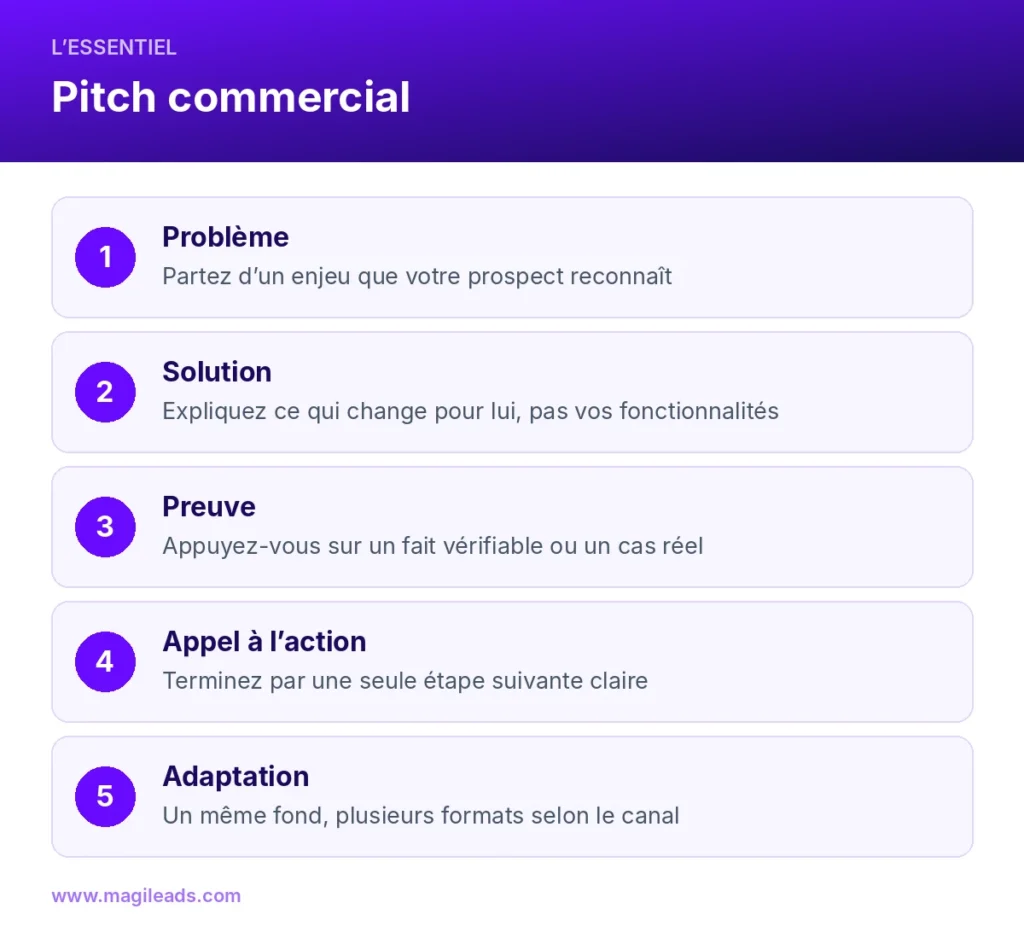
- Problem : Start with an issue that your prospect recognizes.
- Solution : explain what changes for him, not your features.
- Evidence : Support it with a verifiable fact or a real case.
- Call to action : end with a single, clear next step.
- Adaptation : the same background, several formats depending on the channel.
What is a sales pitch?
The word "pitch" comes from English and, in a business context, refers to a short, persuasive argument. A sales pitch summarizes in a few sentences what you do, who you do for, and why it matters to the person you're speaking with. It's used during an initial call, a meeting at a trade show, a discovery meeting, in a prospecting email, or as an introduction to a demonstration.
A good sales pitch isn't a monologue. It starts a conversation: its goal is to get a reaction and move to the next stage, not to say everything. It complements the more detailed, comprehensive sales pitch you then use in the meeting. For a structured pitch template, see also our article on the SIMAC method.
Pitch, argument, and presentation: the differences
The pitch is the short, memorable, and adaptable version. The sales pitch brings together all your arguments, evidence, and responses to objections, categorized by buyer profile. The sales presentation, often supported by visuals, details your offer during a meeting. The sales pitch serves as the gateway to the other two.
Structuring a sales pitch in 4 steps
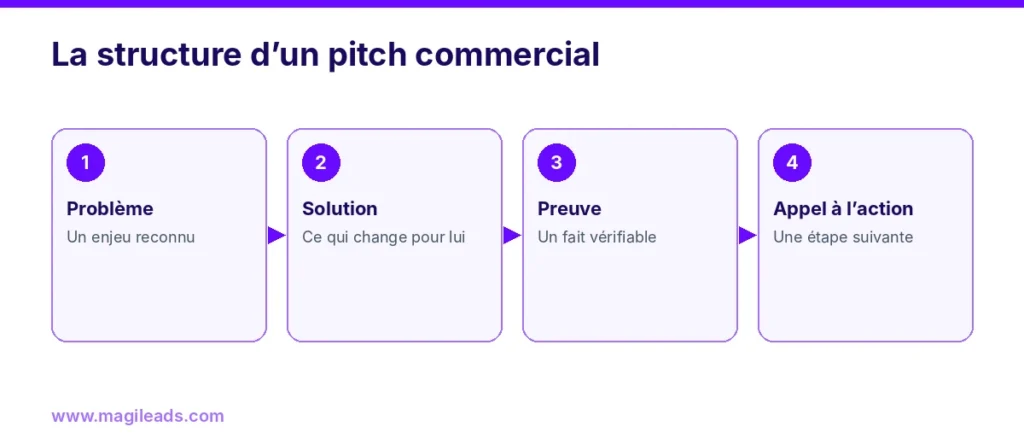
Most effective pitches follow a four-part structure. This structure is easy to remember and adapts to all durations, from thirty seconds to several minutes.
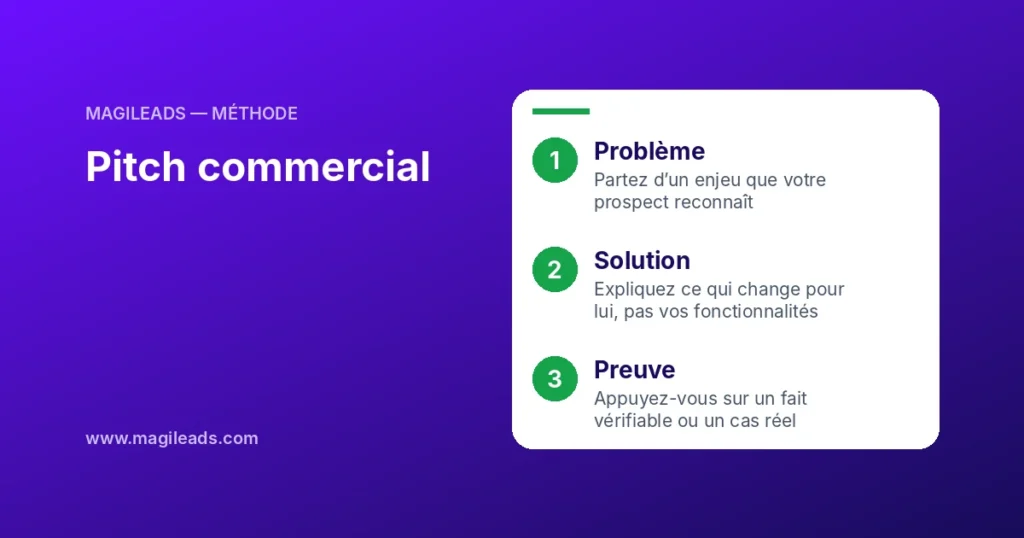
1. The problem
Start with your prospect's challenge, not your company's. Describe a situation they recognize: a difficult goal to achieve, a time-consuming task, a risk they're trying to mitigate. The more specific the description, the more involved the prospect will feel. To identify these challenges, draw on your past interactions with clients and our guide to identifying a prospect's pain points.
2. The solution
Next, explain how your offer will change things for them, focusing on results rather than features. "Your sales team receives a list of decision-makers to contact every Monday" is more effective than a list of modules. Limit yourself to one or two key benefits: those that directly address the problem they've identified.
3. The proof
A sales pitch gains credibility when it's based on verifiable evidence: a comparable client (with their consent), a certification, a quick demonstration, or a proven methodology. Never fabricate figures or testimonials. If you don't yet have measurable results, honest qualitative evidence ("we already work with software publishers of your size") is worth more than a rough statistic.
4. The call to action
Always end with a clear and easy-to-accept next step: a twenty-minute meeting, sending an example, a qualifying question. One request at a time. A pitch without a call to action leaves the prospect to decide what happens next, and they usually don't.
Sales pitch formats
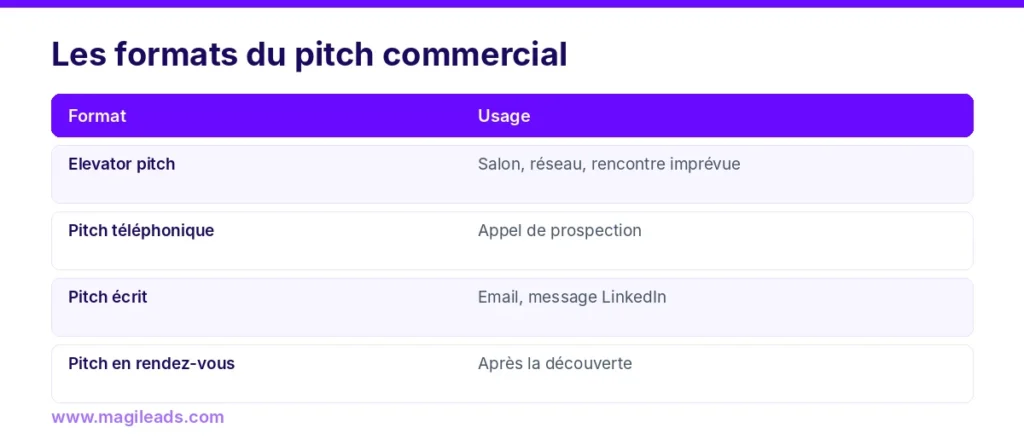
The core of your sales pitch remains the same; the format changes depending on the channel and the time you have available. Prepare several versions so you never have to improvise.
The elevator pitch
The elevator pitch is the shortest version: the length of an elevator ride, or just a few sentences. It answers the question "What do you do?" at a trade show, networking event, or impromptu meeting. It consists of three elements: who you work for, what problem you solve, and what sets you apart.
Generic example : "I help sales managers of industrial SMEs fill their teams' schedules. We identify the right decision-makers and organize prospecting sequences via email and LinkedIn, so that salespeople spend their time in meetings rather than searching for contacts. And you, how do your teams find their prospects today?"
The phone pitch
On the phone, your contact can't see you and wasn't expecting your call. The pitch therefore needs to be even more direct: your name, the reason for the call, and a question that engages the prospect. Give them the floor quickly. The CROC method offers a useful framework for structuring these calls.
Generic example : "Hello Ms. Martin, this is Julien Petit from company X. I'm calling because you're recruiting sales representatives, and we help teams like yours get appointments faster. How do your new sales representatives find their first prospects today?"
The written pitch
In an email or LinkedIn message, your pitch should be read in seconds. Maintain the same structure (problem, solution, proof, call to action) but condense it to three or four sentences. The first line is crucial, as it determines how the rest of the message is read. Our prospecting email templates demonstrate how to condense a pitch into written form.
The pitch in a meeting
In a meeting, the pitch comes after the discovery phase, once you understand the prospect's real challenges. It follows the four-part structure, but is enriched by what your contact has just told you. This is the moment to rephrase their problem in their own words before presenting your solution.
Tailor your sales pitch to your audience
The same pitch won't resonate in the same way with a CFO, a sales director, and an operational user. The first is interested in cost and risk, the second in revenue and team productivity, and the third in time saved daily. Prepare a variation for each buyer profile. Our article on tailoring your sales messages to buyer profiles details this approach.
The level of maturity also matters. A prospect who is just discovering their problem needs help articulating it; a prospect who is already comparing solutions expects differentiating factors. In structured teams, the SDR (sales development representative) uses a short pitch to secure the appointment, then the salesperson delivers a more comprehensive pitch during the meeting.
Common mistakes in a sales pitch
- Start with the company's history : date of creation, number of offices, list of clients before even mentioning the prospect.
- Listing features : the prospect must make the connection to their problem on their own.
- Using jargon : internal acronyms, technical terms that the interlocutor does not understand.
- Talking for too long : a pitch that leaves no room for response becomes a monologue.
- Claiming without proof : "leader", "innovative", "unique" convinces no one without concrete evidence.
- Forgetting the call to action : the prospect doesn't know what you expect from them.
A successful sales pitch often provokes objections: this is a sign that the prospect is engaged. Prepare your responses with our guide on sales objections, and, as the conversation progresses, use our closing techniques to seal the deal.
Practice and improve your sales pitch
A pitch needs to be practiced aloud. Writing out the structure isn't enough: you need to be able to deliver it naturally, without reading, and shorten or lengthen it depending on the listener's reaction. A few simple exercises can help you improve.
- Write three versions : one of two sentences, one of about thirty seconds, one of two minutes.
- Record yourself and listen back: hesitations, overly long sentences and jargon are immediately noticeable.
- Role-play scenarios with a colleague who plays the role of a prospect who is in a hurry, skeptical, or already equipped.
- Test in real-world conditions and note the reactions: questions asked, objections, moments when attention wanes.
- Adjust regularly : a pitch evolves with your offer, your market, and what prospects tell you.
In Magileads, you can deliver your sales pitch across multiple channels: email and LinkedIn, with optional paid SMS and voice steps. The dynamic, global B2B database of decision-makers and contact enrichment help you target the right profiles, the PRM centralizes responses, and lead scoring identifies the most engaged prospects. Data syncs with HubSpot, Pipedrive, and other tools via Zapier, Make, or the API.
A consistent sales pitch across all your channels
Your prospect might discover your company through an email, a LinkedIn post, a phone call, or a meeting at a trade show. Write a master version of your sales pitch and distribute it to sales, marketing, and inbound leads: the same problem, the same promise, and the same proof, presented in a format tailored to each channel. Each can adapt it to their own style, but the structure remains the same.
Frequently Asked Questions
- What is a sales pitch? It is a short and structured presentation of your offer, centered on the prospect's problem, which aims to obtain a next step: a question, a meeting, a proposal.
- What structure for a sales pitch? A four-part structure works in most cases: the prospect's problem, your solution, verifiable proof, and a single call to action.
- What is the difference between a pitch and an elevator pitch? The elevator pitch is the shortest format of the sales pitch: a few sentences to say who you work for, what problem you solve and what sets you apart.
- How to improve your sales pitch? Prepare several lengths, say it out loud, record yourself, do role-playing exercises and adjust it based on the real reactions of prospects.
Share your pitch with the right decision-makers
Target your prospects, enrich their contact details and adapt your pitch into email and LinkedIn sequences: try Magileads free for 7 days.