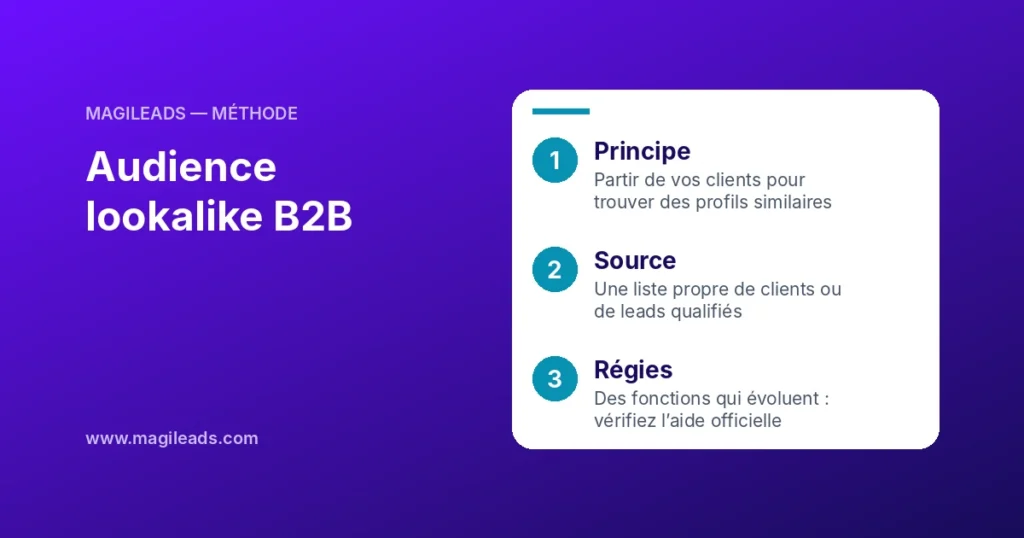
A B2B lookalike audience (or similar audience) starts with a list of existing customers to find other companies or decision-makers who are similar to them. The principle is simple: if your best customers share an industry, size, technology, or buyer role, organizations with similar characteristics are likely to have the same need. This guide explains how a lookalike audience works, what LinkedIn, Meta, and Google currently offer, and how to apply the same logic to your prospect lists.
B2B lookalike audience: the essentials
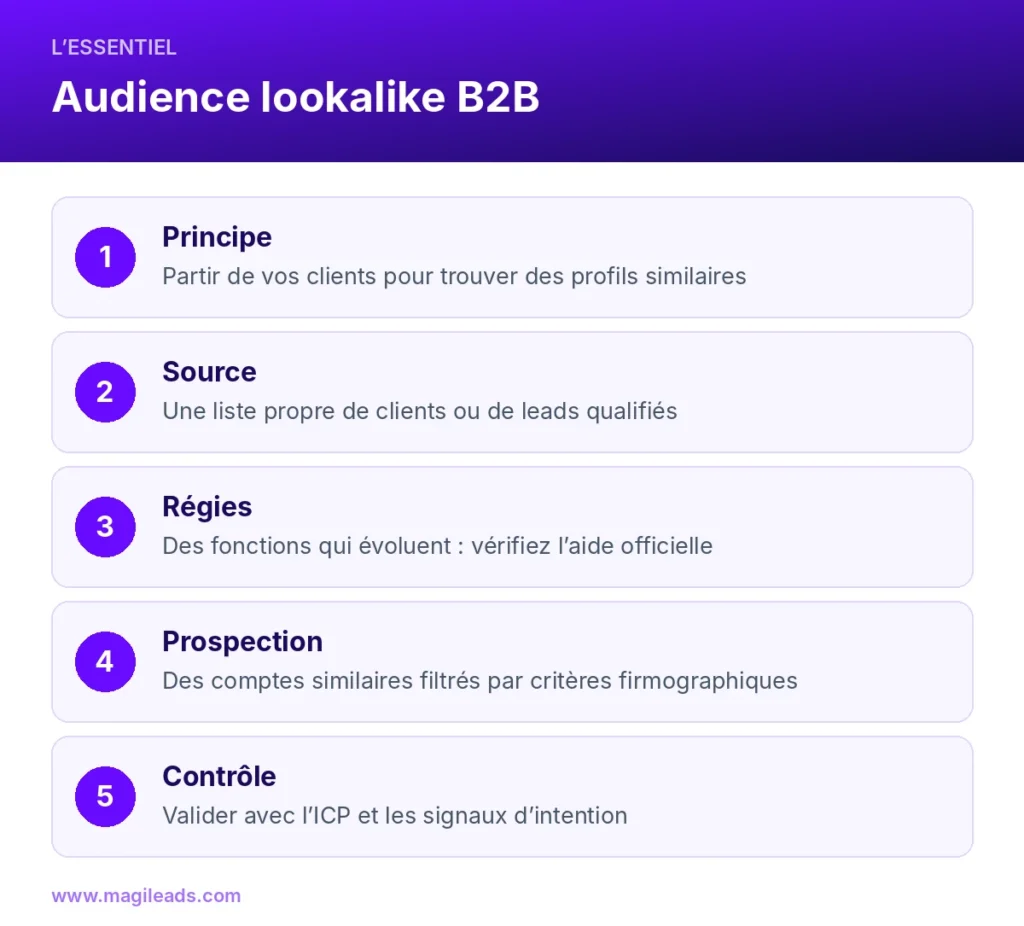
- Principle : start with your customers to find similar profiles.
- Source : a clean list of qualified clients or leads.
- Controls : functions that are evolving: check the official help.
- Prospecting : similar accounts filtered by firmographic criteria.
- Control : validate with ICP and intention signals.
What is a B2B lookalike audience?
A lookalike audience is built from a source audience, also called a "seed": a list of customers, qualified leads, or visitors who have performed a valuable action. An algorithm, or a manual analysis method, identifies the common characteristics of this source and then searches for other profiles that share them. The result is a new audience, larger than the source, but geared towards similar profiles.
In B2B, similarity is measured on two levels. At the account level: industry sector, size, revenue, geographic area, technologies used, growth phase. At the person level: job title, hierarchical level, seniority, skills. An effective B2B lookalike audience combines both, because it's a specific individual making the purchase, within a company that must match your ideal customer profile (ICP).
Why start with your customers?
Your customers are the most reliable proof of how well your offering fits the market. Starting with them, rather than assumptions, allows you to discover segments you hadn't considered and avoid targeting profiles that seem logical on paper but never actually buy. It's also a way to prioritize: among thousands of potential businesses, a lookalike audience highlights those that most closely resemble your past successes.
Building a good source audience
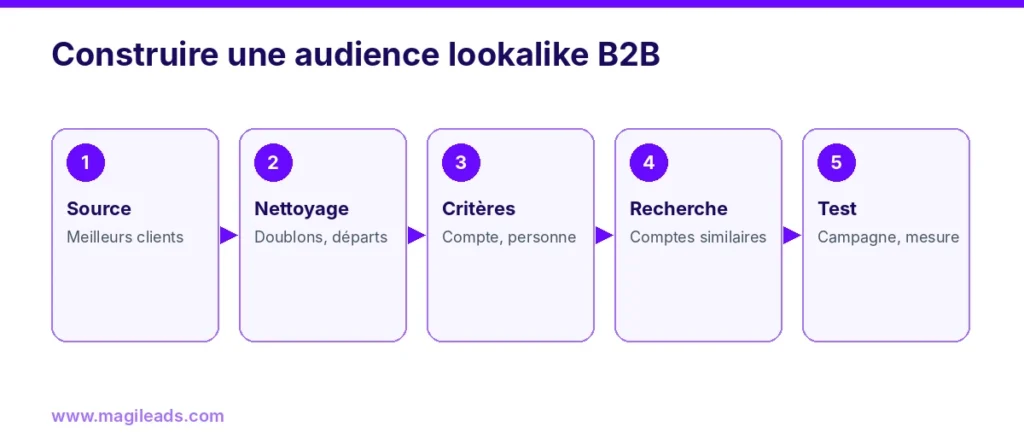
The quality of your source audience determines the quality of your results. A list that mixes profitable customers, lost customers, and newsletter subscribers produces a vague audience. Ideally, select your best customers—those who remain loyal, buy more, or recommend your offerings. Then, clean the list: remove duplicates, personal email addresses, and contacts who have left the company.
Also, ensure consistency. If you sell to both industrial SMEs and large public sector accounts, create two separate data sources rather than one: each lookalike audience will be more homogeneous, and your messages can be tailored to each target. Finally, verify that the use of this data complies with the GDPR and your commitments to your clients.
B2B lookalike audience on advertising networks
Advertising networks have long offered a dedicated "lookalike" function. These functions evolve rapidly: some have been discontinued, renamed, or replaced by mechanisms based on artificial intelligence. The table below summarizes the situation as described in the official help pages, accessed on November 27, 2026.
| Control | Situation according to official aid (27/11/2026) |
|---|---|
| Lookalike audiences were discontinued on February 29, 2024; they were replaced by predictive audiences and Audience Expansion | |
| Meta | Lookalike audiences created from a source audience of at least 100 people |
| Google Ads | Lookalike segments discontinued on May 1, 2023; optimized targeting; Lookalike segments in Demand Gen campaigns |
LinkedIn: Predictive audiences instead of lookalikes
According to the help page "Changes to LinkedIn lookalike audiences" (linkedin.com/help, accessed November 27, 2026), LinkedIn discontinued its lookalike audiences on February 29, 2024: it is no longer possible to create new ones or modify existing ones. LinkedIn recommends two replacements. Predictive audiences combine your data with LinkedIn's AI to generate a new audience that behaves like your source data; Audience Expansion expands your Matched Audiences and targeting criteria, primarily based on professional demographics.
The "LinkedIn predictive audiences" help page (accessed November 27, 2026) specifies the accepted sources: Lead Gen forms, contact or company lists, conversions, and retargeting audiences. A contact or company list must contain between 300 and 300,000 entries, and the other sources must contain more than 300 member accounts. These audiences are refreshed daily. To integrate this approach into your campaigns, consult our guide to LinkedIn Ads in B2B.
Meta: Lookalike Audiences
Meta's official documentation for developers (the "Lookalike Audiences" page on developers.facebook.com, accessed on November 27, 2026) states that a custom audience must have at least 100 people to serve as the source for a Lookalike Audience. The chosen ratio corresponds to a percentage of the population in the targeted country: the lower the ratio, the closer the audience is to the source. In B2B, Meta remains less precise than LinkedIn in terms of professional criteria; however, it can be used to reach decision-makers outside their professional context.
Google Ads: From Similar Segmentation to Optimized Targeting
According to Google's Search Ads 360 Help Center (accessed November 27, 2026), Google Ads no longer generates lookalike segments as of May 1, 2023. The Google Ads Help Center on Optimized Targeting (accessed the same day) recommends instead enabling Optimized Targeting and including your first-party data segments as cues: these serve as the starting point for the model. Lookalike segments exist in Demand Gen campaigns; according to the Google Ads Help Center accessed on November 27, 2026, Google is gradually transforming them into audience suggestions in 2026, with your source list becoming a signal rather than a targeting constraint.
Apply B2B lookalike audiences to prospecting
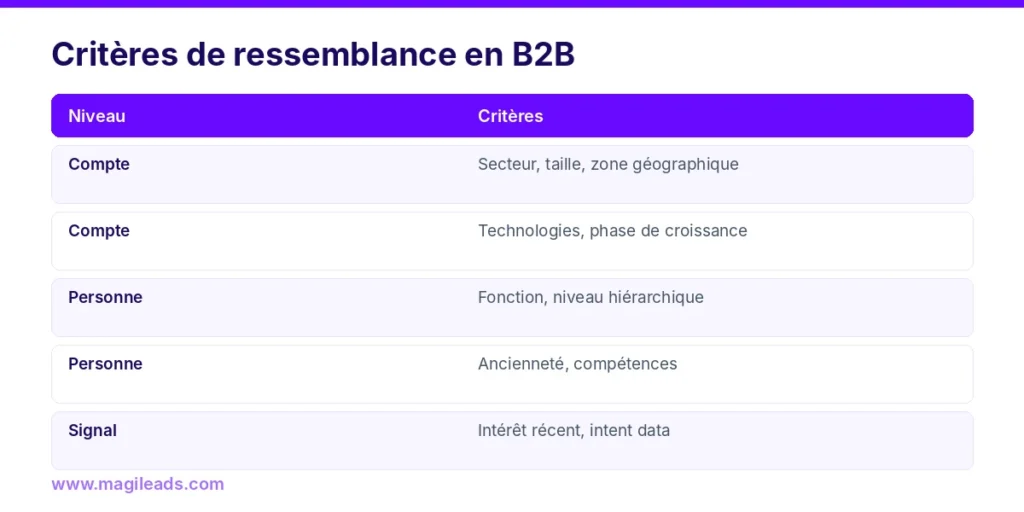
Lookalike marketing isn't limited to advertising. You can apply it to your prospect lists: analyze your best customers, identify their commonalities, and then search a B2B contact database for companies that share those criteria. This method has an advantage over ad networks: you know exactly why each account was selected, and you can tailor your message accordingly.
- Export your best customers from your CRM;
- Describe them using measurable criteria: sector, size, area, buyer function;
- Identify the criteria that come up most often;
- Search for accounts that share these criteria, then search for the decision-makers of those accounts;
- Enrich the contact details and launch a test campaign.
To take it a step further, combine similarity with buying signals. A company that resembles your customers and is currently showing interest in your topic deserves to be contacted first. This is where intentdata, usefully complementing this approach.
The limitations of a B2B lookalike audience
A lookalike audience replicates the past: it finds profiles similar to your current customers, not necessarily those of your future markets. If your offering evolves or you target a new sector, your former customers are no longer a relevant source. You must then start again from your target customer profile and accept a testing phase before you have a reliable source.
On advertising platforms, algorithms remain partly opaque: you don't know exactly why a person was included. Minimum source sizes can also be problematic for companies with few clients, which is common in B2B niche markets. In this case, broaden the source to include your qualified leads or current opportunities, maintaining profile consistency, or prioritize a criteria-based approach within a database.
Measure the quality of your lookalike audience
Don't judge it solely on the volume of clicks or responses. Track the proportion of contacts that truly match your Ideal Customer Profile (ICP), the number of appointments secured, and ultimately, the opportunities created. Compare these results to those of traditional criteria-based targeting: this is the only way to know if lookalike audiences deliver real value. Account-oriented approaches, such as account-based marketing, also use this logic to expand a list of target accounts.
Magileads to create lists of similar accounts
In Magileads, you can filter a dynamic, global B2B database of decision-makers based on criteria that describe your best clients, enrich the professional contact information of selected leads, and then launch email and LinkedIn campaigns, with SMS and voice options available for a fee. Lead scoring then helps you identify the most receptive accounts. The data is hosted in France, and Magileads is ISO 27001 certified.
Frequently Asked Questions
- What is a B2B lookalike audience? It is an audience built from your existing customers to find other companies or decision-makers who are similar to them, for both advertising and prospecting.
- Does LinkedIn still offer lookalike audiences? No: according to LinkedIn help consulted on 27/11/2026, they were discontinued on 29 February 2024 and replaced by predictive audiences and Audience Expansion.
- How large should the source list be? It depends on the ad network: for example, 300 to 300,000 lines for a contact list in LinkedIn predictive audiences, at least 100 people for a Meta source, based on their official pages consulted on 27/11/2026.
- Can you create a lookalike audience without an advertising network? Yes: analyze the common criteria of your best customers and search for similar accounts in a B2B database to build your prospecting lists.
Find companies that resemble your customers
Filter a dynamic and global B2B database of decision-makers according to the criteria of your best customers, then launch your campaigns: try Magileads free for 7 days.