Intentdatarefers to signals that suggest a company is interested in a particular topic, and therefore might be in the research or purchasing phase. For a B2B sales team, these signals allow them to contact the right accounts at the right time, rather than prospecting randomly. Here's what intent data encompasses, where this data comes from, how to use it, and what precautions to take.
Intent data: the essentials
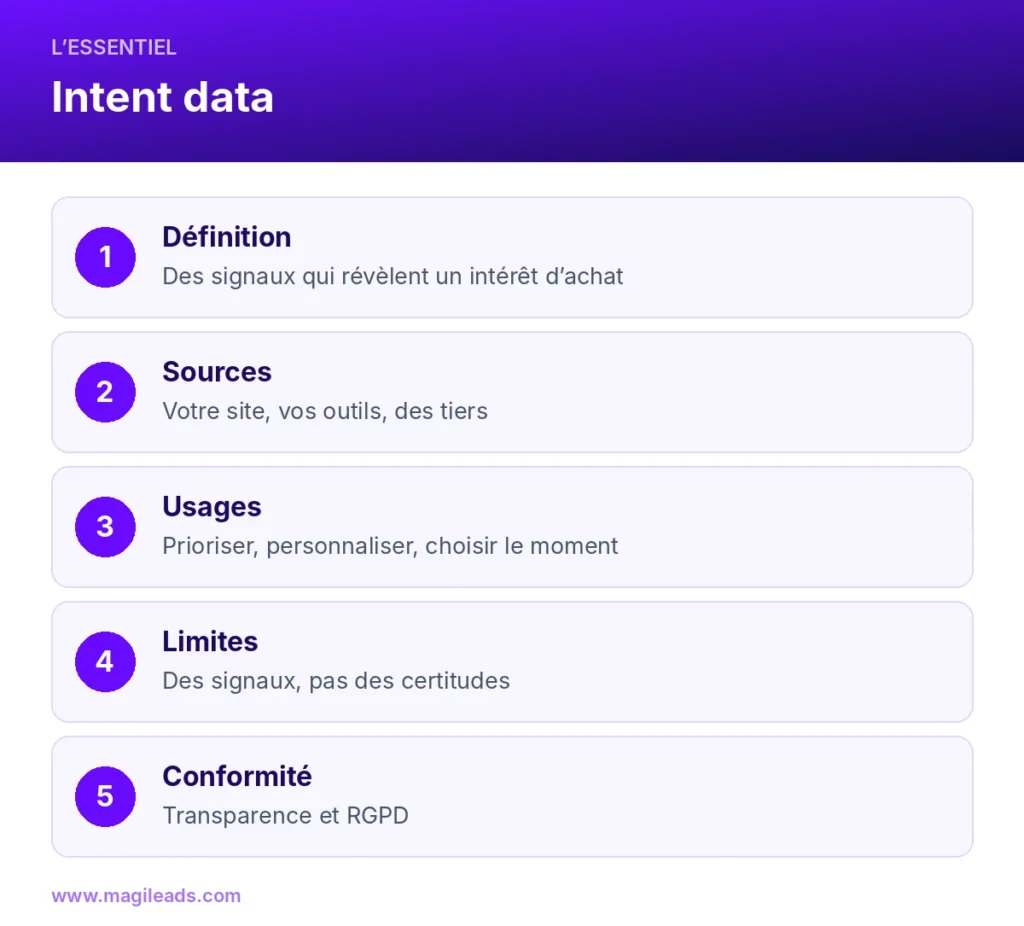
- Definition : signals that reveal a buying interest.
- Sources : your website, your tools, third parties.
- Uses : prioritize, personalize, choose the moment.
- Limitations : signals, not certainties.
- Compliance : transparency and GDPR.
What is intent data?
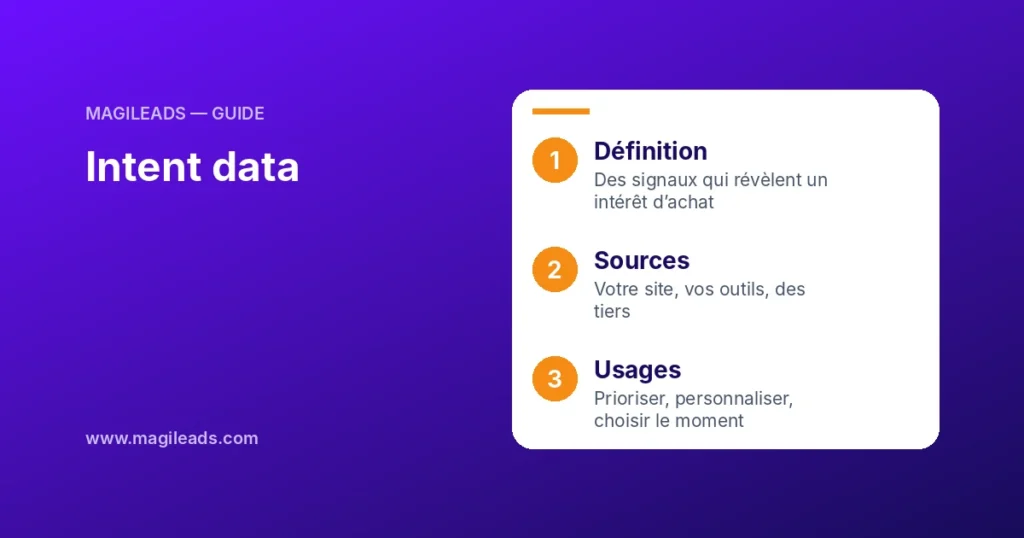
Intent data encompasses observable behaviors that indicate interest: browsing multiple pages on a topic, reading comparisons, downloading a guide, searching for a specific type of solution, or visiting a publisher's pricing page. A single behavior, taken individually, reveals little; it's the accumulation of signals on the same account, within a short period, that suggests intent.
Intent data differs from business signals, which describe company events (recruitment, fundraising, appointments, opening of a new site). The two are complementary: a business signal indicates that a need may arise, while intent data indicates that the company is already gathering information. See our article on business signals.
Intent data sources
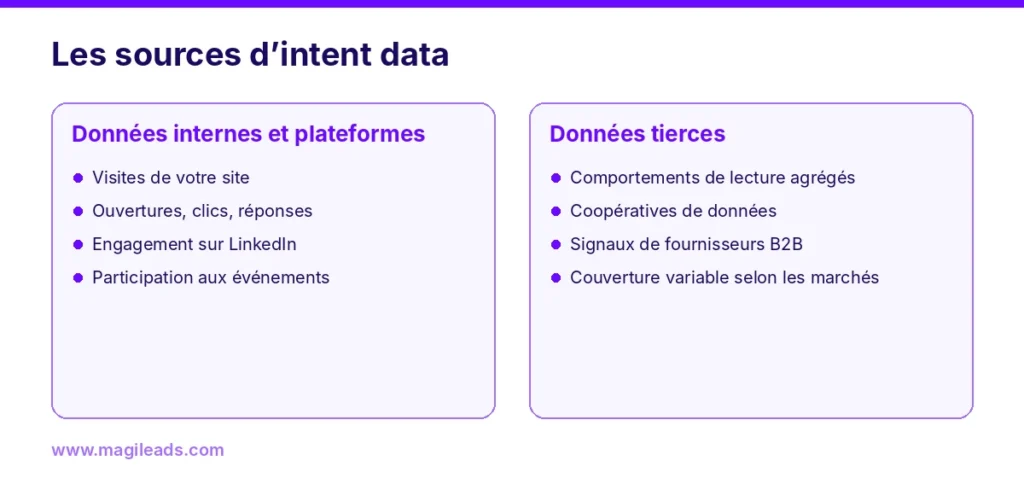
Internal (first-party) data
These are the signals you collect yourself: website visits, page views, downloads, email opens and clicks, campaign responses, and interactions with your posts. This data is the most reliable because it directly relates to your offering. Identifying the companies that visit your site is a first step; see our guide to identifying website visitors.
Platform data
Some platforms display engagement signals: people who like or comment on a LinkedIn post, who attend an event, who follow a page. These signals indicate an interest in a topic, rather than a specific offer.
Third-party data
Specialized providers aggregate reading behavior observed across numerous websites. Bombora, for example, presents itself as a B2B provider of intent, audience, and identity data, and describes itself as a data cooperative bringing together publishers, brand websites, and data providers. Several commercial data platforms also highlight intent signals: Cognism, Lusha, Lemlist, and La Growth Machine mention them on their websites.
How to use intent data in prospecting
Prioritize accounts
The primary use of intent data is prioritization. Among the accounts that match your ideal customer profile, those showing recent intent signals deserve to be contacted first. This allows you to focus your team's efforts where the likelihood of a response is highest.
Choosing the right time
An account that actively seeks information about your topic is more receptive today than it will be in six months. Intent data helps launch a campaign when the need is immediate, rather than according to a fixed schedule.
Personalize the message
The topics viewed provide clues about the account's concerns. Use them to choose the angle of your first message, without ever intrusively revealing that you're following their activity. It's better to talk about a common issue in their industry than to write, "I saw that you visited our pricing page.".
Align marketing and sales
The same signals can inform account scoring, ad audiences, and sales priorities. Sharing a common definition of what constitutes a "hot" account prevents marketing and sales from working on separate lists.
Example of intent data usage
| Signal observed | Possible interpretation | Action |
|---|---|---|
| Several visits to the pricing page in one week | Active comparison of solutions | Quick sales contact, exchange proposal |
| Reading articles on a specific topic | Information phase | Sending a useful resource on this topic |
| Interaction with a LinkedIn post | Interest in the topic | LinkedIn invitation with a note on the topic |
| Recruitment for a position related to your offer | Need for construction | Targeted prospecting towards the future manager |
The limitations of intent data
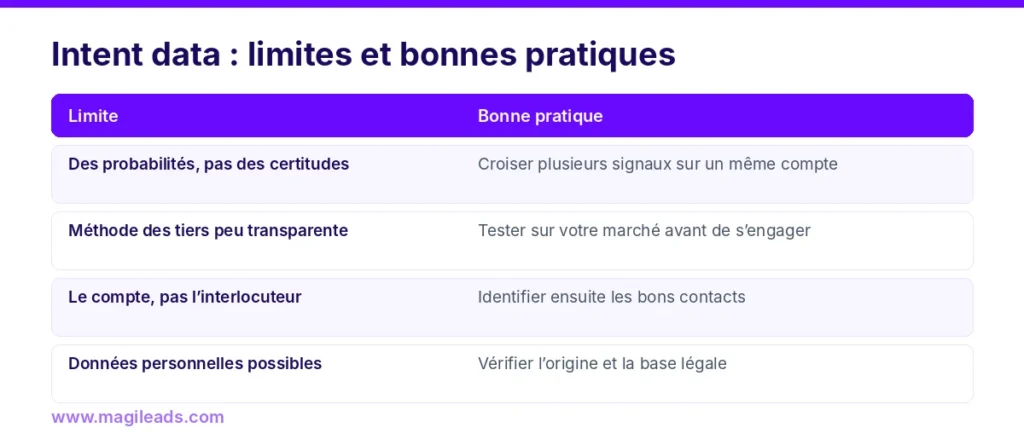
Intent data remains a set of probabilities, not certainties. A student, a competitor, or a journalist might consult the same content as a buyer. Third-party data relies on models whose methodology isn't always transparent, and its coverage varies by country and sector. Test it in your market before entrusting it with your priorities.
Another limitation: intent data indicates that an account is interested in a topic, but not who within the company is leading the project. The next step is to identify the right contacts, find their contact information, and reach out to them with a relevant message. This is where a B2B database and a prospecting platform come in.
Intent data and GDPR
Intent data can include personal data: IP addresses, browsing identifiers, and individual behaviors. Its collection via tracking technologies is regulated: the CNIL (French Data Protection Authority) specifies that only certain audience measurement tools, strictly limited to this purpose and producing anonymous statistics, can be exempt from consent. Commercial uses, however, generally require clear information and, depending on the case, the consent of the individuals. Ask your suppliers about the origin of the data and the legal basis for its processing. See our article on commercial prospecting and the CNIL.
Moving from signals to action
Intent data is only valuable if it triggers swift action. Once priority accounts are identified, the next step is to find the right contacts, enrich their information, and launch a tailored sequence. In Magileads, you can import your priority accounts or find them in the B2B database, enrich the contacts, then launch an email and LinkedIn campaign and track each lead's response. To choose your data sources, consult our guide to selecting a B2B data provider.
Start simply: first leverage your own signals (visits, responses, clicks), measure their impact on your response rates, and then assess the value of third-party intent data. A successful intent data strategy relies less on the quantity of signals than on the speed and relevance of the team's response.
Implementing an intent data approach
An effective intent data approach begins with a simple question: what behaviors, on your website or elsewhere, typically precede a request for a demo or a purchase from you? Analyze the journey of your recent customers: pages viewed, content downloaded, emails opened, interactions on LinkedIn. This will give you an initial list of signals relevant to your business.
Next, define simple rules: at what activity level does an account become a priority? Who handles it, and within what timeframe? What prospecting sequence is reserved for it? Without these rules, signals accumulate in a dashboard without triggering any action. A good intent data system links each signal to a concrete action, assigned to a member of the team.
Finally, measure the results. Compare the response rate and appointment rate of accounts contacted using intent data with those of your usual prospecting. If the difference isn't significant, review your signal selection or processing speed before investing in additional third-party data.
Intent data: choosing the right supplier
If you're considering third-party intent data, ask the same questions you would any data provider: where do the signals come from, how are they collected, what is the coverage in your market and language, how often are they updated, and what is the legal basis for them? Request a test on a list of accounts you know well: do the signals generated match what you know about their situation?
Be wary of overly specific promises. No amount of intent data can guarantee that a company will buy. The best results come from combining multiple sources (your own signals, business signals, and potentially third-party data) and a team capable of reacting quickly with a relevant message.
Keep in mind that intent data is a decision-making tool. It guides your priorities, but it doesn't replace customer knowledge, the quality of your targeting, or the relevance of your messaging. Teams that make the most of it integrate it gradually, measuring at each stage what it actually contributes to their business results.
Frequently Asked Questions
- What is intent data? It consists of behavioral signals (reads, visits, searches, interactions) that suggest a company is interested in a topic and might be in the buying phase.
- What is the difference between intent data and business signals? Business signals describe company events (recruitment, fundraising); intent data describes information search behaviors.
- Where does intent data come from? From your own tools (website, emails, campaigns), platforms (engagement on LinkedIn) and third-party providers that aggregate reading behaviors.
- Is intent data compliant with the GDPR? It can be, provided that the rules on trackers are respected, people are informed and the origin and legal basis of the data used are known.
Transfer signals to prospecting
B2B database, enrichment and email campaigns + LinkedIn to contact your priority accounts: try Magileads free for 14 days.