Attracting traffic and subscribers isn't enough: to grow your revenue, you need to convert prospects into customers. This requires sales skills, conversion-focused landing pages, rigorous tracking, and the right tools. Here are 10 concrete tips to improve each stage of your B2B sales journey.
These tips are for sales teams as well as SME managers who prospect themselves. You don't need to apply them all at once: start with the stage where you lose the most prospects, then move on step by step.
10 tips to turn prospects into customers
1. Work on the skills that sell
Selling is a skill in itself, but it draws on several others: active listening, the ability to ask the right questions, handling objections, and the art of closing. A salesperson who truly understands their prospect's problem secures more appointments than one who simply recites a pitch. Identify your team's weakest skill and prioritize training it, for example, through role-playing or listening to recorded calls. To learn more, see our article on the key skills for excelling in B2B sales.
2. Create landing pages dedicated to conversion
A landing page directs visitors to a page designed for a single purpose: booking a demo, downloading a guide, or requesting a quote. On WordPress, numerous plugins and page builders allow you to create them quickly. Choose a tool that is easy to use, compatible with your theme, and capable of measuring the conversion rate of each page.
3. Get inspired by landing pages that work
Once the tool is in place, you need compelling content. Look at the pages of brands you admire: a headline focused on the benefit, a clear promise, concrete evidence, and a single, highly visible call to action. Note what's consistent across pages, then adapt these principles to your offer rather than copying them. Our tips for capturing B2B leads effectively detail the essential elements of a high-converting page.
4. Improve the click-through rate of your calls to action
To generate leads from your website, your buttons and links must be compelling enough to encourage clicks. Use an action verb, clearly state what the visitor will get ("Receive the guide," "Book my demo"), and place the call to action where the reader naturally wonders what to do next. Test several versions and keep the one with the highest click-through rate.
5. Track each prospect in a CRM, even a simple one
A CRM prevents an interested prospect from being forgotten. If you're starting with limited resources, your email can suffice for a while thanks to labels, reminders, and reply templates. But as soon as the volume increases, switch to a true tracking tool: every exchange, every follow-up, and every stage of the sales cycle is centralized there.
6. Refine your B2B sales proposals
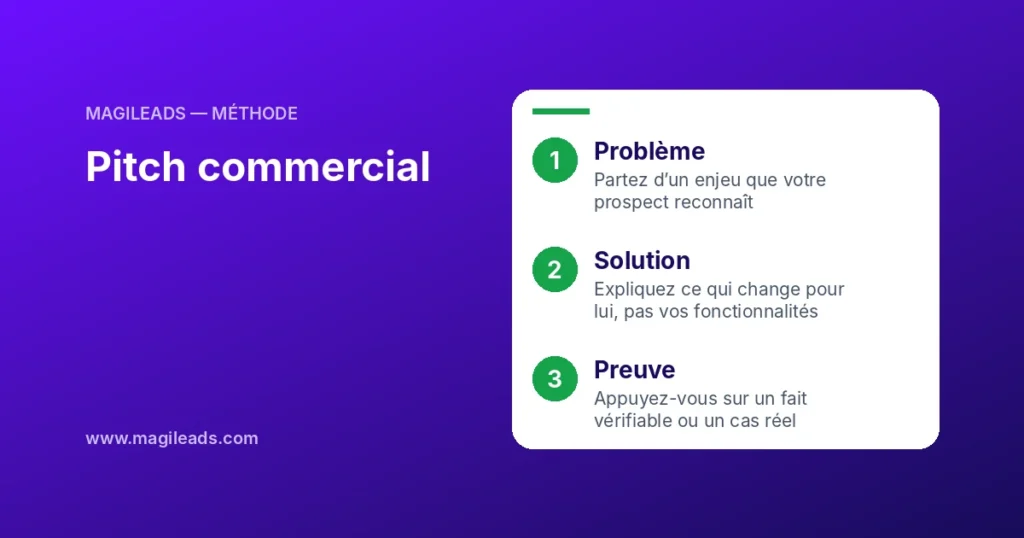
In B2B, the written proposal is often the decisive step. A good proposal rephrases the client's problem in their own words, presents the solution and its measurable benefits, details the process and pricing, and clearly outlines the next steps. Avoid generic documents: a client should feel that the proposal has been written specifically for them.
7. Analyze visitor behavior using heat maps
Heatmaps show where visitors click, how far they scroll, and where they leave the page. They reveal, for example, a button that's too low, a form that's too long, or a paragraph that's been ignored. Use them on your most important pages, fix one thing at a time, and measure the impact of each change.
8. Focus on answer-oriented copywriting
Copywriting isn't just for content marketing: when used correctly, it directly drives sales. Answer-oriented copy starts with the reader's problem, shows the result they can achieve, and prompts them to take immediate action. Apply this method to your prospecting emails, LinkedIn messages, and sales pages. Our copywriting techniques for improving conversion rates will provide you with concrete examples.
9. Monitor your visibility in Google search results
For a local or specialized business, how it appears in Google strongly influences contact requests. Google regularly updates its search results display, especially on mobile devices. Check your business listing, titles, and descriptions, and ensure your contact information is consistent across all platforms.
10. Value your customer reviews
Customer reviews reassure potential customers when making a decision. Ask every satisfied customer for a review, respond to all reviews, including negative ones, and highlight the most relevant feedback on your sales pages. A genuine and detailed review is worth more than a long list of vague compliments.
How to measure your ability to convert prospects into customers
Before applying these tips, follow a few simple indicators to determine what works:
- Visitor → lead rate : the proportion of visitors who fill out a form or book a call.
- Lead rate → opportunity : how many leads become real, qualified sales conversations.
- Conversion rate : the proportion of opportunities that become customers.
- Sales cycle duration : the average time between the first contact and the signing.
Review these figures monthly and test only one change at a time: this way you'll know which action has truly improved your results. To visualize where your prospects are dropping out, refer to your conversion funnel.
Mistakes that cause you to lose sales
Even with good tools, a few habits can subtly hinder your conversions:
- Following up too late, when the prospect has already moved on to something else.
- Send the same generic message to all your leads.
- Talk about the features rather than the problem the client wants to solve.
- Ending a call or email without a clear next step.
Addressing these issues is often the fastest way to close more deals without having to generate more leads.
Set up a simple follow-up routine
Many sales are lost not because of a bad offer, but because no one followed up. A simple routine is often all it takes:
- Day 1 : a short and personalized message that recalls your first exchange.
- Day 3 : a useful resource, such as a guide or checklist.
- Day 7 : a proposed specific time slot for a call.
- Day 14 : a final courteous message that leaves the door open.
Automate reminders, but keep each message personal and tailored to the prospect's situation. Combining email and LinkedIn increases your chances of being read: discover how to choose between B2B prospecting via email or LinkedIn. Sales prospecting software helps you schedule these sequences without missing anything.
Frequently Asked Questions
- What constitutes a good conversion rate? It depends on your industry and your offering. First, compare yourself to your own past results, then progress step by step.
- How quickly should you contact a new lead? As soon as possible, ideally the same day, while the prospect still remembers you.
- Should you use a CRM to convert prospects into customers? Yes: even a simple CRM allows you to track every interaction and not miss any follow-up.
- Which advice should you start with? Start with the stage where you lose the most prospects: the landing page, the first call, or the proposal.
To complement these tips, discover our sales strategies to increase your revenue and our guide to generating qualified leads.
Move from theory to practice
To delve deeper into this topic, consult our comprehensive guide to B2B lead generation. And to apply these tips to your prospecting, Magileads allows you to target your B2B prospects, contact them via email and LinkedIn, and track their responses, all from a single platform.