Saviez-vous que le lead scoring est un élément fondamental de toute stratégie d’automatisation ? Toutefois, étant donné que le parcours client des prospects B2B et B2C est différent. Vous devez en tenir compte afin de bien qualifier et entretenir vos prospects. Découvrez dans cet article comment faire.
Qu’est-ce qu’on entend par lead scoring ?
Le lead scoring est une technique conçue pour qualifier automatiquement les leads de votre base de données. Pour ce faire, vous devez prendre en compte certains paramètres liés aux caractéristiques du client idéal (acheteur) ou à son comportement.
Quand on parle de lead scoring dans le marketing digital, on désigne simplement le fait de donner une certaine valeur au potentiel de conversion d’un utilisateur. Cette valeur est basée sur les données socio-démographiques connues sur lui et sur son comportement en ligne.
Plus le prospect est connu implicitement ou explicitement, plus la note qu’on peut lui attribuer est précise. Plus on le qualifie, plus la stratégie de lead scoring que l’on déploie pour le conduire à la conversion est efficace.
Pourquoi recourir au lead scoring ?
L’objectif du lead scoring est, entre autres, de faciliter la coordination et la collaboration des services marketing et commerciaux. Cela se fait au début du processus de gestion des leads par le biais de la classification des leads acquis. Cela se fait surtout plus tard par des règles claires qui déterminent quand un lead est suffisamment mûr pour être vendu et quelle priorité le service commercial doit lui accorder.
Ces règles et normes sont regroupées dans un modèle de notation des prospects qui peut être mis en œuvre principalement dans le marketing B2B, mais aussi dans le marketing B2C et dans les ventes. Ce modèle permet de décider si une activité de vente est transférée au département des ventes, c’est-à-dire si elle passe au traitement des leads, ou bien si elle continue à évoluer vers le lead nurturing.
Quel est le rapport entre le lead scoring et le marketing automation ?
Le principe est simple. Une fois qu’un certain nombre de leads ont été marqués, il devient pratiquement impossible de les qualifier et de les gérer un par un. Il reste néanmoins essentiel de les segmenter correctement. Ainsi, les ressources et le temps ne peuvent être investis que dans les leads présentant les meilleures opportunités de conversion.
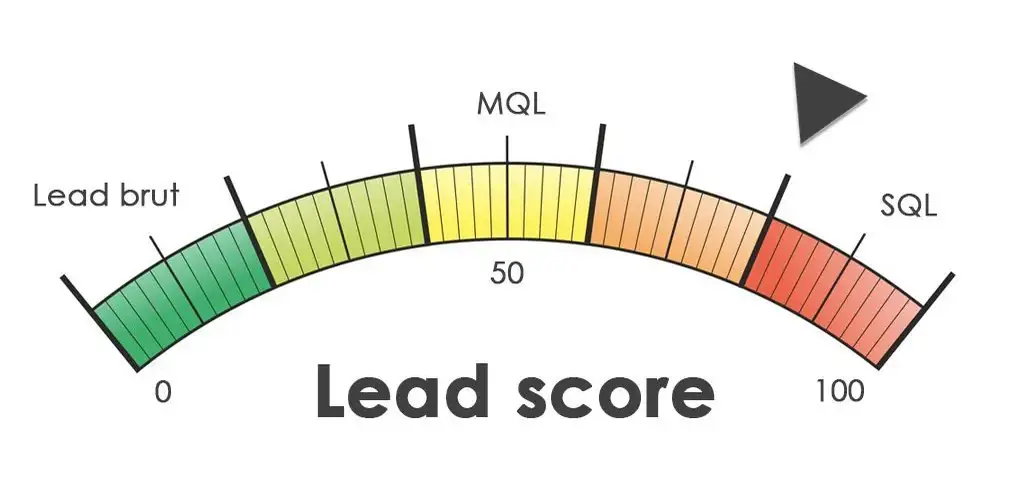
Bien que le type de scoring utilisé puisse être plus général ou plus spécifique selon le processus d’achat, vous pouvez généralement distinguer trois grands types de leads : « chaud » (ou prêt à acheter), « tiède » (dans le processus de décision) et « froid » (qui correspondent au profil, mais qui n’ont pas encore commencé le processus d’achat).
Par exemple, les informations que vous devez envoyer à un contact « chaud » ne sont pas identiques à celles que vous devez envoyer à un contact « tiède ». Un contact « chaud » est venu directement sur votre site pour citer un produit ou un service. Un contact « tiède » est venu d’une recherche sur le Web et s’est abonné à votre newsletter.
Comment attribuer des qualifications à un lead ?
Le score que vous attribuerez à un lead dépendra de ce que vous savez sur lui. En ce sens, si vous disposez d’un outil d’automatisation qui vous permet d’obtenir le plus d’informations possible, vous avez déjà un avantage considérable.
Deux types d’informations permettent de qualifier un lead : les données socio-démographiques liées au profil du client (âge, sexe, pouvoir d’achat, mode de vie, etc.) et les données liées à son comportement de recherche. Par exemple, certains des critères comportementaux pour qualifier les leads sont :
- Visite du site (quelles pages ?) ;
- Fréquence des visites ;
- Canal cible (réseaux sociaux ? recherche organique ? publicité PPC ?) ;
- Type de contenu que vous recherchez (TOFU, MOFU, BOFU) ;
- Inscription sur le site ;
- Téléchargement de contenu ;
- Abonnement à la newsletter ;
- Demande d’informations ;
- Interaction avec un chatbot ou un assistant virtuel ;
- Ouverture des courriers électroniques ;
- Ajout des produits au panier ;
- Etc…
En général, dans le marketing automation, les séquences de lead scoring sont déclenchées par des critères qui ont un rapport à la fois avec le profil de l’utilisateur et le comportement de l’utilisateur.
LIRE AUSSI : Optimisez votre processus de vente avec le scoring des leads
Quelles sont les différences de comportement entre un lead B2B et un lead B2C ?
Il existe plusieurs différences dont vous devez tenir compte lors d’un marketing automation pour le B2B et le B2C. Cependant, les plus importantes en ce qui concerne le lead scoring sont les suivantes :
B2B : Combien vous en avez BESOIN ? vs. B2C : Combien vous en VOULEZ ?
Normalement, un lead B2B ne se convertit que lorsqu’il dispose de toutes les informations techniques du produit ou du service. Il a alors effectué une comparaison détaillée de pratiquement toutes les options disponibles. Il est donc normal que le processus d’achat soit beaucoup plus long et que son évolution soit orientée vers :
- Logique de produit ;
- Retour sur investissement ;
- Votre connaissance de la proposition de valeur.
D’autre part, bien qu’un lead B2C fasse également des comparaisons avant d’effectuer un achat, le facteur émotionnel joue un rôle beaucoup plus important. Ce dernier a tendance à diminuer ou à « refroidir » avec le temps. Il est donc essentiel d’en tirer le meilleur parti dès qu’il se manifeste et d’essayer d’accélérer le plus possible le processus d’achat.
Différents formulaires de contact pour le B2B et le B2C
Souvent, les informations sur les utilisateurs qui sont tout à fait pertinentes pour une vente B2C n’ont aucune pertinence dans un contexte B2B, et vice-versa. La première chose à éviter est de demander des informations qui ne sont pas absolument nécessaires. En effet, plus vous devez fournir d’informations sur un formulaire, moins vous avez de chances de remplir la demande.
Vous devez être très clair sur le minimum dont vous avez besoin pour progresser vers votre avance dans l’entonnoir des ventes et vous concentrer sur celle-ci. Considérez que tout dépend de la relation entre votre produit et vos clients. Toutefois, d’une manière générale, dans le cas du B2B, la meilleure stratégie consiste à recueillir des données visant à offrir une solution personnalisée en fonction de besoins objectifs. Dans celui du B2C, il s’agit d’une solution personnalisée en fonction des goûts subjectifs.
Quand le responsable des ventes entre-t-il en action ?
Dans les entreprises B2B, les responsables des ventes se lancent normalement dans l’action lorsque le processus d’automatisation leur donne des leads « tièdes ». Autrement dit, ils ont déjà une quantité considérable d’intérêts et d’informations sur le produit ou le service. Cependant, ces derniers ont encore besoin de cet argument de confiance définitif ou d’une valeur ajoutée très personnalisée pour prendre la décision.
Dans la plupart des transactions B2C, il est souhaitable que la majeure partie du processus soit automatisée. Le responsable des ventes ne doit être présent qu’avec des leads « chauds » ou prêts à l’achat. En fait, dans de nombreux secteurs, il est habituel que le processus soit déjà complètement automatique, sans l’intervention d’un agent commercial. C’est le cas, par exemple, du commerce électronique ou des services de streaming.
—————————
Magileads est un logiciel d’automatisation de la prospection qui vous permet de gérer facilement tous les aspects complexes de vos processus marketing.
Testez gratuitement Magileads en 14 jours. Cliquez ici.
Ou réservez une démo pour voir comment ça fonctionne. Cliquez ici.