

What is a sales lead and why is it essential?
A sales lead represents a person or organization that has expressed an interest in your products or services. This interest may be demonstrated by a request for information, a newsletter subscription, or a content download.
Sales leads play a central role in your business growth. For example, 50% of leads are qualified but not yet ready to buy, highlighting the importance of nurturing these contacts. Furthermore, companies that nurture their leads generate 50% more sales-ready leads while reducing costs by 33%. By focusing on these opportunities, you optimize your marketing efforts and increase your chances of converting these contacts into loyal customers.
Key Points
A sales lead is someone interested in your products. Understanding this is important for successful sales.
MQLs and SQLs are different and help you sell better. MQLs require attention, SQLs are ready to buy.
Properly classifying your leads helps you sell more easily. Focus on the best leads to make the most of your resources.
Use tools to see what your leads are doing. This helps you adapt your messaging and better engage them.
CRM and prospecting tools like Magileads are useful. They make your sales simpler and less expensive.
Understanding sales leads and their types
Difference between a sales lead and a prospect
A sales lead and a prospect are not synonymous, although they are often confused. A sales lead refers to a contact who has shown initial interest in your products or services. For example, someone who downloads a white paper or subscribes to your newsletter becomes a sales lead.
In contrast, a prospect is a qualified lead who matches your ideal customer profile. This individual has demonstrated more concrete interest and is ready to engage in sales discussions. This distinction is crucial to avoid wasting your efforts on irrelevant contacts.
Types of sales leads: MQL (Marketing Qualified Lead) and SQL (Sales Qualified Lead)
Not all sales leads are created equal. They are mainly divided into two categories: MQLs (Marketing Qualified Leads) and SQLs (Sales Qualified Leads).
MQL (Marketing Qualified Lead) : This type of lead has interacted with your marketing efforts, such as downloading content or attending a webinar. However, they are not yet ready to buy.
SQL (Sales Qualified Lead) : This lead has been evaluated by the sales team and is deemed ready for direct interaction with a salesperson.
Converting an MQL into an SQL takes an average of 30 days . This timeframe corresponds to the moment when marketing passes the lead on to the sales team for more targeted follow-up.
B2B Marketing Manager (SaaS sector)
“Before structuring our lead nurturing strategy, we were losing a lot of qualified leads. Thanks to a more targeted approach and the use of a CRM, we doubled our conversion rate in six months. Today, every lead is considered a real opportunity, even if they aren't ready to buy immediately.”
– Sarah G., Marketing Manager at SoftData
Why this distinction is essential for your business strategy
Distinguishing between MQLs and SQLs optimizes your sales efforts. MQLs require specific nurturing, such as sending educational content, while SQLs demand a more direct approach.
Here's why this distinction is essential:
MQLs are prospects who are interested , but without a specific need.
SQLs are prospects who are closer to conversion.
This distinction allows you to tailor your monitoring efforts and maximize your chances of success.
By prioritizing SQLs, you focus your resources on the leads with the highest conversion potential. This improves your conversion rates and reduces customer acquisition costs.
Furthermore, this segmentation helps you refine your marketing strategies. This allows you to attract higher-quality leads, instead of simply generating a large volume of unqualified contacts.
💡 Tip : Regularly analyze your leads to refine your qualification criteria and improve collaboration between your marketing and sales teams.
The importance of sales leads for your business
Optimizing sales efforts through better segmentation
Effective sales lead segmentation allows you to focus your efforts on the most promising contacts. By identifying each lead's specific needs, you can personalize your approaches and maximize your chances of success.
Data segmentation helps to better understand the expectations of potential customers.
A targeted approach strengthens the relevance of your messages and improves engagement.
The most qualified leads receive priority attention, thereby increasing conversion rates.
For example, by tailoring your messaging to lead behavior, such as their interactions with your emails or website, you can offer solutions that precisely meet their needs. This strategy also reduces the risk of losing visitors, as they feel understood and valued.
💡 Tip : Use analytics tools to segment your leads based on criteria such as their behavior, location, or industry. This will help you send the right message at the right time.
Improved conversion rates and return on investment (ROI)
Well-segmented and qualified sales leads directly increase your conversion rates. By targeting the prospects most likely to become customers, you reduce unnecessary effort and optimize your resources.
Behavioral segmentation allows for the sending of personalized emails, which improves prospect engagement.
Messages tailored to the specific needs of leads increase the chances of conversion.
A well-defined strategy maximizes return on investment by reducing costs associated with ineffective campaigns.
Imagine sending a promotional email to a lead who recently visited your product page. This type of targeted interaction demonstrates that you understand their needs, encouraging them to make a purchase. Such an approach not only improves your results but also strengthens the positive perception of your brand.
SME manager (professional services)
“For a long time, we focused solely on hot leads. But since we understood the importance of nurturing warm leads through personalized email sequences, we've reduced our sales cycle by 30%. The key? Don't give up too soon.”
– Jean-Luc M., Founder of LexiConsult
Strengthening customer relationships from the very first interactions
The first interactions with your leads are crucial for building trust. By offering a personalized experience from the outset, you increase the chances of long-term customer loyalty.
Effective lead management can increase customer loyalty by 27% in the first year.
Tools like the Net Promoter Score (NPS) allow you to measure customer satisfaction and identify your brand ambassadors.
A strong customer relationship from the outset can lead to a 30% increase in revenue within the first six months.
When your leads feel heard and understood, they are more likely to remain loyal to your business. For example, a lead who receives a quick and relevant response to their information request is more likely to become a satisfied customer. This initial satisfaction often translates into positive referrals and increased sales.
📈 Interesting fact : Companies that invest in lead management tools see a continuous improvement in customer retention, reaching up to 38% after two years.
Effective strategies for generating sales leads

Use SEO to attract qualified visitors
Search Engine Optimization (SEO) is an essential strategy for generating sales leads. By optimizing your content for search engines, you attract qualified visitors who are actively seeking solutions to their needs.
According to a study by Demand Gen Report, 76% of B2B buyers say that a white paper influences their purchasing decision . This highlights the importance of providing relevant content to convert visitors into leads.
Biospringer, a B2B company, increased its traffic by 33% in one year thanks to the regular publication of 3 to 4 SEO articles per month.
To maximize your results, focus on keywords specific to your industry. Create educational content such as guides or case studies that answer your prospects' frequently asked questions. By optimizing your pages for these keywords, you increase your chances of attracting visitors who are ready to become qualified leads.
Leverage social media to engage your audience
Social media plays a vital role in generating sales leads . It allows you to create direct interactions with your audience and increase the visibility of your content.
Social media engagement promotes customer loyalty and increases content visibility, which can lead to an increase in qualified leads.
In the B2B sector, social networks help to develop brand awareness, attract prospects and retain customers.
To engage your audience, share a variety of content such as videos, infographics, or customer testimonials. Respond promptly to comments and messages to strengthen relationships with your prospects. A well-thought-out social media strategy can turn interactions into business opportunities.
Create landing pages optimized for conversion
Landing pages are powerful tools for converting your visitors into leads. A well-designed page guides the visitor toward a specific action, such as filling out a form or downloading content.
An optimized landing page can increase the conversion rate by up to 50% .
Moving from 10 to 15 landing pages on a site can generate 55% more leads, according to a HubSpot study.
To optimize your landing pages, use clear headlines, compelling calls to action, and attractive visuals. Ensure the form is quick and easy to complete. By regularly testing your pages, you can identify the elements that work best to maximize conversions.
Participating in events and trade shows for direct interaction
Trade shows and events offer a unique opportunity to meet your prospects face-to-face. These direct interactions allow you to create a human connection, often more impactful than digital exchanges. This enables you to better understand your prospects' needs and present your solutions to them in a personalized way.
To maximize the results of your participation, adopt effective practices. For example:
Evaluate the quality of the prospects met by observing their level of engagement.
Note the questions asked and the interactions with your products or services.
Track the time visitors spend at your booth to identify those who show genuine interest.
This data helps you prioritize the most promising leads and adjust your follow-up strategies.
Trade shows aren't just about lead generation. They also allow you to directly measure your return on investment (ROI). You can track the number of deals closed during the event and analyze sales generated by the prospects you met in the following weeks. These metrics demonstrate the tangible impact of your efforts on your revenue.
Finally, these events boost your credibility and increase your brand visibility. By actively participating, you demonstrate your expertise and build trust with potential clients. This can transform a simple interaction into a long-term collaboration.
💡 Tip : Prepare attractive visual aids and interactive demonstrations to capture visitors' attention. An engaging presentation can make all the difference.
How to qualify and maximize the potential of sales leads
Introduction to lead scoring: evaluating the potential of a lead
Lead scoring is an effective method for assessing the quality and potential of a lead. It involves assigning a score based on specific criteria, such as behavior or interactions with your company. This approach helps you identify the most promising leads and focus your efforts on those most likely to convert into customers.
Here are some key indicators for evaluating a lead:
Visiting key pages : A lead who visits pages such as product or pricing pages shows a high level of interest.
Content downloading : Leads who download white papers or participate in webinars demonstrate active engagement.
Email engagement : Email opens and link clicks are valuable signs of interest.
By using these criteria, you can prioritize your leads and optimize your sales efforts.
SDR (business development)
“A good lead isn't just a contact; it's a person with a problem. As soon as I identify that need, I can tailor my approach. By using tools like Magileads, I can better segment my lists and save valuable time to engage in quality conversations.”
– Nina T., SDR at Innov-Dev
Lead nurturing: maintaining the relationship with relevant content
Lead nurturing involves maintaining a relationship with your leads by providing them with content tailored to their needs. This strategy aims to support your prospects throughout their buyer's journey, strengthening their trust in your company.
The advantages of lead nurturing are numerous:
You generate more purchase-ready leads
You reduce the cost per lead by 33%.
You shorten the sales cycle by 23%.
You increase the average basket size by 47%.
To succeed, offer a variety of content such as blog articles, case studies, or explainer videos. These resources should answer your prospects' frequently asked questions and guide them toward a purchase decision.
Use CRM tools to track and analyze interactions
CRM (Customer Relationship Management) tools play a vital role in managing and analyzing interactions with your leads. They allow you to centralize data, track campaign performance, and improve your sales strategies.
Here are some statistics that illustrate their effectiveness:
87% of marketers use lead tracking to evaluate their campaigns.
79% of companies with a CRM benefit from complete visibility into their sales performance.
76% of companies report better sales forecasting thanks to CRM.
By using a CRM, you personalize your interactions and improve lead engagement. You also identify conversion opportunities and optimize your efforts to maximize your results.
Using lead generation and acquisition software

Why use prospecting software like Magileads?
Lead generation software like Magileads simplifies and optimizes sales lead generation. It allows you to target the most promising prospects while reducing the effort required to qualify them.
Here are some statistics that demonstrate its effectiveness:
70% of the buying journey is completed before a potential customer contacts a sales representative.
One company observed a 40% increase in lead conversion rate and a 30% reduction in prospecting costs after using Magileads.
A consulting firm doubled its number of appointments with qualified prospects in just three months thanks to Magileads.
By using a tool like Magileads, you save time and improve your sales results. This allows you to focus your efforts on the most interested prospects and maximize your chances of success.
Key features of Magileads for generating leads
Magileads offers advanced features that boost your business performance. These tools help you automate your campaigns while increasing their effectiveness.
Functionality | Numerical Result |
|---|---|
Increased conversion rates | 35 % |
Improvement in open rate | 20 % |
Reduction in qualification time | 25 % |
Increase in the number of new customers | 50 % |
Reducing customer acquisition cost | 40 % |
Improvement in response rate | 30 % |
Increase in the average response rate | 25 % |
Reduction in campaign management time | 40 % |
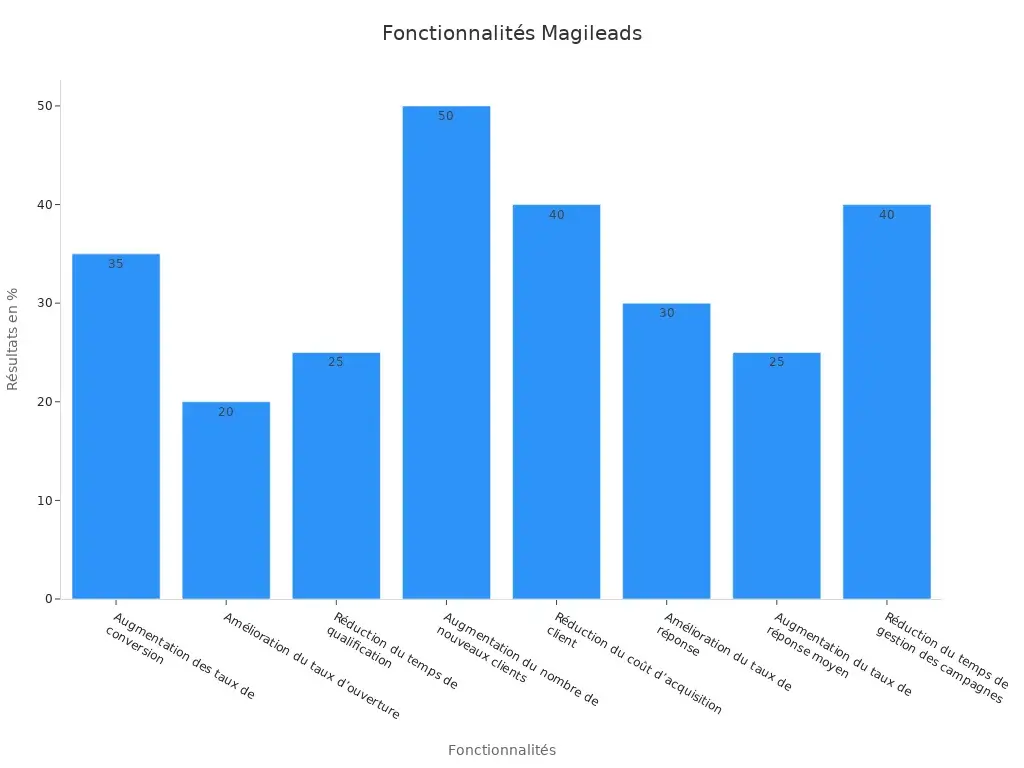
These features allow you to better understand your prospects and adapt your strategies to their needs. This enables you to obtain measurable results that boost your sales effectiveness.
Automate without losing personalization
Automating prospecting processes doesn't mean sacrificing personalization. Magileads combines technology and a human touch to ensure relevant interactions with your prospects.
Indicator | Description |
|---|---|
Conversion rate | Prospect conversion |
Open rate | Initial interest in emails |
Click-through rate | Level of commitment |
KING | Campaign profitability |
Customer satisfaction | Long-term impact |
These metrics allow you to measure the effectiveness of your campaigns while maintaining a personalized approach. For example, by analyzing open and click-through rates, you can identify the content that captures your prospects' attention. This enables you to tailor your messaging to meet their specific needs.
With Magileads, you automate repetitive tasks while maintaining a human touch in your interactions. This combination improves customer satisfaction and strengthens brand loyalty.
Integration with prospecting channels: email, LinkedIn, telephone
Multichannel integration is essential to maximizing the effectiveness of your sales prospecting. By combining channels like email, LinkedIn, and phone, you create a cohesive strategy that strengthens trust and engagement with prospects .
A campaign combining these three channels achieved an overall response rate of 20% .
Two qualified appointments were obtained out of ten prospects contacted.
Using multiple channels maintains constant and consistent communication, thereby increasing conversion opportunities.
For example, you can send an email to introduce your services, then follow up via LinkedIn with a personalized message. Finally, a phone call can finalize the interaction by answering the prospect's specific questions. This multichannel approach allows you to multiply touchpoints and tailor your message to each prospect's preferences.
💡 Tip : Analyze the performance of each channel to identify the one that generates the most responses and adjust your strategy accordingly.
Real-time performance monitoring and analysis
Real-time tracking significantly improves your lead generation strategy. Instant reports allow you to quickly identify what's working and what needs adjusting.
Real-time reports reveal hidden opportunities.
They facilitate the alignment of efforts between your sales and marketing teams.
A rigorous analysis helps to anticipate the adjustments needed to optimize your campaigns.
For example, if you notice that a specific email generates a high open rate, you can replicate its style in your future campaigns. Conversely, a low response rate on LinkedIn may indicate the need to review your approach or message.
📊 Interesting fact : Companies using real-time tracking tools see a 25% increase in their sales efficiency.
Concrete use cases with Magileads
Magileads delivers impressive results thanks to its advanced features. Here are some concrete examples of its effectiveness:
Use Cases | Additional details | |
|---|---|---|
B2B sales prospecting agency | +35 % | Customizing tools and automating campaigns |
B2B company | +30 % | Multichannel acquisition scenarios |
B2B service company | +35 % | 20% improvement in email open rates |
Digital marketing agency | +50 % | 40% reduction in customer acquisition cost |

These results demonstrate that Magileads can transform your prospecting efforts into measurable successes. By automating your campaigns while maintaining personalization, you achieve higher conversion rates and reduce your acquisition costs.
💡 Tip : Test different multichannel acquisition scenarios to identify the one that works best for your industry.
Sales leads are at the heart of your company's growth. A well-defined strategy helps you maximize their potential. By qualifying your leads and using the right tools, you improve your results.
Conversion rate : Measure success by comparing leads generated and converted.
Revenue generated per lead : Evaluate the quality of leads based on the revenue obtained.
Net profitability per lead : Analyze the net value after deducting acquisition costs.
Average revenue per sale : Optimize your sales strategies to increase your profits.
Investing in efficient processes ensures optimal management and increased profitability.
Sales manager in the B2B sector
“Before Magileads, our prospecting was manual, time-consuming, and inefficient. Since using the platform, we've structured our multichannel campaigns and quickly identified the right contacts. In three months, we've tripled our number of qualified leads while reducing our acquisition costs. The real advantage? Intelligent automation without any loss of personalization.”
– Camille D., Sales Manager at Axion B2B
FAQ
What is a qualified sales lead?
A qualified sales lead is a contact who has shown a clear interest in your products or services. They are your ideal customer and are ready to engage in sales discussions. You can prioritize them to maximize your chances of conversion.
How can I generate quality leads?
Utilize strategies like SEO, social media, and optimized landing pages. Attend industry events for direct interaction. These methods attract qualified leads and increase your conversion rates.
💡 Tip : Create educational content to meet the needs of your prospects.
Why is it important to segment your leads?
Segmentation helps you target the most promising prospects. You personalize your messages and improve your conversion rates. It also reduces the costs associated with ineffective campaigns and optimizes your sales efforts.
What tools should you use to manage your leads?
CRM tools like HubSpot or Salesforce centralize your data and analyze your interactions. Software like Magileads automates your campaigns while maintaining personalization. These solutions increase your efficiency and results.
How long does it take to convert a lead?
The timeframe varies depending on the type of lead. An MQL may require several weeks of nurturing before becoming an SQL. On average, converting a qualified lead takes 30 days.
📈 Interesting fact : Effective nurturing reduces this delay and improves your results.