Discover the 7 key advantages of SaaS software for B2B businesses. Transform your business with these modern and efficient solutions.
In today's ever-evolving business world, companies are seeking innovative solutions to boost their productivity. This is where SaaS (Software as a Service) comes in. It offers undeniable advantages for businesses of all sizes and across all sectors. By adopting SaaS , companies can revolutionize how they manage their operations and achieve their goals.
So, what makes SaaS software so attractive to businesses? Here are 7 key advantages that will propel your business to success.
1 – Cost reduction
The transition to SaaS software offers a significant advantage to businesses through cost reduction . Here are the reasons why opting for SaaS software can help you save money:
- Lower initial costs: Businesses don't need to purchase servers, licensed software, or expensive hardware to operate SaaS software. They can access the necessary software via the cloud, using only an internet connection.
- No additional maintenance fees: Maintenance fees are usually included in the SaaS subscription.
- No hidden fees: The costs of software updates, security patches, enhancements, and new features are included in the monthly or annual subscription. This allows businesses to have a clear view of their software costs and avoid unexpected hidden expenses.
- No hardware upgrade costs: Because SaaS software is hosted in the cloud, businesses don't need to upgrade their hardware to meet software requirements. SaaS software can be easily run on common computers and mobile devices.
SaaS software allows businesses to access advanced software features at a reduced cost. It offers users greater flexibility and better cost predictability , enabling businesses to focus on other core areas of their operations.
2 – Ease of use
SaaS software stands out for its ease of use, a major advantage for businesses. It offers immediate accessibility via a user-friendly web interface. Users can log in quickly and start working without the need for complex installation . All they need is a web browser and a login to access the features.
But there are other reasons why these programs are beneficial. Here are a few examples:
- Intuitive interface: SaaS software is designed with a focus on user experience. Its interface is intuitive, with clear menus, self-explanatory icons, and simplified navigation. Users can easily find the features they need and perform their tasks without difficulty.
- Minimum training required: SaaS software differs from traditional software, which often requires extensive training. SaaS is designed to be user-friendly from the outset. It significantly reduces the time and effort required to train users. New employees can quickly become familiar with the features.
- Support and assistance: SaaS providers offer customer support and online resources to assist users. Tutorials, user guides, and FAQs are often available. This allows users to resolve issues and maximize their productivity.
READ ALSO: What is Nudge Marketing >>
3 – Regular updates
SaaS software offers regular updates, a crucial aspect for businesses seeking optimal security and . With this model, SaaS providers proactively manage updates, freeing users from the tedious task of manual installation.
Regularly updating SaaS software offers numerous advantages. First, it ensures data and system security by incorporating the latest advancements in cybersecurity . SaaS providers implement stringent security measures, such as firewalls, intrusion detection systems, and encryption protocols, to prevent potential vulnerabilities.
Furthermore, regular and automatic updates improve software performance. SaaS providers constantly optimize their applications, fix bugs , enhance features , and introduce new improvements . This results in a smoother user experience and improved functionality for users.

4 – Remote Accessibility
Remote accessibility is one of the advantages offered by SaaS software. It allows employees to work flexibly and efficiently, wherever they are. The software is accessible via a simple internet connection from any computer or mobile device. This eliminates constraints related to the geographical location of the account.
This remote accessibility offers a multitude of advantages to businesses. First, it boosts productivity by allowing employees to work outside the traditional office. Whether they are at home , traveling , or in remote branches, employees can access SaaS software. They can continue to perform their operational tasks efficiently. This translates into greater flexibility, reduced travel, and better time management .
Furthermore, teams can work on the same projects in real time . They can share information and collaborate without being limited by geographical barriers. This helps improve internal communication and coordination.
5 – Flexible scalability
SaaS software is characterized by its scalability, offering businesses the flexibility they need to adapt to growth and evolving needs. This scalability allows companies to easily add new users to their SaaS system as they expand. Creating new accounts and granting employees the necessary access takes just a few clicks. Similarly, companies can quickly delete accounts for users who are no longer part of their workforce, avoiding the expense of paying for unused licenses.
Furthermore, SaaS software allows for adjustments to functionalities based on evolving business needs. Companies can choose from a range of available features multilingual management or currency management capabilities to meet these new needs.
6 – Ease of integration
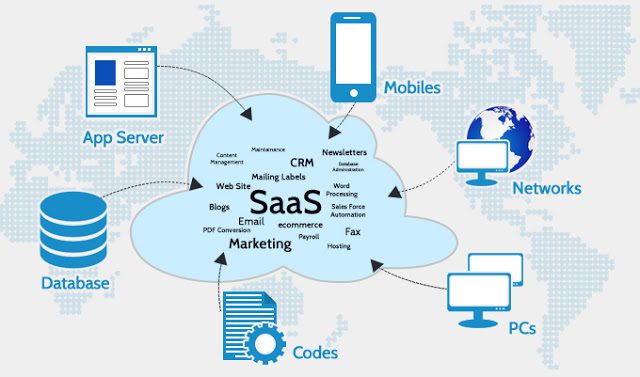
SaaS software can easily integrate with other tools already used within a company. This interconnectivity improves overall operational efficiency. These software solutions are compatible with various existing platforms and systems. They can also be connected to CRM (Customer Relationship Management) or marketing automation seamless sharing of data and information between different platforms.
Furthermore, SaaS software integration centralizes data and eliminates information silos. Relevant information is synchronized and shared across systems, facilitating data access and informed decision- . For example, integrating SaaS project management software with an internal communication tool enables seamless , real-time collaboration among team members. This significantly improves coordination and productivity across different teams working on the same project.
7 – Data Security
Data security is a major concern for all businesses, and SaaS software addresses this need by offering advanced security measures . SaaS providers implement rigorous security protocols to protect user data.
First, SaaS software uses encryption techniques to ensure data confidentiality . Sensitive information and personal data are encrypted during transmission and securely stored in highly protected data centers. This significantly reduces the risk of data leaks or breaches.
In addition, SaaS providers implement physical and logical security measures to protect servers and infrastructure. These measures include firewalls , intrusion detection systems , and strict access policies to prevent unauthorized access.