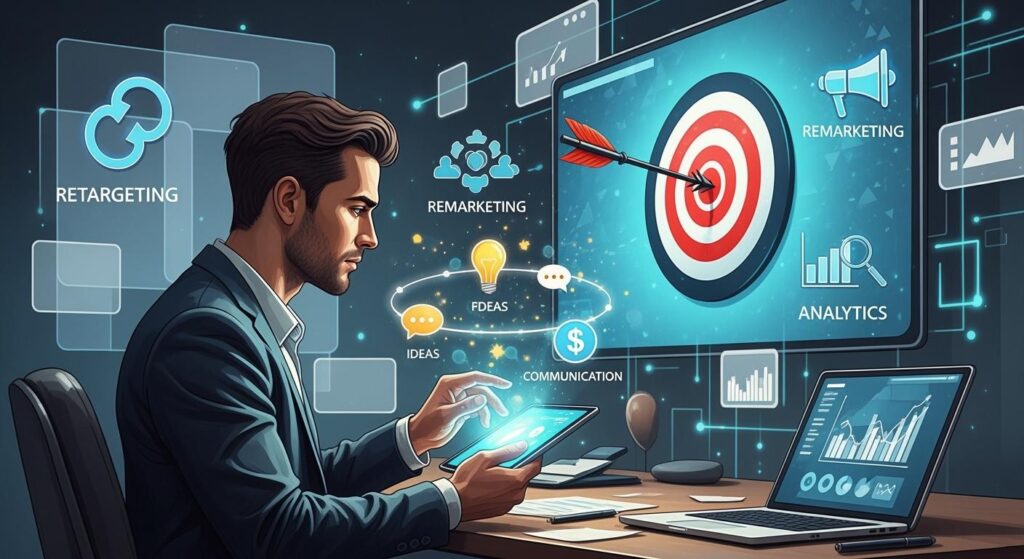
Looking to boost your conversions and reduce cart abandonment? More than 7 out of 10 customers leave their cart without making a purchase, according to the Baymard Institute. Retargeting and remarketing allow you to remind customers of your brand, increase brand recall, and improve ROI by targeting visitors who have already shown interest.
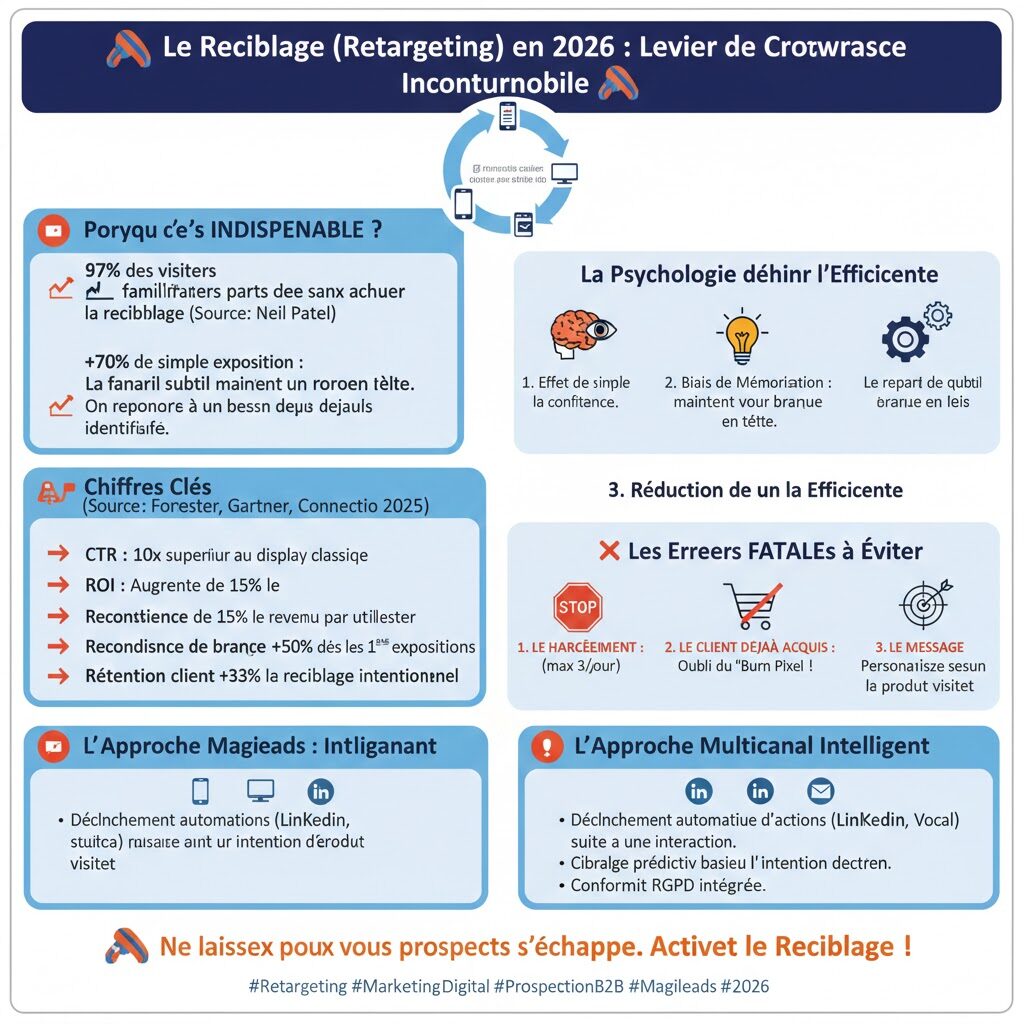
Did you know that 97% of internet users leave a website on their first visit without making a purchase or filling out a form? Without a retargeting (or remarketing ) strategy, these prospects are probably lost forever.
Retargeting is not just an advertising technique; it's the safety net of your conversion funnel.
Expert opinion: Why retargeting and remarketing have become essential
In the saturated digital ecosystem of 2026, attention has become the rarest currency. Retargeting is no longer a technical option; it's a psychological response to the radical evolution of the customer journey.
What opinion leaders are saying
To establish the credibility of your strategy, you need to examine the analyses of the world's leading strategists:
“Modern marketing is no longer about 'finding' customers, but about being present throughout their decision-making process. Retargeting is the thread that guides the prospect through the labyrinth of their own indecision.” — Ann Handley , Chief Content Officer at MarketingProfs.
For his part, Rand Fishkin , founder of SparkToro, highlights a paradigm shift: “The era of one-click conversion is over. Today, a brand needs 7 to 12 touchpoints to become a trusted option in the consumer's mind.”
Changing consumer behavior: The era of “fragmented buying”
Online shopping trends have undergone a profound transformation. According to a Gartner study (2025) , the average B2B consumer now consults more than 10 different sources of information before contacting a salesperson.
Information overload: Faced with an excess of information, the human brain uses the "familiarity bias." We tend to trust what we have already seen.
Multi-device: A user starts their search on mobile in the morning, compares options on desktop at midday, and makes their decision in the evening on their tablet. Retargeting is the only technology capable of linking these moments in their life to offer a seamless experience.
Market Data and Trends 2026 on Retargeting and Remarketing
A recent analysis by Forrester Research indicates that companies using personalized retargeting based on intent (and not just visit) see their customer retention rate jump by 33% .
Consumer Trend | Impact on Retargeting |
Search for social proof | Retargeting should include customer testimonials to reassure them. |
Price sensitivity | Dynamic retargeting allows for the display of comparative offers in real time. |
Relevance requirement | 74% of buyers feel frustrated by advertisements that do not match their stage in the buying cycle. |
Magileads' expertise: Retargeting, predictive remarketing
Magileads' marketing automation solutions , you're not just tracking your visitors. You're analyzing their behavior to retarget only those with a high "intent score." It's the end of wasted advertising and the beginning of surgically precise results.
Statistics and Scientific Evidence (Trust & Expertise)
Retargeting and remarketing rely on proven psychological mechanisms, such as the mere-exposure effect . The more an individual is exposed to a brand, the more they develop a preference for it.
Click-through rate (CTR): According to a study by Connectio , the CTR of retargeting ads is on average 10 times higher than that of classic display ads ( 0.70% versus 0.07% ).
ROI: Academic research published in the Journal of Marketing Research demonstrates that personalized retargeting increases revenue per user by an average of 15% by reducing cognitive friction.
Brand memory: Retargeting improves brand recognition by 50% from the very first exposures.
Case Study: The Success Story of the “EcoDrive” Company
The Problem: 85% cart abandonment rate . Users compared prices and never returned.
The Solution: They set up a dynamic retargeting on LinkedIn and Facebook via Magileads, offering not a discount, but a free guide: “5 tips to optimize your electric journeys” .
The Results:
Recovery of abandoned bookings: 22% of users who received the guide returned to finalize their booking.
Cost per acquisition (CPA): Reduced by 40% thanks to ultra-precise targeting of “warm” audiences.
The 5 Common Retargeting/Remarketing Mistakes to Avoid (Value Added)
To be successful, retargeting and remarketing must be subtle. Here's what you absolutely must not do:
Advertising “Harassment” (Over-frequency): Don't set too high a repetition limit. Beyond 3 exposures per day, the feeling of intrusion overrides any interest.
The absence of a "burn-in pixel": This is the most annoying mistake. Don't continue to show an ad for a product the user has already purchased .
Unique creation: Don't show the same banner for 3 months. Vary the visuals to avoid "ad fatigue".
Ignoring GDPR: In 2026, trust is key. Ensure your tracking pixels only activate after explicit consent.
A message that's too generic: The prospect saw a specific product? Show them that product, not your website's homepage.
Retargeting, remarketing and B2B prospecting: The contribution of Magileads
In a complex sales strategy, retargeting is not limited to banner ads. With Magileads , you can practice “Multichannel Retargeting” .
Scenario: A prospect clicks on a link in your prospecting email but does not reply.
Magileads Action: The software detects this interaction and automatically triggers a personalized invitation on LinkedIn or a specific advertisement displayed on their news feed.
Benefit: You stay top of mind with the decision-maker without being intrusive, using marketing automation features to maintain a consistent presence.
Conclusion: Retargeting and remarketing, the engine of your growth
Integrating retargeting means accepting that the buyer's journey is not linear. By offering your visitors a second chance, you optimize every euro invested in your traffic acquisition.
Key points on retargeting and remarketing
Retargeting and remarketing help remind visitors what they liked, thus increasing the chances of conversion.
This strategy reduces shopping cart abandonment by encouraging customers to complete their purchases with targeted advertising.
Using tools like Magileads can improve your campaign results by ensuring GDPR compliance and optimizing targeting.
Retargeting, remarketing: definitions and differences
How advertising retargeting works
Retargeting and remarketing rely on a simple yet powerful technology. When you visit a website, a small file called a cookie is saved on your device. This cookie allows the website to track your browsing behavior. Here's how it works:
A conversion pixel placed on the site triggers the recording of a cookie as soon as you arrive on a page.
The collected data is sent to advertising networks.
You then see targeted ads on other sites or apps, even if you are no longer on the original site.
The goal is to remind you of the offer or product you viewed and encourage you to come back to complete your purchase.
For example, if you added a jacket to your cart but didn't complete the purchase, you might see a banner ad for the same jacket on another website. Sometimes, an offer like free shipping will appear to entice you to come back.
Differences between retargeting and remarketing
There are important differences between retargeting and remarketing. You can remember them like this:
Retargeting advertising targets users who have visited a website or viewed a product, by displaying ads on partner sites or social networks.
Remarketing primarily uses email to re-engage people who have already interacted with the brand, such as after an abandoned shopping cart.
Retargeting aims for a broad visual impact, while remarketing offers a more personalized message.
Kind | Main Channel | Objective | Example of use |
|---|---|---|---|
Retargeting | Display, social networks | Recall a viewed offer | Banner on a partner website |
Remarketing | Restart an action | Abandoned cart email |
Retargeting and remarketing therefore allow you to adapt your strategy according to the behavior of your visitors and the most effective channel.
Advantages and limitations of retargeting/remarketing
Why integrate retargeting/remarketing into your marketing strategy
Do you want your visitors to remember your brand and take action? Retargeting and remarketing help you turn interest into conversion. You remind your visitors what they liked about your site. You reduce cart abandonment and encourage repeat purchases. Here's why you should implement this strategy:
You increase your brand awareness. Users see your logo and products multiple times.
You convert interest into a purchase. Hesitant visitors are more likely to return.
You reduce cart abandonment. Reminders encourage customers to complete their orders.
You encourage loyalty. After a purchase, you suggest complementary products.
A study shows that the click-through rate on retargeting ads is 10 times higher than that of traditional ads. This proves that you get a better return on investment.
Concrete benefits of retargeting/remarketing for businesses
When you use retargeting/remarketing, you see fast and measurable results. Businesses often see:
An increase in the conversion rate.
An improvement in marketing return on investment.
Enhanced customer loyalty.
More precise targeting of internet users.
Nine out of ten managers use dynamic retargeting to drive purchases. By improving your campaigns, you can increase your ROI by 10%. Retargeting keeps your brand top of mind for users. You remind them of their interest in your products. After a purchase, you can suggest complementary items to strengthen loyalty.
Advantage | Impact on your business |
|---|---|
Guaranteed reputation | Your brand remains visible |
Increased conversion | More visitors become customers |
Reduced shopping cart abandonment | Fewer lost sales |
Enhanced customer loyalty | Customers return more often |
Limitations and points of vigilance of retargeting/remarketing
Even though retargeting/remarketing offers many advantages, you must remain attentive to certain risks.
Advertising fatigue can set in if you show the same ad too often. Users may feel overwhelmed.
Respect for privacy is essential. The GDPR imposes strict rules. Fines can reach €20 million or 4% of global turnover.
An audit can disrupt your campaigns and harm your revenue.
The audience remains limited to people who have already interacted with your brand.
Here is a table that shows the effect of repeated advertisements :
Number of views | Perceived effect | Impact on the purchase |
|---|---|---|
1 to 3 | Incentive | Probability of purchase multiplied by 4 |
5 | Embarrassed | Advertising deemed intrusive |
10 | Rejection | Anger and damaged brand image |
To limit these drawbacks, you can:
Space out or reduce email sending to avoid saturation.
Segment your target audience to deliver useful and relevant messages.
Use tools that control the frequency of advertisements and respect commercial pressure.
Tip: Always monitor the frequency of your campaigns and adapt your messages based on your visitors' behavior. This will protect your reputation and respect your customers' privacy.
Implementing an effective retargeting/remarketing strategy

Key steps and best practices
To succeed with your retargeting strategy, you need to follow several essential steps. You start by defining your objectives: do you want to increase conversions or reduce cart abandonment? Then, you choose the appropriate platforms, such as Google Ads or social media, to reach interested prospects. You segment your audience according to specific criteria:
Areas of interest
browsing habits
Age and sex
Geographic location
Purchasing behavior
You personalize your messages for each segment. You select the most effective channels: display, email, social media. You analyze your campaign performance to adjust your strategy. Experts recommend using dynamic remarketing on Facebook and Google Ads to target visitors with relevant offers.
Tip: Precise targeting and message personalization increase conversion rates and loyalty.
Recommended tools and Magileads
In France, tools like Criteo , Google Ads Smart Bidding, and Adloop are widely used. Magileads stands out for its ability to track leads and automate multichannel prospecting. You can import contacts from LinkedIn or Google Maps and launch campaigns via email, SMS, or LinkedIn. Users report a 60% increase in conversions and a 40% reduction in the sales cycle. Magileads guarantees GDPR compliance: you obtain explicit consent, ensure traceability, and offer valuable content.
Tool | Main function | Result obtained |
|---|---|---|
Magileads | Automated prospecting | +60% conversions |
Criteo | Display retargeting | Large audience |
Google Ads | Smart Bidding | ROI optimization |
To discover how Magileads fits into your strategy, visit Magileads . You benefit from a complete, GDPR-compliant solution that optimizes advertising pressure and maximizes your results.
You discover that retargeting and remarketing are becoming essential for a successful marketing strategy.
You increase conversions through personalized ads.
You build customer loyalty.
Use Magileads to maximize your results and adapt to new consumer expectations.
Retargeting FAQ retargeting remarketing
How can I tell if retargeting/remarketing is working for my site?
You can track conversion rates, cost per acquisition, and return on investment. Use Google Analytics or your advertising platform's reports.
Does retargeting/remarketing respect user privacy?
Yes, if you comply with the GDPR. You must inform visitors, obtain their consent, and allow them to manage their cookie preferences.
How long should I run my retargeting/remarketing campaigns?
You can test different durations. Generally, an effective campaign lasts between 7 and 30 days after the first visit.
See also
How a Marketing Agency Can Increase Your Success
Tips to Improve Your Cold-Mailing Campaigns
Three Essential Elements of Multichannel Campaigns