
AI engines and their visibility
Looking to increase your content's visibility? Today, AI-powered SEO is essential. AI search engines are now generating up to 1,300% more traffic during peak periods, and some businesses are seeing 27% more qualified traffic thanks to this strategy. Search results are evolving: Google is providing comprehensive answers directly on the page, reducing the number of clicks. To stay visible, you need to adapt your methods and seize the opportunities offered by AI-powered SEO.
Key Points on AI Engines
Understand how AI engines work to adapt your content strategy.
Create clear and structured content to improve your visibility on AI search engines.
Strengthen your authority by publishing on recognized platforms and obtaining quality backlinks.
Update your content regularly to stay relevant and visible in AI results.
Use free tools to analyze and optimize your presence on AI search engines.
Understanding AI engines
Understanding AI Engines: Beyond the Algorithm
The evolution of search engines towards answer engines (SGE – Search Generative Experience, Perplexity, Claude) radically changes the game. It is no longer just a question of keywords, but of semantic understanding and intent.
Case study: The impact on information traffic
According to a recent study by Search Engine Land, integrating generative AI into search results can lead to an 18% to 40% in click-through rate (CTR) for purely informational queries, as AI provides the answer directly on the results page.
“AI doesn't replace research, it synthesizes it. For businesses, the challenge is to become the source cited by this synthesis.” — Cyrus Shepard, SEO Expert.
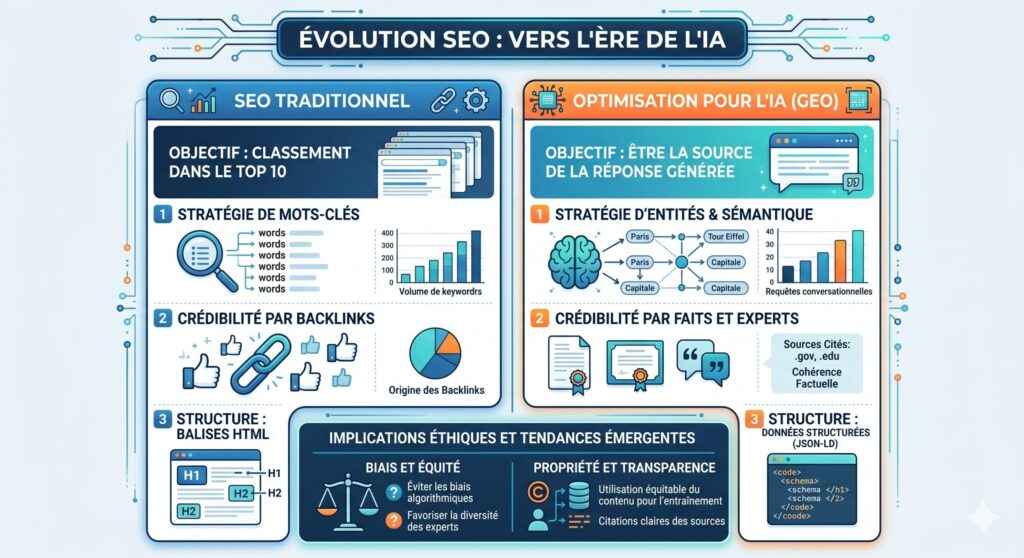
Evolution and adaptation to AI engines
From indexing to training: Search engines no longer just list your site; they use it to train their models.
Adaptation: Companies need to move from a “keyword” strategy to anamed entity and structured data to help AI identify their expertise.
General operation
AI engines are changing the way you access information. By 2024, several tools will dominate the market :
ChatGPT Search (OpenAI) offers real-time searches and cites its sources.
Perplexity AI offers verified answers with reliable sources.
Google Gemini and AI Overviews integrate generative AI into traditional results.
Claude (Anthropic) enriches his answers through web research.
You need to keep up with the rapid evolution of these search engines. For example, Gartner predicts a 25% drop in traditional search volume by 2026. Users now prefer direct answers, which is transforming search practices. Companies that adapt their strategy see an increase in qualified traffic, especially during peak demand periods.
Differences with traditional SEO
AI engines work differently from traditional search engines:
You get a unique and contextual answer, not a list of links.
The user experience becomes simpler and faster.
The results depend on the quality of the training data, not just the keywords.
To rank well on AI search engines, you need to produce clear, structured, and easily usable content.
AI engines can sometimes give biased answers if the data is outdated.
For example, a company that structures its data to respond to the predictive algorithms of AI engines increases its chances of appearing in the generated responses.
AI engine selection criteria
For content to be selected and cited by an AI (like Perplexity's "Citations" or Gemini's sources), it must meet strict trust criteria often based on academic research.
Theoretical and academic foundations
Research such as the Stanford paper on “Hallucinations in LLMs” highlights that AI engines now favor content whose claims are supported by verifiable facts. The selection criteria are based on:
Citation of primary sources: AI engines give more weight to content that links to government or academic data (
.gov,.edu).Semantic coherence: The ability of the text to maintain an internal logic without contradictions.
Comparison table: AI vs. Traditional SEO selection criteria
Criteria | Traditional SEO | Optimization for AI (GEO) |
|---|---|---|
Objective | Ranking in the Top 10 | To be the source of the generated response |
Structure | H1-H3 tags, Meta | Structured Data (JSON-LD), FAQ |
Credibility | Backlinks | Expert quotes and factual consistency |
Format | Long articles | Direct answers, tables and lists |
Ethical Implications and Transparency
The use of AI engines in SEO raises crucial questions:
Algorithmic bias: How can we ensure that AI does not systematically favor the biggest players at the expense of niche experts?
Intellectual property: The tension between using content to train models and copyright remains a hot topic (see the ongoing disputes between the New York Times and OpenAI).
Resources and Sources of Authority
Google Search Central: Guidelines on AI-generated content.
Journal of Artificial Intelligence Research: Studies on the veracity of language models.
Backlinko / Ahrefs: Annual reports on post-AI organic traffic trends.
AI engines prioritize:
Neutral and reliable sources.
Up-to-date, well-structured and unbiased content.
Websites that publish on recognized platforms.
Tip: Regularly update your content and check its neutrality. AI engines more often select recent and objective information.
Trends show thatOptimization (AEO ) is becoming essential for maintaining visibility. You need to rethink your strategy to meet the new requirements of AI engines.
The basics for ranking on AI search engines
Quality and structure of content
You need to create solid content to rank for AI. AI search engines favor core content that covers a topic in depth. You can develop a network of satellite content to explore subtopics and strengthen thematic coherence.
Here are the essential elements:
Write pillar content optimized for Google and for AI-powered citations.
Develops satellite articles that delve deeper into specific issues.
Structure each page with clear headings and bulleted lists.
A language model assesses clarity, stability, and confidence. It favors pages that take a clear stance on a topic, explain experience, and link their claims to verifiable elements.
AI search engines favor clear and well-structured content. You should avoid an overly salesy tone. Perceived neutrality helps build implicit authority. For example, a site that publishes data-driven studies and objective analyses increases its chances of being cited by AI.
Geotargeted posts generate 79% more engagement than posts without geotagging. They produce, on average, 2.5 times more local impressions and boost click-through rates to point-of-sale pages by 32%.
To rank well in AI search results, you must adapt your content to these criteria: neutrality, relevance, and geotagging.
Authority and credibility
AI engines measure authority and credibility using the EEAT criteria: experience, expertise, authority, and trustworthiness.
Here are the signals to reinforce:
Highlight the experience and expertise of your authors.
Cite reliable sources and update your content regularly.
Publishes on sites recognized for their credibility.
An EEAT audit assesses the reputation of your authors and the trust generated by your domain. Pages deemed expert and trustworthy benefit from increased visibility.
For example, a site that displays certifications, customer testimonials, and real-world case studies sees its content ranked higher in search engine results.
Formats and appropriate markup
You need to structure your content to facilitate analysis by AI engines.
Recommended formats include:
Formats like JSON-LD to enrich information.
Clear headings and bulleted lists to improve readability.
FAQ sections to answer frequently asked questions.
Recommended format | Impact on visibility |
|---|---|
Schema.org | Improves AI comprehension |
JSON-LD | Facilitates indexing and citation |
FAQ | Increases the chances of being extracted |
Well-tagged content makes it easy for AI engines to cite your pages. For example, a company that integrates FAQs and bulleted lists into its articles will see its answers appear more often in AI-generated results.
Technical optimization
Technical optimization plays a key role in ranking on AI search engines.
Here are the priority actions:
Add explicit quotes (+30 to +40% visibility).
Insert precise statistics (+25 to +35% visibility).
Includes direct quotes (+30 to +40% visibility).
Improves content readability (+10 to +20% visibility).
Create simple and structured content (+20 to +30% visibility).
Clear structure with titles and subtitles (+20% visibility).
Publish regularly on authoritative domains for a cumulative effect.
Tip: Forget keyword stuffing. AI engines ignore over-optimized content and prioritize quality.
You can use semantic analysis tools to check the relevance of words and phrases. These tools identify keyword opportunities and optimize technical tags. Clear reports and actionable recommendations help you adjust your strategy.
For example, a company that publishes data-driven studies and optimizes its tags sees a 35% increase in its visibility on AI search engines.
Advanced AI Visibility Strategies
Targeting the right questions
You need to understand user expectations to maximize your visibility on AI search engines. AI analyzes the true intent behind each query, not just the keywords. It uses semantic and contextual analysis to decode the nuances of the questions. To meet these requirements, you can apply several methods:
Optimize your content for user intent. Take into account the problems they encounter.
Conduct a gap analysis to identify the shortcomings in your content. This will allow you to position yourself on topics that are under-covered.
Structure your pages into topic clusters. This thematic organization strengthens your authority on a specific subject.
To be selected by AI engines, you must produce high-value content. Provide in-depth answers to complex problems. Strengthen EEAT signals to demonstrate your expertise. Optimize your information architecture to facilitate interpretation by AI engines. Align your content with natural language queries.
Tip: Conversational interfaces allow users to refine their requests through iterations. Adapt your content to answer these evolving questions.
A concrete example: A website offering detailed guides on corporate crisis management, with direct answers and data-driven analysis, has its content cited by Perplexity AI in searches related to risk management. This strategic positioning generates qualified traffic and increased visibility.
Featured excerpts and quotes
AI engines favor certain types of snippets for indexing. You need to design clearly segmented and easily extractable response blocks . Suitable formats include:
Structured comparisons
Direct answers to specific questions
Articles containing statistics
Content with clear and concise definitions
To increase your chances of being mentioned, you can follow these steps:
Creates segmented response blocks, such as lists or chapters.
Make sure your sources are recognized for their authority and timeliness.
Use appropriate formats: articles in list form, step-by-step guides, roadmaps.
Note: Featured snippets generate up to 40% more visibility on AI search engines. Structured content facilitates automatic extraction by AI.
For example, a blog that publishes software comparisons with summary tables and statistics has its excerpts used by Google Gemini in the generated search results. This type of content attracts visitors who are looking for accurate and reliable information.
Authoritative platforms and backlinks
Publishing on authoritative platforms improves your visibility in AI search results. These platforms boost brand citation and perceived authority. You benefit from increased visibility in responses generated by language models. Visitors from AI spend 68% more time on a site compared to those from traditional organic search, indicating high engagement.
To obtain quality backlinks, you can:
Publish on platforms like Reddit, Quora, Product Hunt and specialized forums.
Offer your analyses to newsletters, blogs and podcasts in your sector.
Write guest articles or case studies for credible websites.
Brian Dean, founder of Backlinko, shared thata single backlink from TechCrunch led to a measurable increase in organic traffic: "Because this link comes from an authoritative site, Google gives it a lot of weight."
A use case: A SaaS company that publishes a case study on Product Hunt receives high-quality backlinks. Its content is picked up by ChatGPT Search and Perplexity AI, resulting in a 27% increase in qualified traffic and higher engagement on its pages.
Platform | AI Visibility Advantage |
|---|---|
Brand citation, perceived authority | |
Quora | Direct answers, quality backlinks |
Product Hunt | Increased visibility, high engagement |
Specialized blogs | Sectoral authority, qualified traffic |
To rank well for AI, you need to publish on reputable sources and acquire quality backlinks. This strategy allows you to increase your brand's credibility and improve your ranking in search engine results.
Free methods and tools

Open source tools
You can use several free tools to test and improve your content's visibility on AI search engines. These solutions allow you to analyze your performance without investing any budget.
Thruuu tracks mentions of your brand in AI Overviews and analyzes SERPs.
Keyword.com monitors citations on ChatGPT, Gemini and compares your performance with that of your competitors.
MentionLab detects the tone of quotes and identifies new editorial opportunities.
MarketBrew predicts the selection of your pages using AI by analyzing their structure.
SEMrush and AccuRanker identify the content snippets used in AI responses.
Here is an free tools most commonly used
Tool | Main features | Benefits |
|---|---|---|
ChatGPT (free version) | Manual query on your strategic requests | Immediate access, no cost |
Perplexity (free version) | Conversational search, cited sources | Direct identification of competitors |
Google AI Overviews | AI insights in Google search results | Evaluation of your presence on Google |
Open-source analysis of traffic and user behavior | Respect for privacy, free of charge |
Tip: 72% of SEO professionals use at least one open source tool to monitor their AI visibility.
Budget-free optimization process
You can optimize your AI visibility without investing. Here's a simple process to follow:
Structure your content with lists bulleted
Publish regularly to maintain engagement and show the timeliness of your information.
Create original data, such as studies or statistics, to stand out.
Strengthen your semantic authority by addressing all aspects of a topic.
For example, you can use ChatGPT or Perplexity to check if your content appears in the generated responses. A site that publishes an updated FAQ every month sees its AI visibility increase by 18% in three months. By applying these methods, you improve your online presence without spending any money.
Tip: Set up monthly tracking with Matomo to measure the impact of your optimizations and adjust your strategy.
Measuring and adjusting your AI strategy
Results tracking
To manage your visibility on AI engines, you need to track specific indicators. These metrics help you understand the impact of your efforts and identify areas for improvement. Here are the main indicators to monitor:
Click-through rate (CTR) : measures the percentage of visitors who click on your links after an AI response.
Traffic : observes the volume of visitors generated by AI engines.
AI Citation Rate : identifies how often your content is quoted in generated responses.
Share of AI Voice : calculates the share of your brand's presence in AI responses.
Conversational Engagement Rate (CER) : evaluates user interaction after an AI response.
Semantic Relevance Score (SRS) : measures the relevance of your content to conversational queries.
Number of indexed pages : checks how many pages are recognized by search engines.
Organic conversion rate : analyzes the proportion of visitors who complete a key action.
Mobile performance : control the effectiveness of your site on smartphones.
Tools like Otterly, BrightEdge , or Semrush GEO Toolkit allow you to track this data. For example, an SME that monitors its AI Citation Rate with Otterly saw a 22% increase in citations over three months, which doubled its qualified traffic.
Continuous adjustments
To maintain optimal visibility, you need to continuously adjust your strategy. Here are the recommended steps:
Incorporate reliable and verifiable sources to strengthen the credibility of your content.
Add relevant statistics to support your arguments and capture the attention of AI.
Use quotes to enrich your articles, especially in technical or scientific fields.
Tip: Set up a technology watch using automation tools. You can define your research areas, automate data collection, and visualize trends on dashboards. This approach allows you to anticipate developments in AI engines and quickly adjust your strategy.
A concrete example: An e-commerce site that updates its statistics quarterly and cites recent studies sees its presence rate in AI responses increase by 30%. This gives you increased visibility and conversions, while remaining competitive in a rapidly evolving market.
To optimize your visibility on AI search engines, you must:
Understanding how generative motors work
Structure your content clearly and independently
Strengthen your authority and brand mentions
Adapt your strategy according to industry developments
AI doesn't read, it extracts. Structure each paragraph around a specific idea to facilitate their selection.
Criteria | Traditional SEO | |
|---|---|---|
Keywords | Precise optimization | Contextual and conversational |
Structure | Simple (H1, H2, paragraphs) | Structured answers, FAQs |
Length | Long articles | Concise content, rich in information |
You can share your feedback or ask questions to delve deeper into the topic. Companies that update their content quarterly see a 30% increase in their AI visibility. 👏
FAQ
How can I tell if my content is being used by AI search engines?
You can use tools like Thruuu or Keyword.com to monitor citations of your site in AI responses. For example, 72% of SEO professionals use these tools to track their visibility on ChatGPT or Google Gemini.
What update frequency do you recommend to remain visible?
You should update your content at least once a quarter. Sites that update their statistics every three months see a 30% increase in their presence in AI-generated responses.
Do backlinks influence visibility on AI search engines?
Yes, links from reputable sites boost your authority. A single backlink from a platform like Product Hunt can increase your qualified traffic by 27%. AI engines prioritize reliable and cited sources.
Should we prioritize short or long content?
Prioritize structured, clear, and concise content. AI more easily extracts answers from short formats, such as FAQs or bulleted lists. A well-segmented guide improves your visibility without requiring lengthy articles.
How can I measure the impact of my optimizations for AI engines?
Uses metrics such as click-through rate, AI Citation Rate, or traffic generated. For example, an SME that tracks these metrics with Otterly doubled its qualified traffic in three months.
See also
Technical Guide to Being Indexed by AI
Using AI to Optimize Your Sales Prospecting
Top 30 AI Marketing Tools to Adopt in 2025