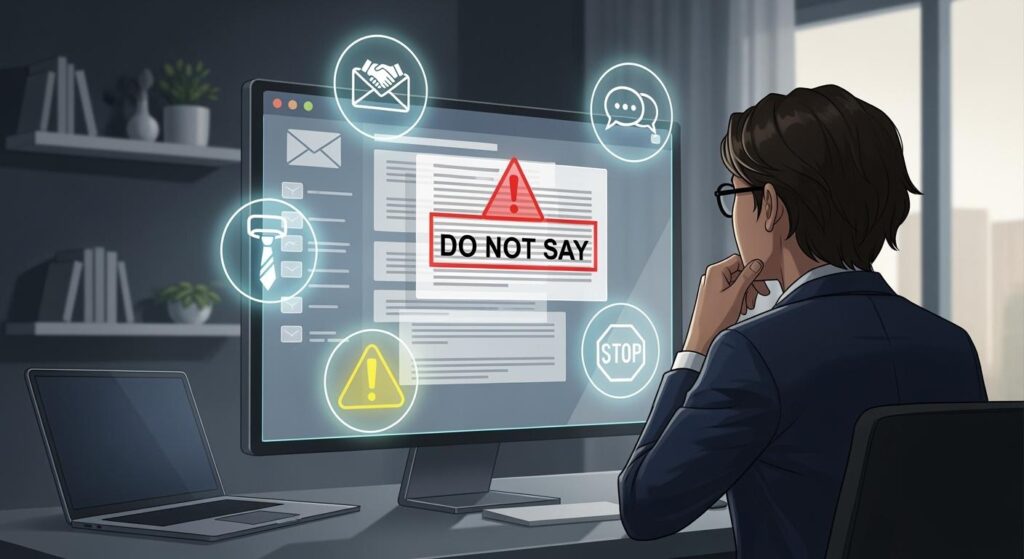
Have you ever received a flat-out "no" from your prospects? If so, did you remain inactive? Did you consider revising your prospecting strategy? Did you think about reviewing your sales pitch and reworking your approaches? If any of these questions resonate with you, you're probably on the right page.
These days, salespeople can no longer rely on sales techniques . Access to information has become easier, faster, and more comprehensive. Prospects are sometimes better informed than the salespeople themselves ! They ask much more precise questions, and their reasoning is all the more intelligent . Salespeople must accept this reality; they must change their approach to better convince prospects. This remains true even when a prospect rejects a proposal . It's essential to react appropriately, not give up, and find the right solution. In this article, we offer the best advice for overcoming prospect rejection.
3 mistakes that lead to potential customers rejecting their offers
If your prospect rejects your offer, there's a reason. Most of the time, it's because the salesperson doesn't understand their prospect's perspective. They don't grasp their client's real needs and prioritize their product or service. Sometimes, it's also due to salespeople not cultivating a transparent relationship with their prospects. Ultimately, you have to adapt to the evolving behavior of prospects , who have become better informed. Here are three mistakes to avoid to convert your prospects .
1 – Not targeting the right person
This is a common mistake in B2B prospecting . Salespeople are often poorly informed about their prospects. However, today, simply contacting them with a title and name is no longer sufficient. More detailed information , such as whether your contact is a decision-maker or not . By conducting your research, you simultaneously gather references, other names, rare information, and perhaps even the right person !
Also consider prospecting on LinkedIn . This professional network is a goldmine of potential clients . You can gather relevant information about your target audience there. But be careful! The contact you find must match the buyer persona for your product or service. This is a profile of your ideal customer based on market data, field interviews, and more. To learn more, see our article on this topic →
2 – Not proposing the right solutions
If you don't understand needs , how can you convince ? This also applies to companies with a negative reputation among their customers . These companies try to sell a solution that doesn't meet their prospects' expectations. For you, this would be a golden opportunity to differentiate yourself from the competition and avoid these ineffective tactics.
You need to sell people what they're looking for. This means your product or service must align with your prospect's needs. If your solution doesn't, it means it doesn't address the difficulties , challenges , and obstacles your prospect faces daily . It will be perceived as useless. Sometimes, simply revising how you present your product or service is enough: by stating the problem and demonstrating how your solution solves it. In fact, these days, we don't sell a product, but a solution. In other words, an action that makes the prospect's professional life easier and helps them achieve their goals.
3 – Not working on your online reputation
If you don't cultivate your brand awareness , your product or service will never be known . Worse still, your competitors will outclass you and capture all the market share . If your company also has a poor online reputation , the situation becomes critical. A product or service sold online without customer reviews is already less appealing to buyers. So, imagine you only have negative comments —how do you plan to turn things around? The answer is to work on your online reputation .
Remember to provide useful content to people. Inform them , share company news, or provide web updates that might interest them. You can also reach your audience on social media . Encourage them to engage and connect with you. The best marketing is to get others to do the work for you.
Let them build your brand awareness organically, without them even realizing it. If you choose social media, post regularly and maintain a consistent pace. Remember to also maintain your website and update your blog from time to time. This will also help your prospects get to know you. Finally, you can launch personalized email campaigns , whether targeting prospects or existing customers. Email marketing remains an essential tool , whether used for acquisition or retention.
READ ALSO: Our tips for writing effective emails
The recovery plan for a turnaround in the situation
Didn't close a sale? Don't panic, it's not over yet. This is when you need to think about the foolproof technique of follow-up . This technique is one of the strategic sales actions that shouldn't be overlooked. However, you need to know how to use it intelligently.
First of all, follow-up is an art, one that some salespeople haven't mastered. There are even salespeople who don't even try to follow up with a prospect after an initial refusal . This is very unpleasant for the company. Sales often involve encountering failure and rejection. If products sold themselves, we would n't need salespeople . That's why the real sale begins when the prospect says no!
But if you give up after the first refusal, you 're missing out on sales opportunities . The prospect might not be convinced yet. They might be testing you. Or they might be trying to gauge your limits, seeing how far you're willing to go. The possibilities are numerous . So now, let's see how to make a proper follow-up…
1 – When it is a conditional NO
After the initial rejection of a prospect, there's no guarantee they can't be won back. What you need to do is take a step back and think about a plan of attack . If necessary, you should revise your sales pitch and change your approach . You need to dig a little deeper; the prospect may have multiple needs . They're also facing several challenges , and you need to leverage at least one of them to trigger a purchase . You can send a follow-up email , getting straight to the point.
2 – When it is a categorical NO
When faced with a firm no or a definitive refusal , there's only one thing to think about: the future! Simply because losing a sale doesn't mean losing a future client . So, when you receive this kind of rejection, leave gracefully while thanking your prospect for their interest. Express your regret at not being able to work together . The goal is to create a sense of uncertainty and a touch of regret while leaving the door open for a future business relationship . Then, you can suggest another meeting maintaining a good relationship is crucial .