
In the age of artificial intelligence, you need to put trust at the heart of your SEO strategy. The Ultimate Guide to the Google EEAT Standard helps you understand how Google values real-world experience evidence and distinguishes human-generated content from AI-generated content.
EEAT is establishing itself as a pillar of effective organic search engine optimization in 2026.
You must prove the quality of the information, the legitimacy of the author, and the reliability of the site.
Trust is built through expert content, case studies , and consistent signals.
Discover how to strengthen each pillar to establish yourself on Google.
Key Points of the Google EEAT Standard
The EEAT standard is essential for SEO. It is based on Experience, Expertise, Authority, and Trustworthiness.
To gain Google's trust, prove your experience with real testimonials and case studies.
Use reliable and verifiable sources to strengthen the credibility of your content.
Get quality backlinks to improve your authority and visibility on Google.
Regularly update your content to meet Google EEAT standards to stay relevant and attract the attention of search engines.
What is the Google EEAT standard and why is it vital?
Want to understand why Google places the EEAT standard at the heart of its algorithm? This principle rests on four pillars: Experience, Expertise, Authority, and Trustworthiness. Each plays a key role in how Google assesses the quality and credibility of your content.
Tip: Think of your site as a shop window. The more you showcase your real-life experience, the more you inspire trust in your visitors and in Google.
The four pillars of the Google EEAT standard
Experience : You must prove that you have tested, experienced, or used what you are talking about. Google values concrete feedback, testimonials, and real-life examples.
Expertise : You demonstrate your competence on the subject. Articles written by specialists or validated by experts gain credibility.
Authority : You become a reference in your field. Other sites cite you, experts recommend you, and your content is shared.
Trust : You ensure security, accuracy, and transparency. Users must feel they can rely on your information.
Why is the Google EEAT standard vital for your SEO?
Do you want your site to rank highly in Google search results? The EEAT standard is essential. Here's why:
Better engagement : Users stay longer on your site, come back and share your articles.
Better search rankings: Google prioritizes reliable and useful content. Strong Google EEAT signals show that your content is authentic.
A stronger brand: Publishing reliable content positions you as an expert. You become a source of trust, not just another result.
More conversions: Trust encourages visitors to buy or subscribe to your services.
How the Google EEAT standard influences visibility on Google
To increase your site's visibility, you must answer your visitors' questions precisely. Google verifies that you demonstrate genuine expertise . Aligning search intent with Google's EEAT standards remains crucial. This reduces the user's comprehension effort and ensures long-term visibility.
Pages that comply with the EEAT standard better meet the expectations of potential customers.
An SEO-optimized article strictly adheres to these criteria .
Regularly updating your data strengthens your performance in the long term.
💡 The Ultimate Guide helps you understand how to apply these principles to every step of your Google EEAT SEO strategy. Use infographics, expert videos, and real-world examples to boost reader engagement.
In 2026, generic content won't cut it. You'll need to prove your value in every line. Google's EEAT standard transforms your site into an essential reference. The Ultimate Guide gives you all the keys to building that trust and dominating organic search.
Experience: Proof and credibility of the Google EEAT standard

Enhancing the user experience
Want to convince Google and your visitors of the value of your content? Highlight your real-life experience. Tell us how you used a product, tested a service, or solved a specific problem. For example, share the story of a client who overcame a challenge thanks to your advice. Describe the steps, the difficulties encountered, and the results achieved. This type of direct testimonial inspires confidence and shows that you know your subject matter inside and out.
Theory alone is no longer enough. By 2026, Google's EEAT algorithm will prioritize content that provides "proof of life ." Highlighting your real-life experience will transform a passive reader into a convinced prospect.
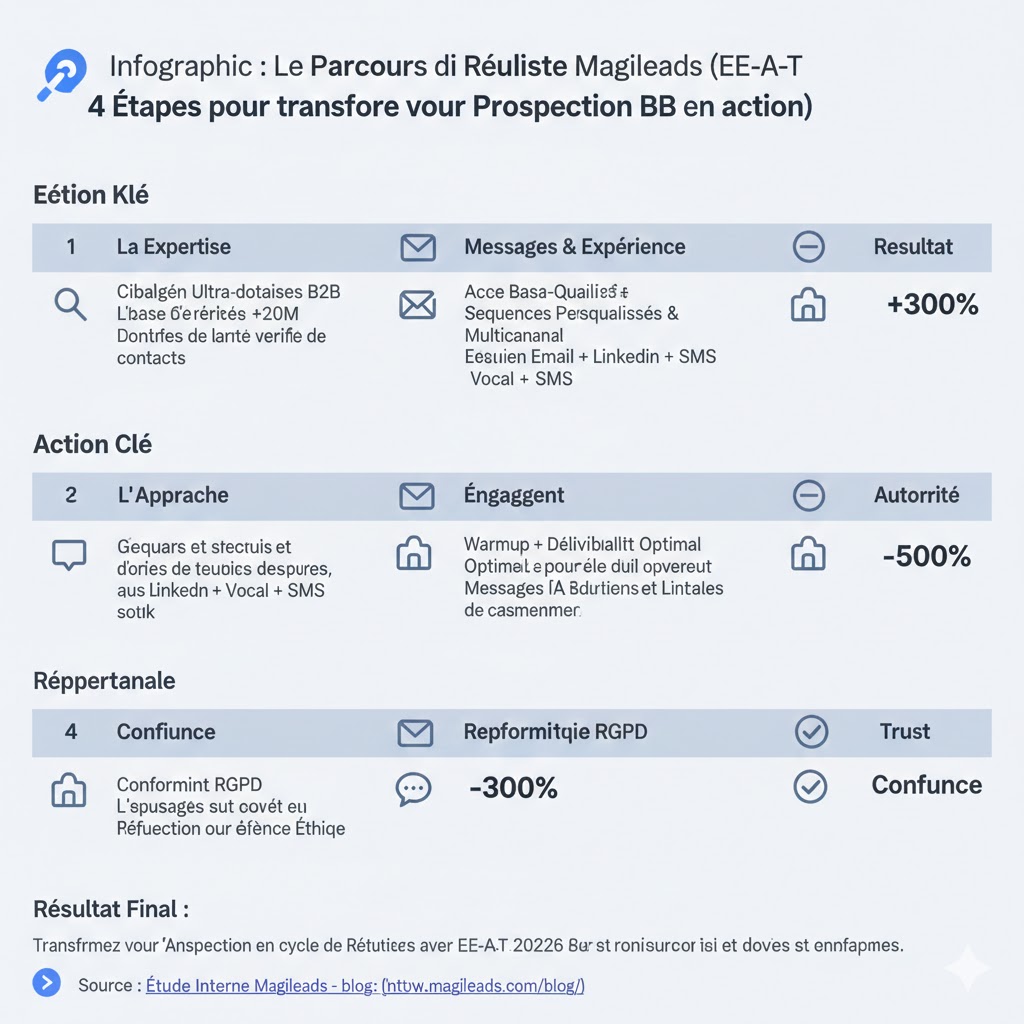
Case Study: The Challenge of the Company “TechLogistix”
The Challenge: TechLogistix, a logistics service provider, was stagnating with a conversion rate of less than 1% for its prospecting emails. Despite a quality database, their messages were perceived as too generic.
Implementation: By applying our advice on hyper-personalization and domain warmup , the team radically changed its approach:
Warm-up Phase: 3 weeks of forced warm-up to restore the reputation of their domain.
Fine Segmentation: Magileads behavioral filters to target only decision-makers who have posted on LinkedIn in the last month.
The Voice Message: Sending a 20-second voice message following the first email.
Results (Visualization):
Metrics | Before application | After 3 months | Evolution |
Opening Rate | 18% | 54% | +200% |
Response Rate | 0.8% | 6.5% | +712% |
Cost per Lead (CPL) | 145 € | 38 € | -73% |
Testimonial: “Emotion at the heart of business”
“At first, I was skeptical about the idea of recounting our failures or technical difficulties in our blog posts. But by sharing how we struggled to configure our DMARC before succeeding, our clients saw us as honest partners, not just salespeople. Trust was established even before the first call.” — Clarisse V. , Marketing Manager.
Why does it work?
Emotional Connection: By describing the “difficulties encountered” (such as the stress of a drop in deliverability), you create a bond of empathy. The reader thinks, “They understand my problem because they’ve been through it.”
Visual Engagement: Using tables or infographics to present results makes them easier to read. A graph showing an upward response curve is more memorable than three paragraphs of explanation.
Google EEAT Standard Authority: You move from the role of “writer” to that of “mentor”. You don’t just say what to do, you show what has been done .
Magileads' advice for your customer experience
To collect this valuable data, use your platform's analytics reports. For example, Magileads' Reporting and Analytics allows you to extract these performance graphs with a single click and integrate them directly into your case studies.
“After following the recommendations in the Ultimate Guide, I doubled my website traffic in three months. The case studies and practical examples helped me better understand my customers' expectations.”
— Julie, digital entrepreneur
Don't hesitate to include quotes, raw data, or even demo videos. Users appreciate content that's been tested and validated through real-world use. A recent study shows that the art of authentic storytelling, where you share your mistakes and lessons learned, creates a strong emotional connection. AI can't replicate that authenticity.
Differentiating between human content and AI
To stand out from AI, focus on practical evidence . AI-generated content often lacks real-life experience and personal details. You can demonstrate your expertise by showcasing tutorials based on real-life situations or sharing unique experiences.
Tell true stories with precise details.
It presents in-depth case studies, with direct quotes and concrete figures.
Show that you have tested the proposed solutions yourself.
A study conducted by METR revealed that even experienced developers using AI tools took 19% longer to complete their actual tasks than they anticipated. Despite this reality, they still believed they were faster, demonstrating a significant perception gap. This difference underscores the value of human experience and practical evidence in creating credible content.
Expertise: Demonstrating competence
Expertise signals for Google
Want to prove to Google that you're an expert? Highlight clear signs of your expertise . Google analyzes several criteria to assess a website's competence:
Real experience behind every piece of content published.
Mastery of the subject and ability to give precise advice.
Recognition by the community or peers.
Reliability of shared information.
To boost your credibility, add expert endorsements to the end of your articles. For example, a health case study could include validation from a recognized physician. Don't hesitate to include links to academic sources, such as the National Library of Medicine or leading universities. This approach reassures your readers and shows Google that you're working from a solid foundation.
“Google is no longer just looking for experts, it’s looking for practitioners.” — Lily Ray, SEO and Google EEAT Standards Consultant
Strengthen the quality of writing
High-quality writing remains a cornerstone of expertise . Use clear, precise language tailored to your audience. For YMYL (Your Money Your Life) topics, the requirements are even more stringent. Inaccurate information can damage your visibility and erode user trust. Prioritize content written or validated by specialists. Include detailed case studies, testimonials, and expert quotes to support your points.
Consider varying your formats: add infographics to explain complex concepts, or offer short videos from experts. The Ultimate Guide recommends always citing your sources and updating your content to remain relevant. This rigor positions you as a leader in your field and reassures Google of your level of expertise.
Authority: Building legitimacy
Authority plays a central role in the success of your Google EEAT SEO strategy. Google values sites that become authorities in their field. To achieve this, you must prove the legitimacy of your content and demonstrate that other experts recognize your expertise.
Obtaining quality backlinks
High-quality backlinks remain one of the most powerful signals for Google. When reputable sites link to your pages, you gain credibility. You should aim for links from reliable sources, such as specialized media outlets, expert blogs, or recognized institutions.
Here's what strengthens your site's authority:
and recognized authors
Use reliable and verifiable sources.
Organize your content clearly to make it easier for search engines and users to understand.
Tip: An article cited by an authoritative site can see its traffic increase by 30% in a few weeks. For example, Health-Tech Solutions recovered 60% of its lost traffic by integrating links to clinical studies and expert opinions.
Collaborations and partnerships
Collaborating with other experts or companies strengthens your credibility. You can organize joint interviews, publish guest articles, or launch collaborative projects. These partnerships allow you to reach new audiences and gain mentions on influential websites.
Participate in webinars or podcasts with specialists in your sector.
Offers case studies in collaboration with recognized partners.
Highlight customer or expert testimonials to support your claims.
The Ultimate Guide recommends always highlighting these collaborations in your communications. The more real-world evidence you provide of your authority, the more Google and your visitors will trust you.
Trust: Accuracy and security
Reliable and verifiable sources
Want your readers to trust you? Start by relying on reliable and verifiable sources . Factual accuracy remains the foundation of credibility. When writing content, always verify the origin of the information. Prioritize academic studies, official reports, or recognized research articles. Solid content is based on specific criteria:
Readability and clarity of the argument
Presence of verifiable and current data
Added value for the reader
Ability to respond in a precise and distinctive manner
Don't forget that trust directly influences purchase intent. The numbers speak for themselves:
Nearly six out of ten French people refuse to share their personal information.
83% of consumers express strong concerns about data security.
37% fear the misuse of their data.
31% are concerned about resale without consent.
30% are concerned about privacy violations.
Only 17% of consumers fully trust AI recommendations.
The more you demonstrate the reliability of your sources, the more you reassure your visitors and Google.
GDPR security and compliance
Data security and GDPR compliance are not optional. You must guarantee to your users that their information remains protected. To do this, adopt simple and effective practices:
Manages cookie consent transparently.
Display full legal notices on your website.
Secures all personal data collected.
Inform your users about their rights.
Ensures transparency in data processing.
Article 32 of the GDPR requires data controllers to ensure a level of security appropriate to the risks associated with personal data.
By implementing these rules, you strengthen your visitors' trust. You show that you respect their privacy and take security seriously. This approach sets you apart and improves your reputation with Google and your customers.
AI and SEO: Complying with the Google EEAT standard
Using AI without losing authenticity
You want to leverage the power of AI to boost your SEO copywriting, but you must adhere to Google's EEAT guidelines. To maintain the authenticity of your content, you need to involve a human editor at every stage. AI can help you gather information or draft content, but you must add your personal touch. You can incorporate unique experiences, proprietary data, and original perspectives to ensure experience, expertise, authority, and trustworthiness.
Prioritize the quality of the content .
Involves a human editor in the process.
Uses AI for initial research and drafting.
Adds exclusive data and real testimonials.
"Our focus on the quality of the content, rather than how it is produced, is a useful guide that has enabled us to deliver reliable, high-quality results to users for years."
To maximize engagement, you can enrich your articles with infographics, expert videos, or interactive charts. These visual elements make your content more accessible and strengthen its credibility with Google and readers.
AI tools for Google EEAT-compliant SEO
Do you want to optimize your SEO writing with powerful tools ? Several solutions exist to help you comply with the EEAT standard while saving time.
Uses interactive calculators and simulators to provide a personalized experience.
Provides exclusive data such as survey results or original benchmarks.
Offers unique analyses, for example detailed case studies.
Create localized and verified content, such as authentic customer reviews.
Highlight the authors' qualifications and achievements.
Anchor your claims in measurable facts and cite your sources.
Obtain mentions and backlinks from authoritative sites.
You can also structure your content using appropriate formats: Article, FAQ Page, How-To, Product, Organization, Local Business. These formats make your content easier to understand and improve its visibility on Google.
By using AI intelligently, you keep your content relevant, reliable, and engaging. This allows you to meet Google's EEAT standards and propel your site to the top of search results.
Magileads: Prospecting and the Google EEAT standard
Magileads Technological Expertise
Want to optimize your B2B prospecting and comply with EEAT standards? Magileads offers an intelligent platform that transforms the way you prospect. You gain access to a database of over 20 million qualified contacts. You use advanced filters to target the right decision-makers. Magileads allows you to automate your campaigns while maintaining complete control over message personalization.
You analyze the performance of each campaign in real time.
You segment your targets with precision.
You benefit from expert support at every stage.
Tip: Use the Magileads dashboard to view your results and adjust your strategy in just a few clicks.
You can discover all the features on the official website: Magileads – B2B Prospecting .
Authority and GDPR compliance
Magileads guarantees ethical prospecting that complies with GDPR. You respect the privacy of your prospects thanks to consent management tools and robust security protocols. The platform helps you build a solid reputation based on transparency and reliability.
You ensure the security of personal data.
You display complete legal notices.
You inform your prospects about their rights.
“Thanks to Magileads, we segmented our target audience with surgical precision. Our response rate jumped by 300% because our prospects are finally receiving messages that demonstrate our real expertise.”
— Marketing Manager, IT Sector
Result | Before Magileads | After Magileads |
|---|---|---|
Response rate | 8% | 32% |
Number of qualified leads | 120/month | 480/month |
Do you want to build authority in your industry? Magileads helps you prove your expertise, strengthen your legitimacy, and build trust. You gain visibility, comply with industry standards, and propel your B2B prospecting to success.
Summary: Actions for SEO based on the Google EEAT standard
Do you want to apply the EEAT standard on a daily basis and guarantee the performance of your site? This summary gives you the key steps to transform your SEO strategy and stay at the top of Google results.
Google EEAT Standard Checklist
Here's a practical checklist to integrate the Google EEAT standard into your SEO routine. Use it to check each page of your site and boost your credibility:
Update your content regularly. Recent or updated pages attract more attention from search engines. 90% of the pages cited by AI had been published or updated within the past year.
Check your site's technical configuration. Review the robots.txt file and cache servers to ensure access for AI robots.
Add testimonials, case studies, and expert quotes to prove your real-life experience.
Always cite reliable and verifiable sources. Favor official reports, academic studies, and recognized references.
Obtain quality backlinks from authoritative websites. This strengthens your legitimacy in the eyes of Google.
Respect the fundamentals of authority: Google EEAT standard, PageRank and user signals remain essential to establish your online reputation.
Secure your users' data and ensure GDPR compliance. Display clear legal notices and manage cookie consent.
Highlight the qualifications and expertise of the authors of your content.
It offers a variety of formats: infographics, expert videos, comparison charts. These visual elements facilitate understanding and increase engagement.
Structure your content with appropriate tags (FAQ, HowTo, Product) to improve visibility on Google.
📝 Tip : Print this checklist and keep it handy every time you update your site. The Ultimate Guide helps you remember everything you need to build lasting authority.
Continuous monitoring and optimization
You must continuously monitor and optimize your Google EEAT strategy. This ongoing effort ensures that your content remains credible and trustworthy for Google and your visitors.
Analyzes the performance of each page. Uses SEO audit tools to identify areas for improvement.
Update the experience, expertise, authority, and reliability of your content. Verify that all information remains relevant and accurate.
Monitor your site's credibility. Reliability directly influences your visibility in search results.
Ask your readers for feedback. Their opinions and comments help you adjust your content and meet real expectations.
Stay informed about changes to Google algorithms and SEO trends. Adapt your strategy as soon as something new appears.
Schedule regular audits to anticipate changes and stay ahead of your competitors.
🔎 Note : Continuous optimization allows you to maintain a high level of confidence and expertise. This ensures the sustainability of your visibility and the growth of your traffic.
By applying this synthesis, you transform every SEO action into an opportunity to strengthen your brand. The Ultimate Guide helps you make trust and expertise your best allies on Google.
You've discovered how the Ultimate Guide helps you implement the Google EEAT standard to dominate SEO in 2026. Use the checklist and tools like Magileads to strengthen each pillar. Trust and human expertise remain essential for success. SEO specialists predict:
Google algorithms that prioritize human expertise.
A sustainable positioning for original websites.
Stay informed and adapt your strategy to maintain your advantage.
FAQ about the Google EEAT standard
What is the Google EEAT standard?
The Google EEA-TT standard stands for Experience, Expertise, Authority, and Trustworthiness. You must prove that you master your subject, that you have experienced what you describe, and that your information is reliable.
How can I improve the user experience on my website?
You can add testimonials, case studies, or explainer videos. Highlight concrete examples to show that you have tested the solutions you are proposing.
Why is GDPR compliance important for SEO?
GDPR compliance reassures your visitors. Google values sites that protect personal data. You must display legal notices and manage cookie consent.
Can AI replace human expertise for SEO?
No, AI helps produce content, but you still need to add your experience and analysis. Google prioritizes authentic content, validated by human experts.
What tools can be used to strengthen the Google EEAT standard?
You can use Magileads for B2B prospecting, Google Search Console to track your performance, and SEO audit tools to check the quality of your content.
See also
Can AI Really Identify Your Geo in 2026?
Strategies for Successful Competitive SEO Analysis
Succeeding in Your Prospecting Campaigns in 2026: A Guide