
Today, you can create artificial intelligence for marketing, even without technical expertise. More and more companies are getting involved:
30 to 40% of French companies are already using these technologies.
43 % Agencies plan to increase their use of no-code platforms, and 76% of professionals are seeing an acceleration of their campaigns thanks to these tools.
To succeed, define clear objectives and target the tasks to automate. Leverage no-code platforms like Magileads or DataBird. A structured approach protects you from common pitfalls and maximizes your efficiency.
Key Points of Artificial Intelligence
Define clear objectives for your AI marketing project. This helps you stay focused and efficient.
Identify repetitive marketing tasks to automate. This frees up time for more strategic activities.
Use no-code tools like Magileads or DataBird. These platforms simplify the creation of applications without coding.
Collect internal and external data to train your AI. Quality data ensures reliable results.
Clean and structure your data before using it. This prevents errors and improves AI performance.
Establish success indicators to measure the effectiveness of your AI. This allows you to adjust your strategy as needed.
Test your AI before deploying it. This ensures that everything works correctly and that users are satisfied.
Personalize your marketing campaigns with AI. This improves engagement and strengthens relationships with your customers.
Define marketing objectives
Before choosing a technology or platform, clarify your marketing needs. This step allows you to target the actions to automate and align your artificial intelligence project with your strategic priorities. This will improve your efficiency and relevance.
Target the tasks to automate
Identify the marketing tasks that consume the most time or require a high level of responsiveness. Automation allows you to free up resources and increase the performance of your campaigns. Here are some examples of tasks with high automation potential:
Content creation for your social media or blog
Personalizing marketing emails based on each prospect's profile
Content curation to fuel your newsletters
Using chatbots to answer frequently asked questions
Automation of advertising campaigns across different channels
Automated prospecting
You can automate prospecting to identify and qualify new leads. Artificial intelligence analyzes data, detects signals of interest, and provides you with lists of high-potential contacts. This approach accelerates lead generation and reduces time spent on repetitive tasks.
Campaign personalization
Personalizing marketing campaigns becomes easier thanks to AI. You can tailor your messages based on each customer's behavior and preferences. This personalization improves engagement and strengthens relationships with your audience.
Tip: List the tasks that take up the most time in your daily marketing routine. Prioritize those that can be automated without loss of quality.
Set indicators of success
To measure the effectiveness of your project, define success indicators from the outset. These indicators help you track progress and adjust your strategy as needed. The most commonly used indicators in marketing with artificial intelligence are:
Success rate : percentage of queries resolved during the first interaction
Average response time: speed at which requests are processed
Transfer rate: proportion of cases requiring human intervention
Customer satisfaction rate: results of post-interaction surveys
Bounce rate: the number of sessions where the user quickly leaves the bot
Usage rate: volume and frequency of active sessions
Average duration of exchanges: detection of excessively long journeys
Non-response rate: failures in understanding or lack of content
By setting these indicators, you can track the impact of your solution and quickly identify areas for improvement.
The main marketing objectives targeted by AI include improving products and services , creating new offers, and strengthening customer relationships. By keeping these objectives in mind, you maximize the added value of your project.
Collect and prepare the data

The success of your artificial intelligence project depends on the quality of the data you collect and prepare. You must organize this data rigorously to guarantee reliable and relevant results. This step forms the foundation of any effective marketing automation strategy.
Marketing data sources
To train artificial intelligence, you need to gather data from different sources. This data falls into two main categories: internal and external.
Internal and external
Internal data : You leverage purchase histories, website interactions, email campaign responses, and customer feedback. This information helps you better understand your customers' behavior and segment your audience precisely and dynamically .
External data : You can enrich your analyses with data from social networks, market research, or public databases. These external sources complement your internal information and allow you to create highly targeted segments.
Tip: Combine multiple datasets to train your algorithms. For example, use annotated images for computer vision or large volumes of text for natural language processing.
Cleaning and structuring
Before training your artificial intelligence, you must clean and structure your data. This step ensures the reliability of the results and avoids bias.
GDPR compliance
Here are the key steps to prepare your data:
Remove duplicates to avoid skewed analyses.
Manage missing data to avoid introducing errors into the models.
Standardize the formats to facilitate integration into your tools.
Use automation solutions to speed up and improve the reliability of cleaning.
Always comply with the GDPR when collecting and processing data. You must obtain valid consent to use personal data. Limit data collection to what is strictly necessary and define a specific purpose for each processing activity. Ignoring these rules can lead to penalties: fines of up to €20 million or 4% of global turnover, and public warnings from the CNIL (French Data Protection Authority).
Tip: Integrate GDPR compliance from the very beginning of your project design. This protects your business and strengthens customer trust.
By structuring your data and complying with regulations, you lay the foundations for effective and responsible artificial intelligence marketing.
Choosing artificial intelligence technology
To ensure the success of your marketing project, you need to choose an artificial intelligence technology that suits your needs and skills. Today, many accessible solutions exist, even if you have no programming knowledge.
No-code tools and artificial intelligence platforms
No-code tools allow you to create applications and automate tasks without writing a single line of code. This enables you to optimize your marketing processes and increase your daily efficiency. These solutions are particularly suited to marketing professionals who want to quickly test ideas or automate repetitive actions.
You can use platforms like Magileads or DataBird to automate prospecting, personalize your campaigns, or analyze your customer data.
No-code software makes it easy to create workflows, manage multi-channel campaigns, and integrate with your existing tools.
Here are some examples of no-code tools used in digital marketing:
General-purpose conversational assistants (e.g., ChatGPT) to generate text or respond to your prospects.
Visual creation tools (e.g., Google Gemini, MidJourney) to produce custom images or videos.
Productivity tools (e.g., Notion AI) to organize and manage your marketing content.
Tip: Test several no-code platforms to identify the one that best integrates with your work environment and objectives.
Magileads, DataBird
Magileads and DataBird stand out for their ease of use and ability to automate complex tasks. You can configure prospecting scenarios, segment your audiences, or analyze campaign performance without any technical skills. These platforms also offer connectors to link your CRM, ERP, or other business tools.
Pre-trained AI models
Pre-trained artificial intelligence models, such as GPT or its alternatives, allow you to accelerate the implementation of advanced marketing solutions. You benefit from algorithms already optimized for text generation, data analysis, or content creation.
GPT and alternatives
You can use GPT to write personalized emails, generate chatbot scripts, or analyze customer feedback. Other templates, such as those offered by Google or Meta, provide similar features for creating visual content or predictive analytics.
Advantages of pre-trained models:
Save time in deploying your projects
Personalization of messages and campaigns
Marketing performance optimization
Stimulating the creativity of your teams
Limitations to consider:
Potential biases in the generated results
Data confidentiality to monitor
Complexity of certain settings
Lack of transparency regarding internal operations
AI bias occurs when training data reflects existing prejudices, which can lead to unfair or irrelevant results.
How to choose the right artificial intelligence technology?
To select the solution best suited to your marketing needs, consider the following criteria:
Interoperability with your existing systems (CRM, ERP, etc.)
Scalability to support your company's growth
Total cost of ownership (purchase, maintenance, training)
Data security and GDPR compliance
Quality of technical support and documentation
Criteria | Why is this important? |
|---|---|
Interoperability | Facilitates integration with your tools |
Scalability | Allows you to grow with your business |
Total cost of ownership | Long-term budget control |
Security and GDPR | Data protection and compliance |
Technical support | Quick assistance in case of a problem |
By evaluating these criteria, you maximize the chances of success for your artificial intelligence marketing project.
Build and customize your AI
To ensure the success of your marketing project, you need to configure and train your artificial intelligence in a structured way. This step allows you to obtain a high-performing assistant, aligned with your objectives and brand identity.
Code-free setup
Today, you can configure artificial intelligence without writing a single line of code. No-code platforms simplify every step, from defining the objective to continuous optimization.
Here are the essential steps to configure your solution:
Clearly define your business objective
. Identify a specific problem to solve. For example, you might want to reduce customer support response time or improve lead qualification.Leverage your existing data.
Centralize your data in a reliable CRM or database. This information will serve as the foundation for training your virtual assistant.Choose and configure the right tool.
Select a no-code platform that meets your needs, such as Magileads' Marketing Assistant or a similar tool. Set up scenarios, automated responses, and personalization rules.Deploy, test, and optimize.
Launch your virtual AI assistant. Analyze its performance using the metrics defined earlier. Adjust the settings to improve the relevance of responses and the user experience.
Tip: Test each scenario with real-world cases to ensure the reliability of your assistant before a large-scale deployment.
Virtual AI Assistant
A virtual AI assistant can automate customer request management, lead qualification, and product recommendations. You can personalize its responses, integrate your brand guidelines, and adapt its tone to your brand. This personalization strengthens the consistency of your communication and improves customer satisfaction.
Training on marketing data
Training your artificial intelligence relies on the quality and diversity of your marketing data. You must prepare this data to ensure reliable and relevant results.
Intelligent data ingestion:
Your assistant can handle various formats: Excel files, databases, real-time feeds. This flexibility accelerates onboarding and integration into your workflows.Automated cleaning and preparation:
Modern tools automatically correct duplicates, missing values, and inconsistencies. You save time and reduce human error.Intelligent multi-level analysis
. Artificial intelligence analyzes your data on multiple levels: descriptive (what happened), predictive (what will happen), prescriptive (what to do). You make more informed and faster decisions.
Customization according to the graphic charter
Personalizing your AI goes beyond text-based responses. You can adapt the assistant's interface, colors, visuals, and tone to your brand guidelines. This visual and editorial consistency reinforces your brand identity.
Some concrete examples:
AI analyzes your customers' data to offer tailored content, anticipating their needs before they even express them.
On Amazon, the homepage and recommendations evolve based on clicks and purchases, which increases the frequency of purchases.
Netflix adapts promotional images for series for each user, while Spotify personalizes playlists according to listening habits.
Tip: Personalize every touchpoint with your audience. A tailored experience improves engagement and loyalty.
The results of personalization are measurable:
Companies see an average increase of 29% in sales within 12 months after implementing personalized AI.
95% of users of solutions like HubSpot achieve a positive return on investment.
76% observe results in less than four weeks.
84% of marketers note a direct improvement in user experience.
79% report a better alignment between their content and search intent.
Expected profit | Impact observed |
|---|---|
Sales increase | +29% in 12 months |
positive ROI | 95% of users |
Speed of results | 76% in less than 4 weeks |
User experience | 84% improvement observed |
Content/Intent Alignment | 79% of marketers are satisfied |
By following these steps, you build a marketing artificial intelligence that adapts to your needs, respects your brand identity, and generates concrete results.
Testing and deploying AI
Once your artificial intelligence is configured, you must validate its performance before deploying it in your marketing processes. This step ensures the reliability of your results and the satisfaction of your teams.
Performance validation
To test your solution , you need to use several complementary methods. Each test targets a specific aspect of your project.
Test type | Objective | Tool or approach |
|---|---|---|
Functional | Confirm the quality of the AI responses | Use cases, conversation scripts |
Performance | Measuring speed and robustness | Load simulations, real-time monitoring |
Integration | Check the connection to existing systems | APIs, sandbox, exchange logs |
User Experience | Gathering user satisfaction | Surveys, beta tester feedback |
You need to simulate real-world scenarios, analyze the AI's responses, and measure processing speed. Involve test users to gather their feedback and identify areas for improvement.
Marketing indicators
To measure the impact of your artificial intelligence, select appropriate marketing indicators :
Productivity gains (automation, reduced processing time)
Value creation (new features, innovation)
Improved decision-making
Time saved in content writing
Engagement or conversion rate after personalization
Cost reduction per lead
Improvement in satisfaction or NPS
Tip: Choose KPIs directly related to your objectives to track performance progress.
Integration into workflows
Integrating AI into your marketing workflows requires a structured approach. Follow these steps for success:
Assess your company's digital maturity.
Choose the AI tools and solutions that suit your needs.
You must connect your solution to existing systems (CRM, email marketing tools, advertising platforms). Test each integration in a secure environment before full deployment.
Monitoring and adjustments
After deployment, continuously monitor the performance of your artificial intelligence. Analyze results, detect trends, and adjust your campaigns in real time. AI optimizes targeting , tailors messaging based on interactions, and provides recommendations to maximize ROI.
Adjust advertising campaigns based on conversion rates.
Optimize your email sending schedule to increase engagement.
Automate the targeting of the most responsive segments.
Identify the most profitable actions and adapt your strategies.
Tip: Regular monitoring allows you to anticipate market developments and continuously improve your marketing performance.
Examples and use cases of artificial intelligence

Automated prospecting
You can transform your sales prospecting with artificial intelligence. Several companies are already using solutions to automate lead generation and qualification. Here are a few concrete examples:
Manus Intelligence analyzes past interactions to recommend the best time to follow up with a prospect.
A SaaS SME sends automated messages and schedules follow-ups on LinkedIn, while integrating the responses into its CRM.
A B2B sales force relies on Einstein to predict the contacts most likely to buy within 30 days.
Clay automates the updating of contact records and uses chatbots to qualify incoming requests.
HubSpot offers a smart text generator to create marketing content, while Dropcontact automatically enriches contact records.
More than 80% of marketing departments that have integrated AI report significant improvements in their prospecting processes.
Customized campaigns
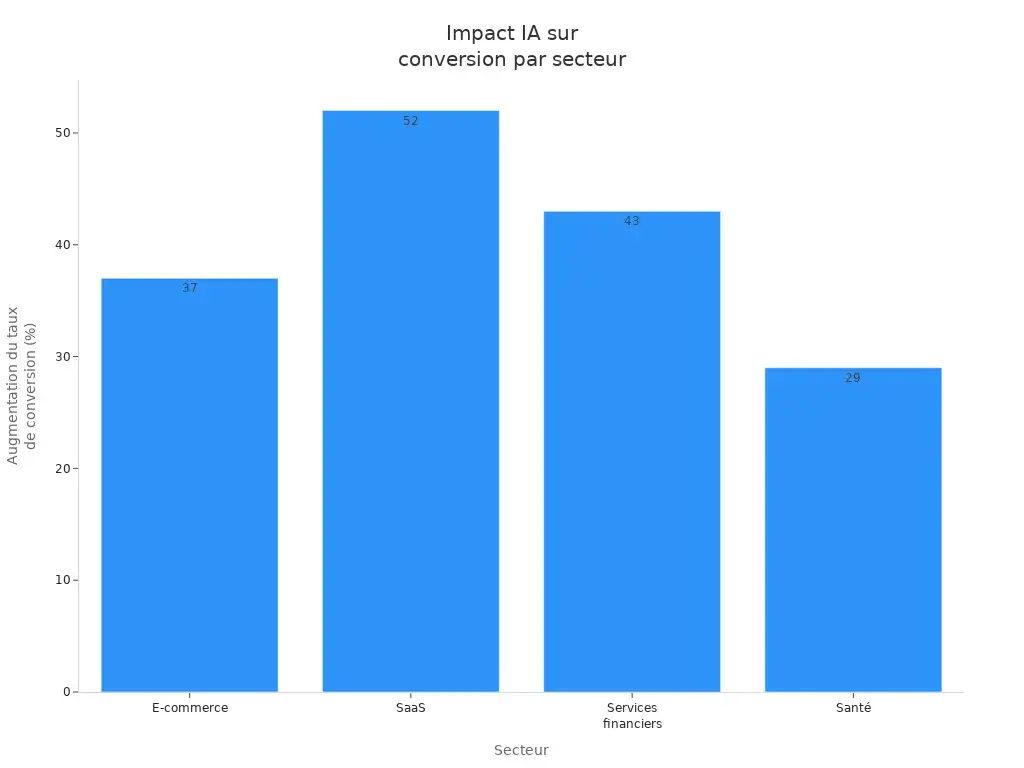
Artificial intelligence allows you to personalize your marketing campaigns at scale. You can tailor your messages based on each customer's behavior and preferences. The results are impressive:
Sector | Increase in conversion rate |
|---|---|
E-commerce | +37 % |
SaaS | +52 % |
Financial services | +43 % |
Health | +29 % |
Email open rate: +29%
Click-through rate: +41%
Engagement: +83%
Average time spent on the page: +47%
Scroll depth: +39%
Social shares: +58%
Reduction in content production costs: 41% on average
81% of companies note an improvement in customer experience thanks to automated personalization.
Virtual AI Assistant
A virtual AI assistant optimizes your customer support and internal communication. You can automate the handling of common requests, accelerate query processing, and ensure a consistent experience.
AI analyzes user data to deliver targeted advertising and optimize your campaigns.
Chatbots handle frequent requests and improve customer satisfaction.
BNP Paribas uses YeldaAI to ensure consistency in internal and external communication.
Type of benefit | Details |
|---|---|
Increased productivity | Employees complete an average of 66% more tasks |
Effectiveness of customer support agents | 13.8% more calls handled per hour |
Productivity of professionals | 59% more documents written per hour |
Customer satisfaction | 6.7% increase in customer satisfaction |
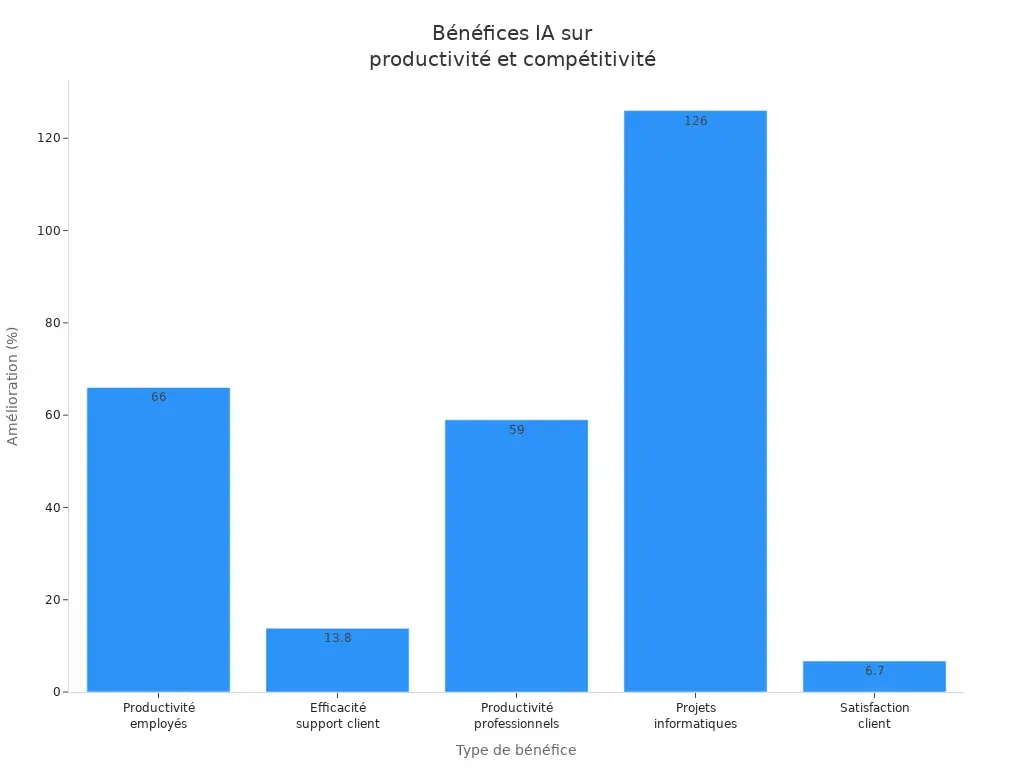
Projects focused on pricing, customer relations, and content personalization are among the most promising for strengthening your competitiveness.
You can create a custom marketing artificial intelligence by following a structured approach:
Develop a custom system to process your data.
Use no-code tools to automate up to 90% of repetitive tasks .
Adopt a clear AI policy and appoint designated contacts to oversee its use.
Data fuels your performance: secure it and measure your results to adjust your campaigns.
Explore the innovative solutions presented to transform your strategy and strengthen your competitiveness.
FAQ about artificial intelligence tools
How to start an AI marketing project without technical skills?
You can use no-code platforms. These tools guide you step by step. You configure your AI with simple interfaces. You don't need to code.
What types of data do I need to prepare to train my AI?
You need to gather internal data (CRM, emails, customer history) and external data (social media, market research). Clean and structure this data to ensure the quality of the training.
Does AI marketing comply with the GDPR?
Yes, if you collect user consent and limit data usage. You must anonymize sensitive information and document each processing activity to remain compliant.
How long does it take to see the first results?
You can see results in just a few weeks. Automation speeds up prospecting and personalization. The first gains often appear within the first month.
Can I integrate AI into my existing tools?
Yes, most AI solutions offer connectors for CRM, email marketing tools, or advertising platforms. This allows you to automate your workflows without changing your existing environment.
What are the main benefits of AI in marketing?
You save time, improve personalization, and increase your conversion rates. AI optimizes your campaigns, reduces errors, and helps you make better decisions.
See also
The Impact of Artificial Intelligence on Modern Sales
Effective Methods to Automate Your Sales Prospecting
Top 30 AI Tools for Marketing in 2025