
Aujourd’hui, tu ne choisis plus entre cold call et emailing pour prospecter efficacement. Tu combines les deux pour multiplier tes chances d’entrer en contact avec tes cibles. Lorsque tu multiplies les points de contact et alignes ton discours, tu observes une hausse de 15 % des rendez-vous en prospection par rapport à l’email seul. La preuve : un taux de contact de 65 % sur une base qualifiée, contre seulement 2,3 % de conversion sur appel à froid isolé.
Statistique | Valeur |
|---|---|
Taux de contact sur une base qualifiée | 65 % |
Taux de conversion sur appels à froid | 2,3 % |
Augmentation des rendez-vous en prospection | +15 % par rapport à l’email |
Points Clés du cold call
Combine le cold call et l’emailing pour augmenter tes chances d’obtenir des rendez-vous jusqu’à 15 %.
Personnalise tes messages pour engager efficacement les prospects et améliorer les taux de réponse.
Utilise plusieurs points de contact, comme les réseaux sociaux et les événements de networking, pour renforcer ta visibilité et tes connexions.
Structure ta prospection avec un workflow clair comprenant des emails ciblés, des relances et des appels pour maximiser l’engagement.
Mesure et ajuste régulièrement ta stratégie en fonction des indicateurs clés de performance pour améliorer continuellement tes résultats.
Pourquoi la prospection multicanal ?
Ce que disent les chiffres et les experts du cold call
L’approche unidimensionnelle n’est pas seulement moins efficace, elle est statistiquement condamnée. En 2026, la prospection “silo” ignore la réalité du parcours d’achat moderne.
1. La preuve par les données : Pourquoi le multicanal et le Cold call est la norme
Pour comprendre l’urgence de cette transition, il faut observer les études de marché les plus récentes des leaders du secteur :
La règle des 8 touches : Selon les recherches du RAIN Group, il faut désormais en moyenne 8 points de contact pour obtenir un premier rendez-vous avec un prospect qualifié. S’appuyer sur un seul canal rend cette fréquence perçue comme du harcèlement, tandis que le multicanal la transforme en présence familière et professionnelle.
L’efficacité combinée : Le rapport “State of Sales” de Salesforce révèle que les commerciaux utilisant le multicanal atteignent leurs quotas 28 % plus souvent que ceux limités à un seul canal.
Le comportement des acheteurs : Gartner souligne que les acheteurs B2B passent seulement 5 % de leur temps à discuter avec un commercial durant tout leur parcours d’achat. Si vous n’êtes pas présent sur LinkedIn ET par e-mail, vous n’existez tout simplement pas durant 95 % de leur phase de réflexion.
2. Les défis de l’unidimensionnel : L’analyse des experts
Les experts du domaine s’accordent sur le diagnostic : l’isolation d’un canal est une erreur stratégique qui limite votre portée.
“L’e-mail seul est facilement ignoré. Le téléphone seul est souvent perçu comme intrusif. Mais quand l’e-mail prépare le terrain pour l’appel, et que LinkedIn valide l’identité du commercial, vous créez une ‘bulle de confiance’ autour de votre prospect.” — Jill Konrath, Stratège commerciale reconnue et auteure du best-seller Agile Selling.
3. Solutions pratiques et Mesure du ROI du cold call
Pour transformer ces données en résultats concrets, votre stratégie doit être pilotée par des indicateurs hybrides que vous pouvez suivre directement dans votre interface de reporting Magileads :
Le Taux de Réponse Global (Blended Response Rate) : Ne mesurez plus l’e-mail et l’appel séparément. Calculez le succès par séquence complète de 100 prospects.
Le “Lift” LinkedIn : Analysez l’augmentation de votre taux de décroché téléphonique sur les prospects ayant préalablement accepté votre invitation. En moyenne, l’interaction sociale préalable offre un “lift” de 30 % à 40 % sur l’efficacité des appels.
Limites du cold call ou email seul
Tu rencontres plusieurs obstacles lorsque tu utilises uniquement le cold call ou l’emailing pour prospecter. Les défis principaux incluent :
Ciblage et segmentation : Tu dois personnaliser chaque message pour toucher efficacement tes interlocuteurs.
Copywriting : Rédiger des emails engageants reste difficile, surtout pour établir un lien avec des inconnus.
Conformité RGPD : Naviguer dans les réglementations peut devenir complexe et risqué.
Volume et technicité : Industrialiser le cold emailing exige des compétences techniques précises.
Peur de vendre : La réticence à contacter des inconnus freine souvent tes efforts.
Pensée erronée sur l’envoi d’emails : Envoyer des emails seuls ne génère pas assez de ventes.
Trouver des emails valides : Tu dois vérifier chaque adresse pour atteindre tes prospects.
Astuce : Tu gagnes en efficacité lorsque tu combines plusieurs méthodes de prospection.
Avantages de la combinaison cold call et emailing
En associant cold call et emailing, tu observes des résultats concrets :
Taux d’ouverture de 66 % sur les emails.
Taux de clics de 11 %.
Taux de réponse de 14 %.
Personnalisation des messages qui augmente l’engagement.
Automatisation des campagnes pour gagner du temps.
Recherche approfondie sur les prospects pour mieux adapter ton discours.
Tests et ajustements réguliers pour optimiser tes résultats.
Relations à long terme avec tes prospects.
Suivi régulier pour maintenir l’intérêt.
Cette approche te permet de transformer des signaux numériques en conversations réelles et d’augmenter le nombre de rendez-vous qualifiés.
Diversifier les points de contact
Tu multiplies tes chances de joindre tes prospects en diversifiant les canaux :
Les réseaux sociaux, notamment LinkedIn, facilitent l’accès aux décideurs.
La prospection terrain te permet de créer un contact direct.
Les événements de networking offrent des opportunités uniques pour échanger avec des prospects.
Conseil : Varie tes points de contact pour maximiser ta visibilité et renforcer ton impact commercial.
Structurer une campagne cold call + emailing
Pour maximiser tes résultats en prospection, tu dois structurer ta campagne autour de trois piliers : un ciblage précis (ICP), un workflow d’outreach multicanal cohérent et un système de scoring pour prioriser tes actions. Voici comment procéder étape par étape.
Ciblage et ICP pour son cold call
La première étape consiste à définir ton ICP (Ideal Customer Profile). Tu dois identifier les entreprises et les interlocuteurs qui présentent le plus fort potentiel de conversion. Pour cela, concentre-toi sur plusieurs critères :
Firmographiques : taille de l’entreprise, secteur d’activité, chiffre d’affaires.
Technographiques : outils et technologies utilisés par la cible.
Comportementaux : problématiques rencontrées, objectifs business, maturité dans le cycle d’achat.
Stratégiques : caractéristiques communes à tes meilleurs clients actuels.
Note : Les données firmographiques te permettent de délimiter un périmètre objectif autour de tes clients idéaux. Tu gagnes en efficacité en sélectionnant un secteur d’activité précis, une taille d’entreprise adaptée et une zone géographique où tu performes le mieux.
Pour démarrer, clarifie l’objectif de ta campagne (par exemple, obtenir des rendez-vous commerciaux). Définis une cible réaliste et commence avec un volume limité de prospects pour tester l’efficacité de ton approche.
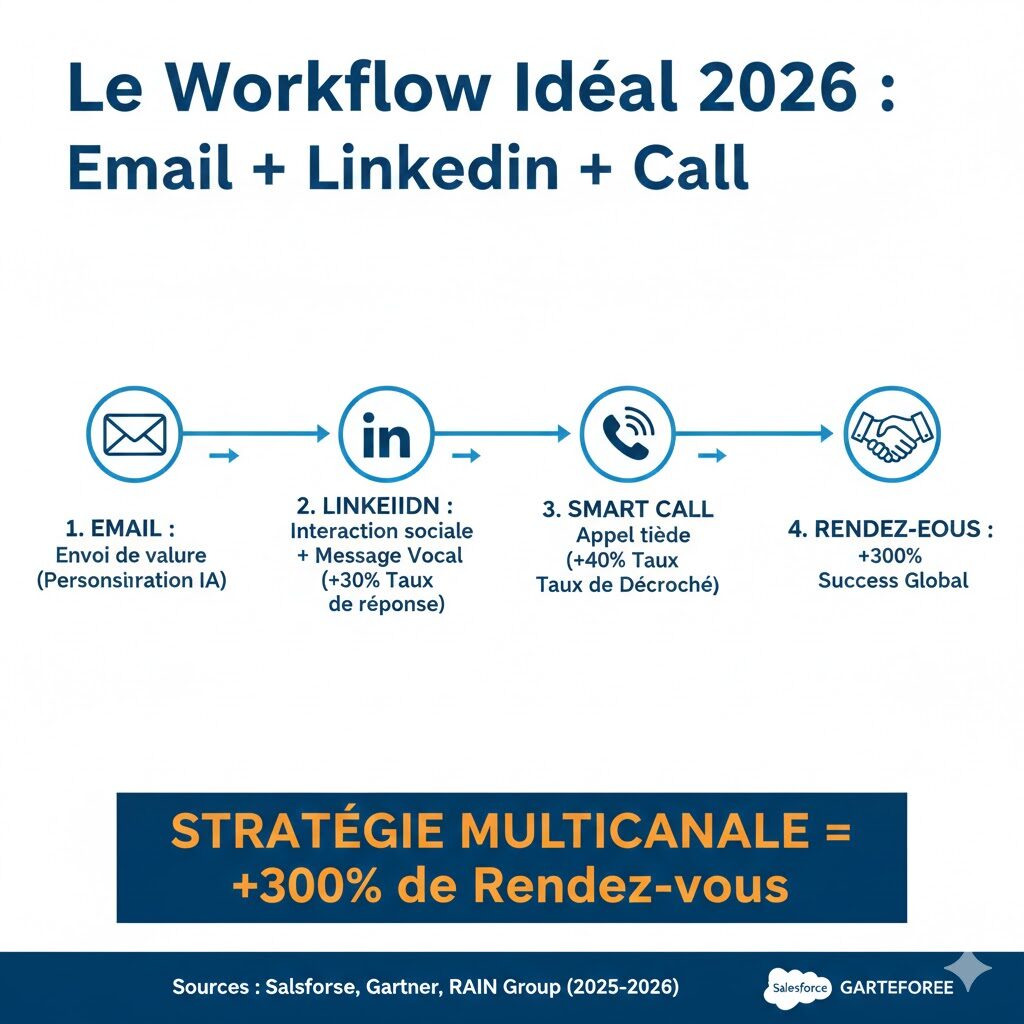
Workflow d’outreach multicanal et cold call
Un workflow d’outreach performant combine plusieurs canaux pour multiplier les points de contact et maximiser la joinabilité. Tu peux structurer ta séquence ainsi :
Email d’introduction : Envoie un message court, personnalisé et non intrusif pour capter l’attention.
Relance LinkedIn : Cible uniquement les prospects qui ont ouvert ton email ou accepté ton invitation.
Cold call : Priorise les contacts ayant montré un intérêt (ouverture, clic, réponse LinkedIn) pour transformer le signal numérique en conversation réelle.
Relance email ou appel : Si besoin, effectue une relance supplémentaire pour maximiser tes chances de prise de rendez-vous.
Pour automatiser et personnaliser tes séquences, utilise des outils adaptés :
Séquences multicanales (email, LinkedIn, appels, SMS)
Rédaction assistée par IA pour optimiser tes messages
A/B testing pour tester différents objets, contenus et timings
Intégrations CRM pour centraliser tes données et suivre l’engagement
Conseil : Un éditeur visuel en glisser-déposer facilite la création et l’ajustement de tes workflows. Tu peux importer des listes de contacts depuis différentes sources et adapter chaque séquence à ton secteur.
Scoring et priorisation des prospects
Le scoring te permet de concentrer tes efforts sur les prospects les plus engagés et les plus susceptibles de convertir. Attribue des points à chaque action détectée :
Ouverture d’email
Clic sur un lien
Réponse LinkedIn
Demande de démo
Participation à un webinaire
Un prospect qui télécharge plusieurs ressources ou visite fréquemment tes pages produits mérite une attention particulière. Ce système de scoring classe automatiquement tes leads par ordre de priorité. Tu peux ainsi organiser tes sessions de cold call en ciblant d’abord les contacts à fort potentiel.
Astuce : Mesure régulièrement tes indicateurs clés pour ajuster ta stratégie :
- Taux de réponse
- Niveau de qualification des leads
- Taux de transformation
- Temps moyen passé au téléphone
- Taux de rebond
- Retour sur investissement par canal
En structurant ta campagne autour de ces trois piliers, tu crées un processus fluide, mesurable et évolutif. Tu augmentes ainsi la qualité de tes rendez-vous et la performance globale de ta prospection multicanal.
Préparer un cold call efficace
Un cold call réussi ne s’improvise pas. Tu dois structurer chaque appel en quatre étapes clés : icebreaker personnalisé, pitch court, gestion des objections, closing et suivi. Cette méthode te permet de maximiser ton taux de conversion et d’installer une relation de confiance dès les premières secondes.
Icebreaker personnalisé
L’icebreaker constitue la première impression. Tu dois capter l’attention de ton interlocuteur et instaurer un climat de confiance. Un message générique ne fonctionne pas : personnalise ton approche en t’appuyant sur des signaux précis ou des informations récentes.
Quelques exemples d’icebreakers efficaces :
Demande comment se passe la journée de ton prospect :
« Bonjour, comment se passe votre journée jusqu’à présent ? »Félicite pour un événement récent :
« Bonjour, j’ai vu que votre entreprise a remporté un prix récemment. Félicitations ! »Fais référence à l’actualité du secteur :
« Bonjour, avez-vous vu les nouvelles concernant la dernière tendance dans votre secteur d’activité ? »Mentionne une connexion commune :
« Bonjour, j’ai vu que vous aviez travaillé avec une entreprise qui est aussi un client de la nôtre. Comment cela s’est-il passé ? »Pose une question sur la stratégie de croissance :
« Bonjour, j’ai récemment lu un article sur votre entreprise qui m’a beaucoup intéressé. Pouvez-vous m’en dire plus sur votre stratégie de croissance ? »
Astuce : Segmente ta liste de prospects et prépare un icebreaker spécifique pour chaque profil. Cette personnalisation augmente significativement le taux d’engagement dès le début du cold call.
Pitch court et impactant pour ton cold call
Après l’icebreaker, tu dois enchaîner avec un pitch concis et percutant. L’objectif : susciter l’intérêt en moins de 40 secondes.
Structure ton pitch autour de trois éléments :
L’accroche : pose un problème ou partage une statistique qui interpelle.
La promesse de valeur : explique en une phrase claire le bénéfice que tu apportes.
Le call-to-action : propose une action concrète, comme un rendez-vous ou une démo.
Exemple de pitch :
« Je travaille avec des entreprises de votre secteur pour réduire de 30 % le temps de traitement des demandes clients. Est-ce un sujet qui vous concerne actuellement ? »
Conseil : Prépare ton script à l’avance, mais ne le lis pas mot à mot. Adapte ton ton et ton discours à chaque interlocuteur pour rester authentique.
Gérer les objections lors du cold call
Les objections font partie intégrante du cold call. Tu dois les anticiper et les traiter avec méthode pour maintenir l’échange.
Voici une démarche efficace :
Pratique l’écoute active. Laisse ton prospect s’exprimer sans l’interrompre.
Pose des questions ouvertes pour comprendre la vraie raison de la réticence.
Reformule l’objection pour montrer que tu as compris, puis propose une solution adaptée.
Réponds en temps réel pour garder l’attention et l’engagement.
Exemple :
Prospect : « Nous sommes déjà équipés. »
Toi : « Je comprends, beaucoup de nos clients étaient déjà équipés avant de découvrir notre solution. Comment évaluez-vous la satisfaction avec votre outil actuel ? »
Note : Prépare une liste des objections les plus courantes et des réponses adaptées avant chaque session de cold call. Cela te permet de rester serein et réactif.
Closing et suivi en cold call
La dernière étape consiste à transformer l’échange en action concrète. Tu dois conclure l’appel en proposant un rendez-vous ou une prochaine étape claire.
Actions à privilégier :
Utilise un call-to-action ferme mais respectueux :
« Seriez-vous disponible pour un échange de 15 minutes cette semaine ? »Si le prospect hésite, propose une alternative :
« Je peux vous envoyer un résumé par email et nous convenons d’un créneau plus tard ? »Note systématiquement les informations clés et planifie un suivi personnalisé après l’appel.
Astuce : Structure chaque appel en quatre temps : icebreaker, pitch, gestion des objections, closing. Respecte le temps de ton interlocuteur et oriente la conversation vers une action précise.
En appliquant cette méthode, tu augmentes la qualité de tes échanges et le taux de transformation de tes cold calls en rendez-vous qualifiés.
Optimiser la gestion des standardistes
Collecter des données utiles
Lorsque tu passes par un standardiste ou un assistant, tu dois voir cette étape comme une opportunité, pas comme un obstacle. Ton objectif consiste à obtenir des informations clés : adresse email, nom du bon interlocuteur, ou même des détails sur la disponibilité du décideur. Pour maximiser tes chances, adopte une attitude professionnelle et empathique dès le début de l’appel.
Prends le temps d’établir une relation cordiale avec le standardiste. Un simple « Bonjour, comment allez-vous aujourd’hui ? » crée un climat positif.
Utilise un langage technique adapté à ton secteur. Cela montre ta crédibilité et rassure ton interlocuteur sur la légitimité de ta démarche.
Prépare-toi à la résistance : si le standardiste hésite, reste calme et réactif. Propose toujours une alternative, comme la vérification d’un email ou la demande d’un contact direct.
Voici quelques formulations efficaces pour obtenir des informations :
« Pouvez-vous me confirmer l’adresse email de Mme Martin pour lui envoyer un résumé de notre proposition ? »
« Je souhaite transmettre une opportunité d’optimisation à M. Dupuis. Pourriez-vous m’indiquer le meilleur moyen de le joindre ? »
N’oublie pas de faire des recherches sur l’entreprise avant d’appeler. Tu montres ainsi que tu connais le contexte et tu gagnes la confiance du standardiste.
Créer une urgence contextuelle
Pour obtenir une réponse rapide, tu dois parfois créer une urgence contextuelle. Utilise des termes positifs et valorisants : parle d’« opportunité » ou d’« optimisation de l’efficacité ». Explique brièvement pourquoi ton message mérite une attention immédiate.
Précise que tu souhaites envoyer un résumé court ou une information importante.
Mentionne un événement d’actualité ou une échéance proche pour contextualiser ta demande.
Reste empathique et collaboratif : montre que tu comprends la charge de travail du standardiste.
Astuce : Un ton respectueux et une demande claire augmentent tes chances d’obtenir l’information recherchée. Tu facilites ainsi la suite de ta prospection et tu améliores la qualité de ta base de données.
Rythme, volume et outils de prospection
Adapter le rythme selon le marché
Tu dois adapter ta cadence de prospection à la taille et à la maturité de ton marché. Sur un marché restreint, une approche chirurgicale s’impose : tu privilégies la personnalisation et la qualité des échanges. Tu analyses chaque prospect, tu ajustes tes messages et tu multiplies les points de contact pour créer une relation de confiance. Cette méthode fonctionne particulièrement bien avec des cycles de vente longs ou des interlocuteurs difficiles à joindre.
Sur un marché large, tu adoptes une stratégie de volume. Tu utilises des séquences automatisées et tu segmentes ta base pour toucher un maximum de prospects. Tu relies chaque point de contact à un objectif précis : détecter les signaux d’intérêt, qualifier rapidement et prioriser les leads les plus prometteurs.
Voici quelques bonnes pratiques pour ajuster ton rythme :
Les cycles de vente longs exigent un nurturing régulier et du contenu éducatif pour maintenir l’intérêt.
Une segmentation fine t’aide à optimiser tes ressources, surtout si tu travailles avec une petite équipe.
Identifie les prospects à fort potentiel selon leur secteur, taille et maturité.
Prends en compte les contraintes de temps de tes interlocuteurs pour planifier tes relances.
Astuce : Structure ton entonnoir de prospection avec des points de contact réguliers pour ne jamais perdre le fil avec tes prospects.
Utiliser les bons outils
Pour accélérer ta prospection multicanal, tu dois t’équiper d’outils performants. Ces solutions te permettent d’automatiser, de personnaliser et de suivre chaque interaction sans perdre en efficacité.
Lemlist : Cet outil te permet d’automatiser l’envoi de campagnes emails, de messages LinkedIn et d’appels téléphoniques. Tu bénéficies d’une personnalisation avancée grâce à l’intelligence artificielle.
La Growth Machine : Cette solution tout-en-un facilite la prospection B2B. Tu peux envoyer des séquences personnalisées sur plusieurs canaux et gérer toutes les réponses dans une boîte de réception unifiée.
Power dialers : Ils accélèrent tes sessions d’appels en enchaînant automatiquement les numéros, ce qui augmente ton volume de contacts quotidiens.
Click-to-call : Cette fonctionnalité te permet de lancer un appel en un clic depuis ton CRM ou ta liste de prospects.
Détection de répondeur : Tu évites de perdre du temps sur les messageries vocales et tu concentres tes efforts sur les conversations réelles.
Conseil : Combine ces outils pour gagner en productivité et garder une vision claire de tes performances. Tu peux ainsi ajuster ta stratégie en temps réel et maximiser ton taux de rendez-vous.
Exemples de séquences multicanal

Tu veux maximiser tes rendez-vous ? Structure ta prospection avec des séquences multicanal adaptées à ton marché. Voici trois exemples concrets pour t’inspirer.
Séquence simple
Pour démarrer, tu peux mettre en place une séquence simple qui combine email et cold call. Cette méthode fonctionne très bien pour tester un segment ou lancer une nouvelle offre.
Définis ta cible et ton objectif (par exemple, obtenir une démo ou qualifier un besoin).
Planifie tes points de contact sur 10 à 20 jours : commence par un email court, puis relance par téléphone le lendemain.
Alterne entre email et appel, sans surcharger ton prospect.
Rédige des messages qui se répondent : chaque relance fait référence au contact précédent.
Prévois des scénarios selon la réponse : intéressé, à rappeler, silencieux.
Suis tes résultats dans ton CRM.
Ajuste la séquence après analyse des taux d’ouverture et de réponse.
Astuce : Les séquences multicanal bien orchestrées génèrent jusqu’à 18 % de taux de réponse. Plus tu multiplies les points de contact, plus tu obtiens de rendez-vous.
Séquence avancée
Pour des cycles de vente plus longs ou des comptes stratégiques, tu peux enrichir ta séquence :
Ajoute un message LinkedIn après le premier email.
Prévoyez un contenu à valeur ajoutée (étude de cas, livre blanc) dans la deuxième relance.
Utilise un SMS court pour rappeler un rendez-vous ou confirmer un échange.
Segmente tes relances selon les signaux détectés (clics, ouvertures, réponses LinkedIn).
Mets en place un tableau de bord pour suivre chaque interaction et prioriser les prospects les plus engagés.
Cette approche crée une expérience cohérente sur plusieurs plateformes et augmente la probabilité de prise de contact.
Adaptation sectorielle
Chaque secteur a ses spécificités. Tu dois adapter ta séquence pour maximiser l’impact :
Industrie manufacturière : privilégie un suivi régulier, car les cycles de décision sont longs (taux de conversion entre 3 % et 8 %).
Santé : adopte une approche spécialisée et respecte les contraintes réglementaires (taux de conversion de 4 % à 7 %).
Services financiers : mets en avant la conformité et la fiabilité, ce qui rassure tes prospects (taux de conversion de 5 % à 12 %).
Conseil : Personnalise toujours tes messages selon le secteur et le profil du décideur. Tu augmentes ainsi la pertinence de ta prospection et tes chances de rendez-vous.
Checklist des erreurs à éviter
Avant chaque session de prospection, tu dois vérifier quelques points essentiels pour éviter les erreurs qui freinent tes résultats. Voici les pièges les plus fréquents et comment les contourner.
Timing et cadence
Tu dois organiser ta campagne en alternant les canaux : téléphone, email, LinkedIn. Une séquence efficace comporte au moins huit contacts sur deux semaines. Chaque interaction doit apporter une information nouvelle pour maintenir l’intérêt du prospect. La régularité et la qualité des échanges priment sur le volume.
Ne surcharge pas tes prospects de messages identiques.
Planifie tes relances pour garder le rythme sans devenir intrusif.
Varie le contenu à chaque contact.
Conseil : La constance dans tes interactions crée une dynamique positive et augmente tes chances de conversion.
Personnalisation insuffisante
Tu dois adapter chaque message à ton interlocuteur. Les prospects répondent davantage aux communications qui les concernent directement.
Utilise le nom du destinataire dans tes emails et appels.
Personnalise le contenu selon le secteur ou les problématiques du prospect.
Évite les messages génériques qui nuisent à la relation.
Astuce : Un message personnalisé multiplie le taux de réponse et renforce la crédibilité de ta démarche.
Suivi et relance oubliés
Un suivi structuré fait toute la différence. Tu dois relancer systématiquement après chaque contact.
Première relance : Suivi de l’échange initial.
Deuxième relance : Rappel du sujet ou de la valeur ajoutée.
Relance finale : Clôture ou proposition de porte de sortie.
Utilise plusieurs canaux pour relancer (email, téléphone).
Personnalise chaque relance.
Respecte un calendrier précis : relance valeur ajoutée (jour 3-5), relance sociale proof (jour 7-8), relance finale (jour 12-14).
Relancer un client est toujours plus rentable que d’en trouver de nouveaux ! Établis un plan de relance et respecte les échéances.
Priorisation des signaux
Tu dois analyser les signaux d’engagement pour prioriser tes actions.
Ne néglige pas les prospects qui montrent un intérêt (ouverture, clic, réponse).
Une mauvaise priorisation peut entraîner une perte de rentabilité et d’opportunités de conversion.
Classe tes leads selon leur niveau d’engagement pour maximiser la performance de ta campagne.
Note : L’apprentissage de ta campagne dépend de ta capacité à prioriser les bons signaux.
Checklist rapide avant d’appeler :
Ai-je alterné les canaux ?
Mes messages sont-ils personnalisés ?
Mon plan de relance est-il structuré ?
Ai-je priorisé les prospects engagés ?
Tu évites ainsi les erreurs classiques et tu optimises chaque session de prospection multicanal.
Optimiser et itérer la stratégie
Mesurer et ajuster
Pour améliorer ta prospection multicanal, tu dois mesurer les bons indicateurs. Ces données te permettent d’identifier ce qui fonctionne et d’ajuster rapidement ta stratégie. Voici les principaux KPI à suivre :
Taux de conversion par canal : tu repères les canaux qui génèrent le plus de rendez-vous.
Taux d’engagement sur les réseaux sociaux et dans tes campagnes email : tu évalues l’intérêt de tes prospects.
Taux de retour et feedback client par canal : tu analyses la satisfaction et la pertinence de tes messages.
Tu dois centraliser ces données dans ton CRM ou un tableau de bord. Cela t’aide à visualiser les tendances et à prendre des décisions basées sur des faits. Si tu constates qu’un canal sous-performe, ajuste la fréquence ou le contenu de tes messages. Mets l’accent sur les points de contact qui apportent le plus de valeur.
Astuce : Mets en place un reporting hebdomadaire pour suivre l’évolution de tes résultats. Tu gagnes en réactivité et tu corriges plus vite les écarts.
Tester et améliorer
Pour progresser, tu dois tester régulièrement tes accroches et tes séquences. La méthode A/B testing reste la plus efficace pour optimiser chaque étape de ta prospection. Voici comment procéder :
Teste l’objet de l’email pour améliorer le taux d’ouverture.
Teste la phrase d’accroche pour augmenter le taux de lecture.
Teste le copywriting pour optimiser l’engagement des lecteurs.
Teste le call to action pour améliorer le taux de réponse ou de clic.
Chaque test doit se focaliser sur une variable unique. Modifier une seule variable par test permet d’isoler les facteurs source d’amélioration.
Tu dois analyser les résultats de chaque test et appliquer les meilleures variantes à l’ensemble de ta campagne. Cette démarche d’itération continue te permet d’augmenter la performance de ta prospection multicanal et de rester compétitif sur ton marché.
Pour réussir ta campagne multicanal, tu dois miser sur la discipline, la qualité de tes données et une vraie curiosité pour comprendre tes prospects. Mets l’accent sur la cohérence de ta marque, l’intégration des données et la personnalisation de chaque message. Teste, score et priorise chaque signal pour transformer l’intérêt en rendez-vous. Lance un pilote sur un segment précis, mesure les résultats et optimise sans relâche. Comme Antoine, tu verras que l’itération continue démultiplie tes opportunités commerciales.
FAQ
Comment choisir le bon moment pour appeler un prospect ?
Tu dois analyser les signaux d’engagement : ouverture d’email, clic sur un lien ou réponse LinkedIn. Privilégie un créneau en matinée ou en début d’après-midi. Ces moments augmentent tes chances de joindre un décideur.
Quelle est la durée idéale d’un cold call ?
Tu dois viser un appel de 3 à 5 minutes. Présente-toi rapidement, expose la valeur ajoutée, puis propose un rendez-vous. Reste concis pour capter l’attention et obtenir un engagement.
Faut-il personnaliser chaque email ?
Oui, tu dois personnaliser chaque message. Utilise le nom, la fonction ou une actualité récente du prospect. Cette démarche augmente le taux de réponse et montre ton professionnalisme.
Quels outils facilitent la prospection multicanal ?
Tu peux utiliser des outils comme Lemlist, La Growth Machine ou un power dialer. Ces solutions automatisent tes séquences, centralisent les réponses et améliorent ton suivi.
Comment mesurer l’efficacité d’une campagne multicanal ?
Tu dois suivre le taux de rendez-vous, le taux de réponse et le niveau d’engagement. Utilise un tableau de bord pour visualiser tes résultats et ajuster ta stratégie en temps réel.
Voir également
L’Impact Du Cold Emailing Sur Votre Réseau Professionnel
Conseils Pour Améliorer Vos Campagnes De Cold-Mailing
Techniques Pour Automatiser Votre Prospection Commerciale
Approches Efficaces Pour Obtenir Des Rendez-Vous B2B
Approche CROC : Structurer Efficacement Votre Prospection Téléphonique