
With AI tools for marketing, artificial intelligence is profoundly transforming marketing by 2025. It influences every aspect, from data analysis and content creation to campaign personalization. Today, 75% of marketing departments already use GenAI , and 10% have fully integrated it into their strategy. In Europe, 67% of micro, small, and medium-sized enterprises (MSMEs) leverage these technologies to remain competitive. You can't ignore this trend if you want to optimize your performance. The best AI tools for marketing are becoming essential allies for innovating and engaging your customers.
Key points on the best AI tools for marketing to use
Artificial intelligence will change marketing in 2025. It will become important to remain competitive.
Tools that automatically write , such as ChatGPT and Jasper, help to work faster and create better texts.
AI tools for marketing image creation, such as Canva and Adobe Sensei, make the process easy. They allow users to create beautiful images without being experts.
Ad management platforms , such as Albert AI, make campaigns cheaper and more effective.
AI tools for recommendation marketing, such as Salesforce Einstein, make the customer experience unique. This helps keep customers happy and loyal.
Best AI tools for marketing and content creation
Automated text generators (e.g., ChatGPT, Jasper)
Automated text generators are revolutionizing the way you create marketing content. These AI-powered marketing tools, like ChatGPT and Jasper , significantly boost your productivity. ChatGPT, developed by OpenAI, generates customized text in seconds. You can use it to write blog posts, product descriptions, or even advertising scripts. Jasper, on the other hand, excels at producing SEO-optimized content . It automates text creation, saving you time and improving your marketing performance.
Here are some key advantages:
Jasper produces SEO-optimized text five times faster than a human writer.
Jasper automates the production of SEO content , thereby increasing the efficiency of writers.
These AI tools for marketing allow you to stay competitive in a constantly evolving market. By using the best AI tools, you can not only accelerate your processes but also ensure consistent quality in your campaigns.
Visual creation tools (e.g., Canva, Adobe Sensei)
AI-powered tools for creative marketing simplify graphic design and deliver professional results, even without advanced skills. Canva, with its intuitive interface, helps you create impactful visuals for your social media, presentations, or advertising campaigns. Its Magic Studio automatically generates custom images tailored to your needs. Adobe Sensei, on the other hand, uses machine learning to refine your designs. You can adjust the brightness, contrast, and sharpness of your visuals in just a few clicks.
These AI tools for marketing allow you to:
Create interactive and personalized designs.
Automate the generation of images and videos.
Easily integrate your creations into platforms like Adobe Photoshop.
By using Canva and Adobe Sensei, you can transform your ideas into captivating visuals, thereby strengthening the impact of your marketing campaigns.
Video creation platforms (e.g., Synthesia)
Video has become an essential format for engaging your audience. Synthesia, an AI-powered platform, lets you create professional-looking videos without the need for expensive equipment or technical skills. You can generate realistic avatars, add voiceovers, and customize your videos to reflect your brand. Synthesia is especially useful for tutorials, company presentations, and advertising campaigns.
The benefits include:
A significant reduction in video production costs.
The ability to create multilingual videos to reach an international audience.
Advanced personalization to strengthen your brand identity.
With Synthesia, you can integrate high-quality videos into your marketing strategies, thereby increasing engagement and conversion.
Performance indicators of AI tools for marketing
AI tools for marketing and content creation have a measurable impact on your marketing performance. Here are some key figures:
Indicator | Percentage |
|---|---|
Using AI for content creation | |
Enriching customer intelligence | 64 % |
Process automation | 62 % |
Analytics and augmented decision-making | 59 % |
Personalizing the customer experience | 57 % |
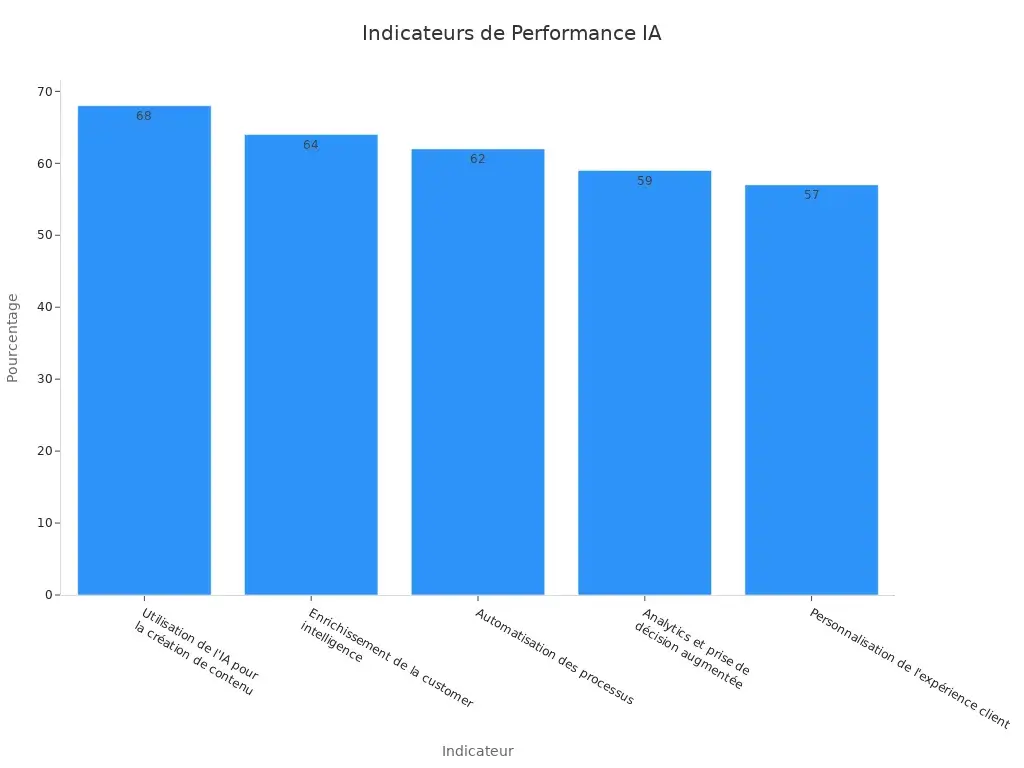
This data clearly shows that integrating the best AI tools for marketing into your marketing strategies can transform your results.
Best AI tools for marketing and advertising optimization
Programmatic buying platforms (e.g., Albert AI)
Programmatic buying platforms, like Albert AI , are transforming advertising campaign management. These AI-powered marketing tools use artificial intelligence to automate and optimize the purchase of ad space in real time. Albert AI analyzes millions of data points in seconds, identifies the best opportunities, and adjusts campaigns to maximize their impact.
With Albert AI, you can:
Automate campaign management across multiple platforms (Google, Facebook, Instagram).
Identify the most relevant audiences through behavioral analysis.
Reduce advertising costs while increasing conversions.
By using a platform like Albert AI, you save time and improve your advertising performance. This allows you to focus on strategic tasks, while letting AI handle the technical aspects.
Predictive analytics tools (e.g., Google Ads AI, Meta Ads AI)
AI tools for marketing and predictive analytics, such as Google Ads AI and Meta Ads AI, play a key role in optimizing advertising campaigns. These technologies leverage advanced algorithms to anticipate user behavior and adjust strategies accordingly.
Here's how these AI marketing tools improve your campaigns:
Conversion optimization : An average increase of 18% in conversion rate compared to manual campaigns.
Intelligent retargeting : Re-engaging internet users with personalized ads, reducing the abandonment rate.
Creating lookalike audiences : Identifying new potential customers with high conversion rates.
Type of result | Value |
|---|---|
18% | |
Increase in conversions | 30% |
Cost reduction per lead | 25% |
Increased performance | 20% |
Additional clicks generated | 42% |
Performance improvement | 40% |
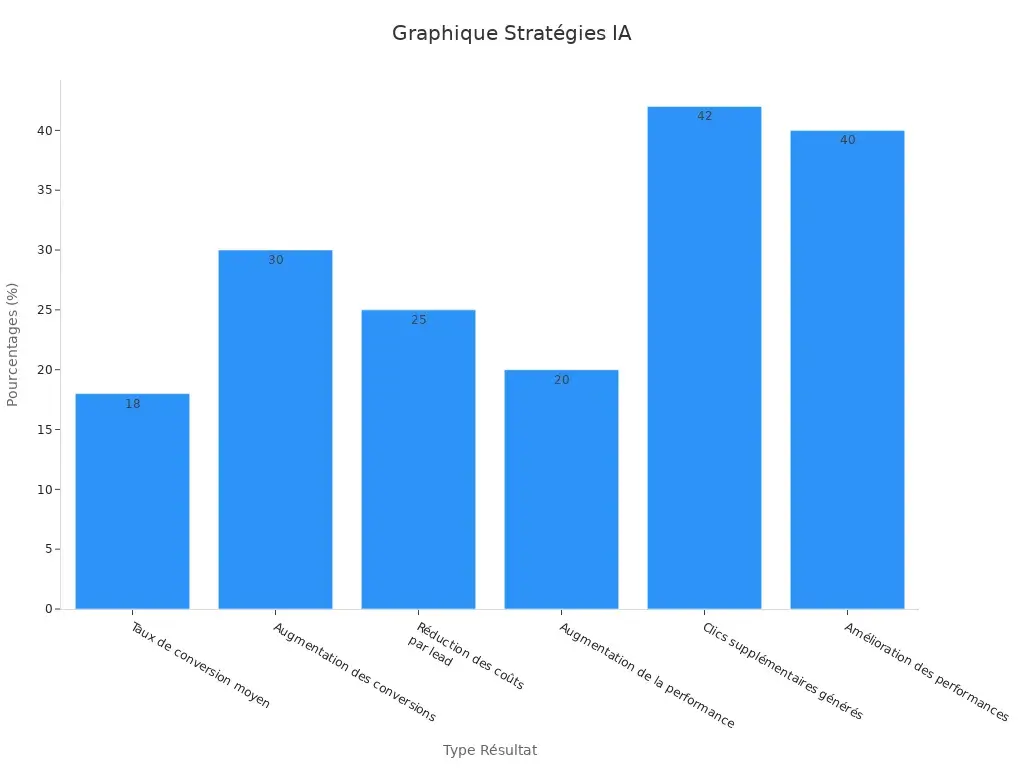
By integrating these AI tools for marketing into your strategies, you benefit from hyper-personalization that improves engagement and the overall performance of your campaigns.
Advertising auction optimization solutions (e.g., Adzooma)
Adzooma is a powerful solution for optimizing your advertising bids. This tool analyzes your campaigns in real time and suggests adjustments to maximize their profitability. Thanks to its user-friendly interface, you can easily identify opportunities for improvement and apply the recommendations with a single click.
Adzooma's main advantages include:
A reduction in cost per click thanks to optimized bidding.
Simplified campaign management across multiple advertising platforms.
Detailed reports to track performance and adjust your strategies.
By using Adzooma, you can improve the profitability of your campaigns while reducing the time spent managing them. This tool is particularly useful for small and medium-sized businesses looking to maximize their return on investment.
Best AI tools for marketing for customer personalization
Recommendation engines (e.g., Salesforce Einstein)
Recommendation engines , like Salesforce Einstein, are transforming how you personalize the customer experience. These AI-powered marketing tools analyze real-time data to suggest products or services tailored to each user's preferences. For example, Netflix uses over 1,300 recommendation engines to analyze viewing habits, contributing to a customer retention rate exceeding 90% . Amazon, meanwhile, generates approximately 35% of its revenue through its recommendation system. These figures demonstrate just how much these technologies can boost your performance.
With Salesforce Einstein, you can:
Identify the most relevant products for each customer.
Anticipating needs through predictive analytics.
Improve customer engagement by offering personalized recommendations.
By integrating a recommendation engine, you optimize your campaigns and strengthen customer loyalty.
Behavioral analysis tools (e.g., Emplifi)
AI tools for marketing and behavioral analytics, like Emplifi, help you understand your customers' expectations. These solutions collect and analyze user interactions on your platforms, allowing you to identify trends and adjust your strategies accordingly. For example, Sephora increased its conversion rate by 80% thanks to personalized recommendations on its mobile app. This demonstrates the direct impact of behavioral analytics on your results.
With Emplifi you can:
Track user behavior in real time.
Identify the points of friction in the customer journey.
Tailor your campaigns to meet the specific expectations of each segment.
These AI tools for marketing allow you to make decisions based on concrete data, thus improving the customer experience.
Advanced segmentation platforms (e.g., ActiveCampaign)
Advanced segmentation platforms, like ActiveCampaign, allow you to personalize your marketing campaigns at scale. These AI-powered marketing tools automatically segment your audience based on specific criteria, such as preferences or behaviors. ActiveCampaign offers features like creating personalized customer journeys and automating interactions, so you can send the right message at the right time.
Here's what you can accomplish with ActiveCampaign:
Identify satisfied and dissatisfied customers.
Personalize your communications for each segment.
Automate interactions to save time.
By using an advanced segmentation platform, you improve the relevance of your campaigns and maximize your conversions. These solutions are among the best AI tools for marketing to optimize your marketing strategies.
Best AI tools for marketing automation
Campaign management software (e.g., HubSpot AI)
Campaign management software , like HubSpot AI, simplifies the planning and execution of your marketing strategies. HubSpot AI analyzes customer data to identify the most qualified leads. It then provides recommendations to optimize your campaigns. You can automate repetitive tasks, such as sending emails or managing leads, while maintaining complete control over your actions.
With HubSpot AI, you benefit from:
Intelligent segmentation of your audience.
Suggestions based on real-time data.
Seamless integration with other AI tools for marketing.
By using software like HubSpot AI, you save time and improve the accuracy of your campaigns. This allows you to focus on strategic initiatives.
Automation of marketing emails (e.g. Drift Email, Phrasee)
Marketing email automation transforms your campaigns into powerful conversion drivers. Drift Email and Phrasee use artificial intelligence to personalize your messages and optimize their impact. Drift Email analyzes interactions in real time to send emails at the perfect moment. Phrasee, meanwhile, generates engaging subject lines and content using natural language processing.
The results speak for themselves:
27% of companies are seeing a 27% increase in engagement rates.
50% of automated campaigns generate 50% more leads.
53% of companies achieve a return on investment that is 53% higher.
These AI marketing tools allow you to maximize the effectiveness of your campaigns while reducing manual effort. This enables you to achieve your marketing goals faster.
AI tools for marketing and social media management (e.g., Buffer AI)
Social media plays a key role in your marketing strategy. Buffer AI helps you manage your posts and analyze their performance. This tool identifies the best times to post and suggests adjustments to maximize engagement. You can schedule your posts in advance and track their impact with detailed reports.
With Buffer AI you can:
Automate the publishing of your content.
Identify the trends that captivate your audience.
Adjust your strategies based on the data collected.
By integrating Buffer AI into your workflow, you optimize your social media presence while saving time. This allows you to remain competitive in a constantly evolving digital environment.
Best AI tools for customer service marketing
Intelligent chatbots (e.g. Drift, Intercom)
Intelligent chatbots are revolutionizing customer service management. With AI marketing tools like Drift and Intercom, you can automate up to 80% of common inquiries. These solutions reduce ticket volume and provide instant answers to frequently asked questions. Motel Rocks, for example, saw a 10% improvement in its Customer Satisfaction Score (CSAT) after implementing them.
Here's what these chatbots bring to your business:
A reduction in response times for simple requests.
A seamless customer experience thanks to rapid interactions.
A reduction in workload for your teams.
By integrating these AI tools into your marketing, you improve customer satisfaction while optimizing your resources. Intelligent chatbots thus become indispensable allies for providing fast and efficient service.
Virtual assistants (e.g., ChatGPT)
Virtual assistants, like ChatGPT , are bringing a new dimension to customer service. These AI-powered marketing tools allow for personalized interactions while reducing response times. Companies save up to 2.5 billion work hours annually thanks to these solutions. IKKS, for example, has automated 79% of its conversations and seen a 52% increase in assisted visitors.
The benefits of AI tools for marketing include:
A 50% reduction in the time required to complete a purchase.
A 24% improvement in customer satisfaction.
An average increase of 20% in the conversion rate.
With ChatGPT, you can offer a personalized and efficient customer experience, while strengthening customer loyalty.
AI tools for sentiment analysis marketing (e.g., Sprout Social AI)
Understanding your customers' emotions is essential for improving their experience. Sprout Social AI analyzes the sentiments expressed in interactions, allowing you to tailor your responses accordingly. This tool identifies trends and pain points, helping you adjust your strategies.
Key features include:
Real-time analysis of comments and messages.
Identifying opportunities to enhance customer satisfaction.
Optimizing interactions to meet specific expectations.
By using Sprout Social AI, you can better understand your customers and offer them a service that meets their needs. This strengthens their engagement and loyalty to your brand.
Best AI tools for marketing analytics and insights
Marketing data analytics platforms (e.g., Tableau AI)
Platforms like Tableau AI transform your raw data into actionable insights. This tool helps you visualize the performance of your marketing campaigns through interactive dashboards. You can quickly identify what's working and what needs improvement. Tableau AI simplifies trend analysis and empowers you to make informed decisions.
Here are some key indicators you can track :
Sessions : Measure the number of visits to your website.
CAC (acquisition cost) : Evaluate how much each new contact costs.
Number of conversions : Identify how many visitors become customers.
Conversion rate : Analyze the percentage of visitors who complete a desired action.
Average spend : Discover how much each customer spends on average.
Shopping cart abandonment rate : Identify customers who leave before completing their purchase.
With Tableau AI, you get a clear view of your marketing performance. This allows you to adjust your strategies to maximize your results.
AI tools for competitive intelligence marketing (e.g., SEMRush, Ahrefs AI)
tools for competitive intelligence marketing , such as SEMrush and Ahrefs AI, help you monitor your competitors and identify opportunities. SEMrush analyzes the keywords your rivals use and shows you how to improve your SEO strategy. Ahrefs AI, on the other hand, focuses on backlinks and competitor website performance.
With these AI tools for marketing, you can:
Identify the keywords that generate traffic for your competitors.
Discover the sites that redirect to your rivals and establish similar partnerships.
Analyze high-performing content to adapt your strategy.
These solutions allow you to remain competitive by anticipating your competitors' moves and optimizing your online presence.
Predictive analytics solutions (e.g., Google Analytics 4)
Google Analytics 4 revolutionizes predictive analytics in marketing. This tool uses artificial intelligence to anticipate user behavior, allowing you to adapt your campaigns before your customers even make a decision. Google Analytics 4 helps you understand the customer journey and identify pain points.
The benefits include:
A better understanding of user preferences.
Recommendations to improve your campaigns.
Optimizing return on investment through accurate data.
By integrating Google Analytics 4, you can predict your customers' needs and adjust your strategies to maximize your results.
Best AI tools for marketing, SEO, and search engine optimization
Keyword generators (e.g., Frase.io, MarketMuse)
AI-powered keyword generators, such as Frase.io and MarketMuse, simplify the search for strategic terms for your content. These AI marketing tools analyze trends and identify the most relevant keywords for your audience. Frase.io stands out for its ability to extract high-potential keywords based on competitor performance. MarketMuse, on the other hand, uses machine learning to suggest terms that enhance the semantic relevance of your text.
With these AI tools for marketing, you can:
Quickly identify high-volume search keywords.
Optimize your content to meet the expectations of search engines.
Improve your ranking for specific search queries.
By integrating these solutions, you save time and increase your chances of attracting qualified traffic.
Other AI tools for content optimization marketing (e.g., SurferSEO, Clearscope)
SurferSEO and Clearscope are transforming the way you optimize your content. SurferSEO analyzes over 500 factors to provide you with precise recommendations. It helps you structure your articles and integrate essential keywords. Clearscope, on the other hand, focuses on improving semantic quality. It offers suggestions to enrich your texts and make them more relevant to search engines.
Here's what these AI marketing tools allow you to do:
Compare your content with that of the top-ranked competitors.
Identify the gaps in your current texts.
Get recommendations to improve readability and engagement.
These AI tools for marketing guarantee effective optimization, thus increasing your chances of reaching the first page of search results.
SEO performance analyzers (e.g., SEMRush)
SEO performance analyzers, like SEMrush, give you a comprehensive view of your SEO efforts. SEMrush tracks your rankings for strategic keywords and analyzes the quality of your organic traffic. It also identifies opportunities for improvement to maximize your conversions.
Key indicators tracked by SEMRush:
Organic traffic
Traffic quality
Positions on strategic keywords
Organic conversions
Number of keywords ranked
To learn more:
Regularly monitor the ranking of your targeted queries.
Analyze the conversions resulting from your SEO traffic.
Monitor the positions to adjust your strategies.
With SEMRush, you gain valuable insights to refine your campaigns and improve your results.
AI tools for marketing and social media management

Automated content schedulers (e.g., Lately)
Automated content planners, like Lately, are transforming social media management. Lately uses artificial intelligence to analyze your existing content and extract the most engaging elements. These extracts are then transformed into posts tailored to each social platform. You save time while maximizing the impact of your messages.
With Lately you can:
Automatically generate posts from long-form content, such as articles or videos.
Schedule your posts across multiple platforms with a single click.
Analyze performance to adjust your strategies.
This tool helps you maintain a consistent presence on social media, while optimizing your marketing efforts.
Understanding social trends is essential to staying relevant. Emplifi helps you identify the topics that resonate with your audience. This tool analyzes interactions across your platforms and detects opportunities to engage your followers. For example, it can reveal the most effective hashtags or content formats.
With Emplifi you can:
Track mentions of your brand in real time.
Identify the influencers relevant to your campaigns.
Adapt your content to the expectations of your audience.
By using Emplifi, you improve your strategy based on concrete data. This strengthens your connection with your community.
Interaction management solutions (e.g., Sprout Social AI)
Sprout Social AI simplifies managing interactions with your followers. This tool brings all your messages and comments together in one place. You can respond quickly and personalize your exchanges. Sprout Social AI also analyzes the sentiment expressed in interactions, helping you better understand your customers.
Key metrics tracked by Sprout Social AI include:
Engagement rate.
Click on the links.
Conversions.
Time spent on the site.
Companies like Spotify have quintupled their automated marketing campaigns thanks to these AI marketing tools. Cdiscount, for its part, has tripled the ROI of its promotions by personalizing its interactions. By integrating Sprout Social AI, you improve engagement and optimize your performance on social media.
The best AI tools for marketing are transforming marketing in 2025. They increase ROI, improve conversion rates, and optimize customer engagement. For example, AI-powered personalized email campaigns show open rates up by 59% , while highly personalized recommendations increase average order value by 20%. By adopting these technologies, you can automate your processes, personalize your campaigns, and outperform your competitors. Test these solutions now to maximize your performance and achieve your strategic goals.
Good to know about AI tools for marketing to use in 2025
Expert references and credible studies
Recent studies
: A Gartner analysis (2024) reveals that 80% of marketing teams will integrate AI tools for marketing into their workflows by 2025. For further information: Gartner Marketing Technology Survey
McKinsey's report, "The State of AI in Marketing 2024," demonstrates that companies using generative AI see a 35% increase in their marketing ROI. See the full study: McKinsey AI in Marketing Report
Recognized experts in AI tools for marketing.
According to Philip Kotler, Professor Emeritus at the Kellogg School of Management: “AI marketing is redefining the fundamentals of the customer journey.” His full analysis is available here: Kotler Marketing Group
Ann Handley, Chief Content Officer of MarketingProfs, emphasizes: “AI tools for content marketing should amplify the human voice, not replace it.” Her latest book, “Everybody Writes,” delves deeper into this concept: MarketingProfs Resources
Detailed testimonials on AI tools for marketing
Testimonial 1:
“Our team integrated Jasper.ai for content creation and reduced our production time by 60% while improving our engagement by 25%.” – Sarah Johnson, CMO at TechGrowth Inc. Source: TechGrowth Case Study
Testimonial 2
: “Albert AI’s predictive analytics enabled us to optimize our digital campaigns with unprecedented accuracy, generating 40% more qualified leads.” – David Chen, Digital Marketing Director at OmniRetail. See the full study: OmniRetail Success Story
In-depth case studies of AI tools for marketing
Case 1: Transformation at L'Oréal.
L'Oréal deployed an AI platform integrating Persado for language personalization, resulting in a 28% increase in email conversion rates. Full details: L'Oréal Digital Transformation
Case 2: Sephora Experience.
Sephora's AI application enabled a 31% increase in cross-channel sales thanks to hyper-personalized recommendations. Detailed analysis: Sephora Retail Technology
Real user experiences
Experience 1
“As a freelancer, Copy.ai has allowed me to increase my writing productivity fivefold while maintaining my unique voice.” – Emma Rodriguez, Content Marketing Consultant. Portfolio: Emma Rodriguez Marketing
Experience 2
: “The video synthesis tool Synthesia.io saved us €15,000 in video production this year.” – Thomas Leroy, Media Manager at StartUp France. Video testimonial: StartUp France YouTube
Segmentation of AI tools for marketing
Type of company | Recommended tools | Main use case |
|---|---|---|
TPE | Canva Magic Write | Quick visual creation |
SMEs | HubSpot Content Assistant | Marketing automation |
ETI | Salesforce Einstein | Predictive analytics |
Startups | Jasper.ai | Content generation |
Key accounts | IBM Watson Advertising | Cognitive advertising |
Diagram: AI Implementation Cycle – From Audit to Continuous Optimization
Questions and Answers about AI Tools for Marketing
1. Which AI tool is best suited for small businesses?
Very small businesses particularly benefit from AI marketing tools like Canva and Magic Write due to their value for money and ease of use. See the full comparison: Forrester Small Business Tech
2. How can we guarantee the authenticity of AI-generated content?
The approach recommended by the Content Authenticity Initiative combines AI tools for marketing with human validation. Learn more: Content Authenticity Initiative
3. What legal risks should be considered?
The GDPR imposes strict rules on the use of data for AI marketing. Consult the guidelines: CNIL AI and Marketing
4. How do you measure the ROI of AI tools for marketing?
The measurement framework proposed by MIT includes 5 key KPIs. Full methodology: MIT Sloan Marketing Metrics
5. Will AI tools for marketing replace marketers?
As Rand Fishkin, founder of SparkToro, explains: “AI is a skill amplifier, not a replacement.” In-depth analysis: SparkToro Blog
6. What budget should be allocated to implement these AI tools for marketing?
A Deloitte study reveals average costs ranging from €5,000 to €50,000 per year, depending on company size. Details: Deloitte Marketing Tech Costs
7. How do you train your teams on these new AI tools for marketing?
The American Marketing Association's certification programs cover AI marketing. Training catalog: AMA Training
8. What AI trends are emerging for 2025?
The CB Insights report identifies 5 major trends. Access the report: CB Insights AI Trends
9. How do you choose between a SaaS solution and custom development?
Gartner's comparative analysis provides a clear decision-making framework. Evaluation matrix: Gartner Marketing Tech Guide
10. Are there AI tools for industry-specific marketing?
Yes, as explained in the Harvard Business Review, verticalization is accelerating. Full article: HBR Vertical AI
FAQ about AI tools for marketing
What are the advantages of using AI tools for marketing?
AI tools boost your productivity. They automate repetitive tasks, analyze data quickly, and personalize your campaigns. You save time, reduce costs, and improve your results. These AI marketing tools also allow you to better understand your customers and optimize your strategies .
How do I choose the best AI marketing tool for my business?
Identify your specific needs. If you want to automate emails, choose a tool like Drift Email. For SEO, opt for SurferSEO. Compare the features, costs, and possible integrations with your existing systems.
Are AI tools for marketing suitable for small businesses?
Yes, many AI marketing tools, like Canva or Buffer AI, are affordable and easy to use. They help small businesses save time and improve efficiency. You can start with simple solutions and scale as needed.
Are AI tools for marketing replacing humans in marketing?
No, AI tools for marketing complement your work. They automate repetitive tasks and provide insights. However, creativity, strategy, and human interaction remain essential for successful campaigns.
Is it difficult to integrate AI tools for marketing into an existing strategy?
Not at all. Most AI marketing tools, like HubSpot AI or ActiveCampaign, integrate easily with your existing systems. They offer guides and support for a quick setup. You can start gradually to adapt.
See also
15 AI Tools to Effectively Improve Your Productivity
15 Content Marketing Tools to Generate Qualified Leads
15 Essential Tools to Optimize Your Sales Strategy