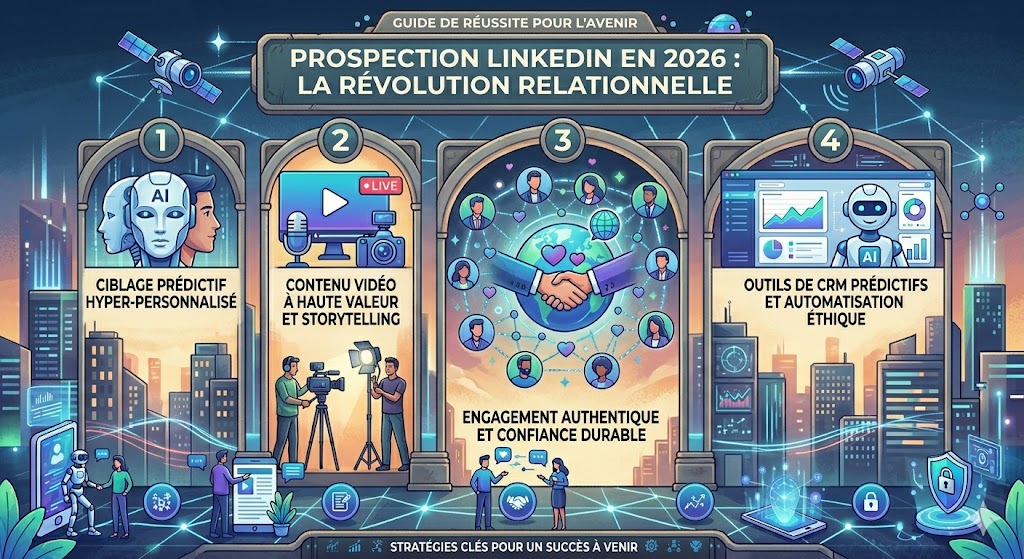
Do you need to increase your sales quickly? You can achieve this with a simple sales funnel designed for the challenges of 2026. Today's successful businesses:
analyze the gaps between objectives and results in order to respond more effectively,
They monitor warning signs to adjust their strategy,
adapt their business plan in real time
balance their prospecting between inbound and outbound.
Experts have found that the bowtie funnel approach maximizes customer lifetime value and accelerates product adoption. Let us guide you step by step to discover practical tips and avoid common pitfalls.
Key Points
A well-constructed sales funnel increases sales predictability and helps identify points of friction.
Personalize every interaction with your prospects to improve their experience and increase the chances of conversion .
Use automation and CRM tools to save time and improve your team's responsiveness.
Analyze your data regularly to adjust your strategy and maximize your results.
Stay in touch with your customers after the sale to turn buyers into brand ambassadors.
Sales funnel: why it's essential in 2026
Definition and role
A sales funnel represents the structured journey you offer each prospect, from the first interaction to purchase and loyalty. This funnel guides the prospect through several stages: awareness, interest, decision, action, and loyalty. At each stage, you qualify and educate your prospects to help them move toward conversion. This process allows you to better understand where your potential customers are and adapt your actions to maximize your results.
A well-constructed sales funnel offers you business predictability . You can forecast your sales by analyzing prospects at each stage, identify pain points, and optimize your marketing resources.
Customer journey and conversion funnel
The customer journey has changed dramatically in recent years. Traditional sales funnel rules are no longer sufficient. Today, consumers expect a personalized and seamless experience. You therefore need to rethink each step to meet these new expectations. For example, you can use techniques like scarcity (" only 3 spots left ") or offer a short call to respect your prospect's time. reporting tools help you track this conversion funnel.
Functionality | Description |
|---|---|
Scoring | Automatic scoring based on contact interactions. |
Customizable dashboards | Lead tracking, conversion rates, and sales performance. |
Reporting tools | Analysis of channels, measurement of ROI, and comparison with objectives. |
Benefits for your business
Implementing a sales funnel gives you greater clarity on the customer journey. You increase conversion rates and optimize your acquisition costs. You also maximize your closing rate through logical and sequenced actions. Integrating advanced technologies, such as AI and automation, allows you to personalize every interaction. Finally, you can align your marketing budget with your growth objectives and actively support revenue growth.
The key stages of the sales funnel

An effective sales funnel relies on several essential steps . You must guide each prospect from the first contact to customer loyalty. Here's how to proceed through each phase.
1. Illustrate through Experience (Case Studies)
Instead of simply describing the “Awareness” or “Attention” stage, incorporate real-life case studies .
Action: Analyze a specific campaign (e.g., a viral content strategy on LinkedIn or a disruptive advertising campaign).
Added value: This proves that your advice is not just theoretical, but validated by field experience.
2. Strengthen Authority (Social Proof)
Trust is the central pillar of the EEAT. Don't be the only one speaking up.
Action: Incorporate quotes from marketing experts or testimonials from clients who have successfully applied these methods.
Tip: Use high-quality visuals or links to LinkedIn profiles to prove the authenticity of these speakers.
3. Measurement for Expertise (Performance Indicators)
An expert knows that what isn't measured can't be improved. Detail the KPIs specific to each stage of the funnel:
Funnel stage | Main objective | KPIs to track |
|---|---|---|
Attraction (TOFU) | Visibility | Organic traffic, Impressions, Click-through rate (CTR) |
Consideration (MOFU) | Commitment | Download rate (Lead Gen), Time on page |
Conversion (BOFU) | Sale | Conversion rate, Customer Acquisition Cost (CAC) |
Loyalty | Retention | Customer Lifetime Value (LTV), Repurchase Rate |
Attracting attention
To attract attention, you need to stand out. Personalized prospecting works better than mass prospecting. On LinkedIn, 91% of decision-makers research before buying. Half of French salespeople use this platform to get to know their prospects better. You can also leverage interest signals, such as profile visits or comments on your posts.
Publish regularly to stay visible.
Use content formats that last, such as articles or videos.
Offer surveys, quizzes or contests to engage your audience.
Asks relevant questions and includes clear calls to action.
Visual elements and the quality of your message play an important role. A well-designed envelope and attractive visuals increase the memorability of your content.
Qualifying prospects
After capturing attention, you need to qualify your prospects . This step allows you to distinguish between those who are simply curious and those who are genuinely interested in your offer. To do this, you must:
Evaluate the prospect's interest based on their actions, such as requesting a quote or adding to the cart.
Check if the prospect has a real need that you can satisfy.
Make sure it matches your target demographic.
Qualifying a prospect allows you to focus your efforts on those most likely to become customers.
You can use tools like artificial intelligence to automate this qualification process. AI analyzes the data and assigns a score to each prospect. A CRM centralizes all the information and allows you to track the progress of each contact through the sales funnel.
Convert into customers
Conversion transforms a qualified lead into a customer. You need to make it easy for them to take action. Here are some effective techniques:
Stage | Objective | Recommended actions |
|---|---|---|
Awareness | Attracting a wide audience | Social media, SEO, advertising, public relations, content marketing |
Interest | Turning visitors into leads | Lead magnets, forms, landing pages, interactive content, customer testimonials |
Consideration | Nurture and qualify leads | Email sequences, case studies, comparisons, product demonstrations |
Action | Converting the prospect into a customer | Personalized proposal, simple purchasing process, objection handling |
Loyalty | Turning the customer into an ambassador | Integration, post-purchase follow-up, loyalty program, upselling, community building |
Email marketing plays a key role here. A email sequence guides the prospect, reduces their doubts, and builds trust. Each message has a specific objective: to inform, reassure, or persuade.
For example, a prospect might receive a message on LinkedIn , followed by an automated follow-up email. If they reply, they move forward in your sales pipeline.
Building customer loyalty after the sale
After conversion, you need to build customer loyalty. A loyal customer buys more often and recommends your offer. To do this, you can:
Offer complementary deals or exclusive benefits.
Thank your most loyal customers with a personalized message.
Regularly evaluate the customer experience with surveys or a mystery shopper.
Digital tools facilitate customer loyalty. Personalized relationship programs create an emotional connection with your customers. Email marketing remains an effective channel for staying in touch and offering new deals. Artificial intelligence helps you personalize every interaction and improve service quality.
A good sales funnel doesn't stop at the first sale. It transforms every customer into a brand ambassador.
Optimizing the sales funnel in 2026

Personalization and AI
You can transform your sales funnel through personalization and artificial intelligence. AI analyzes your prospects' behavior and adjusts the content in real time. Here's how it works:
AI optimizes , predicts, and personalizes every step of the sales funnel.
Machine learning models modify the content, price, and arguments according to the prospect's profile.
Conversational agents qualify hundreds of prospects at the same time, which reduces the cost of acquisition.
In 2026, you will also benefit from:
Autonomous management of activity peaks to maintain consistent quality.
Automatic qualification of missed calls to ensure no opportunity is missed.
Real-time contextual information to help your teams.
Analyze conversational signals to adjust your approach.
Extracting data from exchanges to improve your strategy.
Automation and CRM
Automation and CRM make your process more efficient. You save time and improve your team's responsiveness. Here are the main benefits:
Automation handles thousands of conversations without loss of quality.
An integrated CRM reduces support costs, as AI agents maintain fixed costs.
AI pre-qualifies prospects: your sales team focuses on the most promising contacts.
Tip: Use automated email sequences to re-engage prospects at the right time.
Monitoring and reporting
To make progress, you need to measure each step of your funnel. Reporting tools help you track:
The volume of MQLs (Marketing Qualified Leads) over a period.
The conversion rate of MQLs to SQLs (Sales Qualified Leads).
The performance of each acquisition source.
Acquisition source | Percentage of MQL |
|---|---|
Google Ads | 45% |
LinkedIn Ads | 25% |
SEO (organic) | 20% |
Events and partners | 10% |
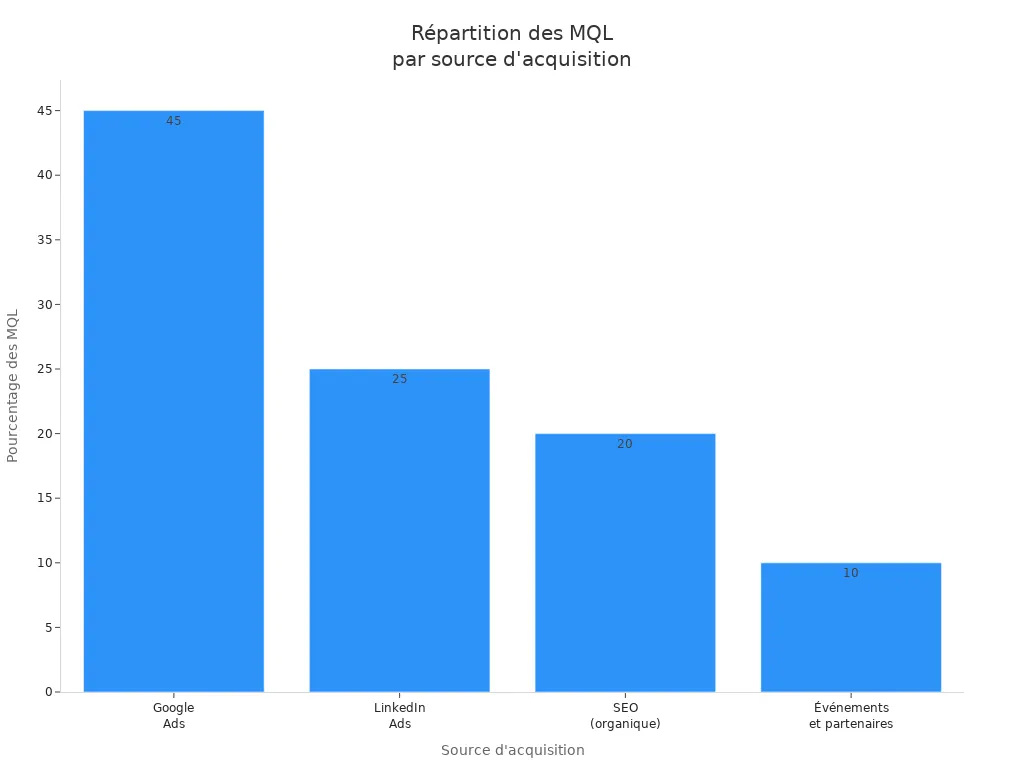
This allows you to adjust your actions and invest in the best-performing channels.
Mistakes to avoid and tips
Common traps
You can encounter several pitfalls when creating your sales funnel. Here are the most common mistakes to avoid:
Over-personalizing without respecting your brand identity . If you personalize too much, you risk losing the coherence of your message.
Measure without deciding. You can have beautiful dashboards, but without making concrete decisions, they are useless.
Changing too many variables at once. If you modify everything at once, you won't know what's really working.
Forget about after-sales service. Customer relations don't end with the conversion. You need to continue supporting your customers.
Desynchronizing sales and service. If you don't take into account feedback from the field, you're optimizing blindly.
Tips for staying efficient
To keep your funnel simple and efficient, you need to apply a few easy tips:
Optimize every step of your sales process. Always strive to simplify your customer's journey.
Use A/B testing to compare different approaches and choose the most effective one.
Automate your communications to save time and stay responsive.
The input resource should solve a minor problem. For example, it could offer a " shop opening checklist in Annonay " or a "3-line supplier follow-up email template." This type of content grabs attention and provides immediate value.
Boost your results
Want to go further? Implement concrete actions to boost your results:
Analyze your data regularly to quickly adjust your strategy.
Stay in touch with your customers after the sale. A simple follow-up message can turn a buyer into an ambassador.
Train your team to use digital tools and CRM to increase efficiency.
Remember: simplicity and quick adaptation make all the difference. A clear, well-followed, and adjusted funnel helps you convert more customers and build lasting loyalty.
You've just discovered the key stages of an effective sales funnel: attract, qualify, convert, and retain. Optimize each phase regularly to maintain your performance. You don't need to be an expert to get started. Simplicity and adapting to new trends will make all the difference in 2026.
Take action today: test your funnel and observe your first results!
FAQ
How to get started with a sales funnel?
You can start by identifying the main stages of your customer journey. Use simple tools like a spreadsheet or a CRM to track each prospect. Implement clear actions to attract, qualify, convert, and retain leads.
What tools can be used to automate a sales funnel?
You can use a CRM, automated email sequences, or chatbots. These tools help you save time and effortlessly track each step of your sales funnel.
How long does it take to see results?
You can see initial results in just a few weeks if you follow each step of your sales funnel. Analyze your data regularly to adjust your strategy and progress quickly.
Why customize the sales funnel?
Personalization makes every interaction more relevant to the customer. You increase your conversion rates and create a better experience. AI can help you tailor your sales funnel to each prospect.
How can I measure the effectiveness of my sales funnel?
You need to track metrics like conversion rate, number of qualified leads, and customer retention. Use dashboards to visualize your progress and identify areas for improvement.
See also
Increase Your Sales with a Prospecting Tool
Best Sales Engagement Tools to Improve Your Sales
15 Essential Tools to Revolutionize Your Business Strategy