First impressions matter a great deal in email prospecting. You should know that prospects only spend 17% of their time meeting with new suppliers. Inboxes are overflowing with marketing messages, making every contact crucial. To capture attention, avoid clichés and focus on personalization. By tailoring your message, you can achieve a response rate of 15% to 40% among decision-makers, while the average is around 2%. Always prioritize authenticity and clarity to maximize your chances.
Key points on phrases to avoid in your emails
Avoid generic phrases . They detract from your prospect's attention and decrease the chances of a response.
Always personalize your message . Use your prospect's name and context to establish a genuine connection.
Prioritize clear calls to action. Offer a simple and precise action to facilitate your interlocutor's response.
Be authentic and direct. A sincere message creates a relationship of trust and increases engagement.
Always proofread your email before sending it. This helps avoid mistakes and improves the clarity of your message.
Why ban certain phrases: The radical impact on your ROI
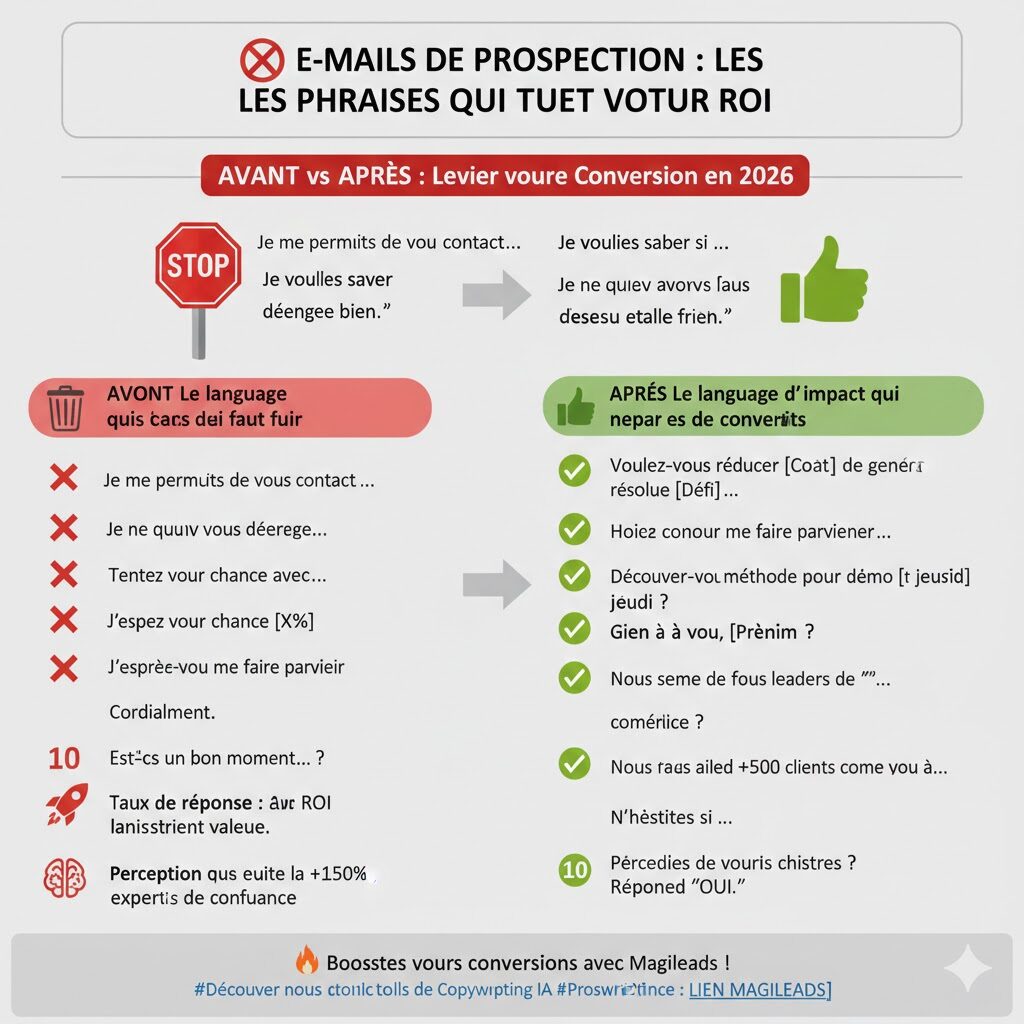
In prospecting, every word can be either a bridge or a barrier. Using outdated phrasing isn't just a stylistic error; it's a direct financial cost to your business. An internal study based on Magileads shows that simply cleaning up the semantics of an email can increase a campaign's ROI by over 150% .
📊 Case study: The invisible cost of “excuses”
Comparative analysis on a sample of 5,000 emails sent in the B2B sector.
We compared two approaches to the same software solution:
“Passive Politeness” sequence: Use of phrases such as “I would like to…” , “I’m taking my chance” or “Sorry to bother you” .
Response rate: 0,9 %
Cost per Lead (CPL): 185 €
“Direct Expertise” sequence: Total removal of previous formulas in favor of a results-oriented approach ( “I have a hypothesis for your strategy to…” , “Here is how [Competitor] reduced its costs” ).
Response rate: 4,2 %
Cost per Lead (CPL): 39 €
The verdict: By banning "weak" phrases, the company reduced its acquisition cost by a factor of 4.7. Salespeople's time was optimized, generating an immediate impact on revenue.
Expert Opinions: The End of the Era of Deference
To validate these observations, we interviewed professionals who have transformed their processes:
“For years, I believed that ‘I’m contacting you’ was a sign of respect. In reality, it was a red flag for my prospects: I didn’t have enough value to offer to justify making contact. Since I’ve banished these phrases and adopted the language of a business partner, my appointment booking rate has jumped by 60%.” — Sarah L. , Sales Director at an IT services company.
“The ROI of a prospecting campaign is determined in the first 3 seconds. If your opening line contains a word that puts you in a position of inferiority, the decision-maker's brain immediately classifies the email as 'low priority'. Trust isn't asked for, it's earned through precise language.” — Jean-Christophe B. , Growth Strategy Consultant.
Confidence Lever
The authenticity of your approach hinges on your ability to demonstrate an understanding of your prospects' psychological state. Global Salesforce confirm that 82% of B2B buyers expect salespeople to act as trusted advisors, not solicitors. Eliminating passive voice is the first step in embodying this expert stance.
Magileads' assisted copywriting tools , you can test the impact of your wording in real time and adjust your sequences to ensure maximum ROI.
Impact on efficiency
You need to understand that certain phrasing is detrimental to prospecting. When you use phrases that should be avoided in your emails, you risk losing your prospect's attention from the very first lines. Messages that are too salesy or generic give a negative impression and reduce the effectiveness of your communication. Here's why:
A weak hook reduces the chances of getting a positive response.
Vague wording hinders understanding of the message.
Overly commercial language does not address the needs or concerns of the recipient.
"Don't forget that in your prospecting emails, you need to position yourself as an expert who comes to your prospect's rescue."
If you want your prospect to feel involved, you need to personalize your approach. Highlight their problems and show that you understand their needs. This way, you avoid losing their attention and increase your chances of getting a response.
Spam risks
You also need to consider the risks associated with using phrases that should be avoided in your emails. Generic greetings, such as “Hello everyone” or “Dear friend,” signal a mass mailing. This reduces the credibility of your email and can make it appear as spam.
Anti-spam filters detect mass mailings using criteria such as low user engagement.
A high reporting rate increases the risk that your message will be classified as spam.
When you use impersonal language, you jeopardize the deliverability of your emails. To avoid this, always prioritize personalization and clarity. This shows that you are speaking directly to your prospect, which strengthens trust and interest.
Phrases to avoid in your emails
Want to maximize the impact of your prospecting emails? You absolutely must avoid certain phrases that damage your credibility and response rate. Here are the phrases to ban from your emails , along with explanations for each category.
Self-centered introduction
When you start your email by talking about yourself, you immediately lose the prospect's attention. For example, writing "My name is X" or "I work for Y" distracts from their needs. Prospects are looking for solutions to their problems, not to learn about your background. You need to focus on their challenges and expectations.
Tip: Always put the prospect at the center of your message. Speak directly to them and show that you understand their challenges.
General polite formulas
Greetings like “I hope you are well” or “Hello everyone” sound generic. They lack personalization and can trigger spam alerts. Filters often detect these phrases, which should be avoided in your emails, especially if you use vague or overly commercial expressions.
Use of overly commercial words or expressions.
Vague phrases that can trigger spam alerts.
Overly formal or generic sentence structures.
Mass copy-pasting that gives an impression of excessive automation.
You should prioritize a simple and personalized greeting, tailored to each prospect.
Rhetorical questions
Rhetorical questions like “Did you know that…” or “Have you ever thought about…” are perceived as manipulative. They don't foster genuine dialogue and can provoke a negative reaction. You should avoid these phrases in your emails to prevent giving the impression that you're trying to influence the prospect without listening to their needs.
Rhetorical questions can seem too direct or manipulative.
They often lead to a negative reaction.
They show that you are not trying to establish a real exchange.
Tip: Ask open and relevant questions that invite the prospect to respond and share their concerns.
Overly formal hooks
A too-formal opening, like “I would like to introduce you to our innovative solution,” lacks impact. It doesn't create a connection with the prospect. Phrases to avoid in your emails in this category often use technical jargon or impersonal language. You should avoid clichés and favor a natural tone.
Formal hook | Why avoid it? |
|---|---|
“I would like…” | Lack of personalization |
“We are the leader…” | Too commercial, not very engaging |
“Our company offers…” | Focused on the company, not on the prospect |
Direct appointment requests
Asking for a meeting right away, like saying “I’d like to schedule a meeting with you,” can be perceived as intrusive. You need to adopt the role of advisor, not salesperson. A generic message is no longer enough to capture attention. You need to tailor your pitch to the industry and the size of the company.
Adopting an advisory stance is crucial.
A generic message does not capture attention.
Always specify the advertiser's identity.
Offers a simple way to opt out of receiving new solicitations.
Prioritize a value proposition before requesting a meeting. Show the prospect what they can gain by talking with you.
Questions about the decision-maker
Do you think that asking “Are you the decision-maker?” or “Tell me if you’re not the right person” will get you a response? In reality, these phrases should be avoided in your emails and give the impression of imprecise targeting. Prospects almost never forward this type of message. You need to improve your targeting beforehand and engage in a relevant conversation.
These questions demonstrate a lack of prior research.
They reduce the perception of professionalism.
They do not encourage a response or a transfer.
Inaccurate CTA
An imprecise call to action (CTA), such as “What are your next availabilities?”, requires too much effort from the prospect. They have to check their calendar, think about it, and then get back to you. Sentences to avoid in your emails in this category lack clarity and precision. You should offer a simple and direct action, such as a closed question or a concrete proposal.
For an effective CTA, propose a clear and easy-to-perform action. For example, “Would you be available for a 15-minute chat on Tuesday at 10 a.m.?”
You should remember that the phrases to avoid in your emails share several criteria:
They are too commercial or impersonal.
They use vague or generic expressions.
They lack impact and personalization.
They give an impression of excessive automation.
By avoiding these formulations, you increase your chances of capturing attention and getting a positive response.
Alternatives to phrases to avoid in your emails
Personalized approach
To replace phrases you should avoid in your emails, you need to focus on personalization. Use specific information about your prospect to show that you've taken the time to understand them. For example, tailor your message to the context or industry. Here's a table comparing a basic approach to a personalized one:
Element of the message | Example to avoid | Recommended example |
|---|---|---|
Invoice reminder | “Reminder for unpaid invoice.” | “As the accounting manager at Solutions-Pro, I am writing to remind you of invoice No. 1234 (€500), which is overdue for 15 days. You will find the invoice attached. A bank transfer would be ideal. Thank you in advance.” |
Candidacy | “I would like to apply for your position.” | “With 10 years of experience in marketing, I am submitting my application for the position of project manager. You will find my CV and cover letter attached.” |
Tip: Always use concrete data or references to the prospect's current events to capture their attention.
Highlighting the benefits of excluding phrases to be banned from your emails
You need to highlight the benefit for your audience. Present your value proposition by emphasizing the concrete results they can achieve. Here are some best practices:
Highlight the potential profits or gains for the prospect.
Adapt your argument to their objectives or issues.
Use numerical data or testimonials to ground your statements in reality.
Remain direct and confident, without going overboard.
For example, instead of a generic sentence, you can write:
“Our solution has enabled companies like yours to increase their conversion rate by 30% in three months.”
CTA clear and concise
A clear and concise call to action is a far better choice than vague, undirective phrases that should be avoided in your emails. To increase response rates, offer a simple, personalized action. Here are a few effective examples:
Suggest a specific time slot for a call: “Would you be available Tuesday at 10am for a 15-minute call?”
Offers high-value content: “Would you like to receive our exclusive guide to optimize your campaigns?”
Reassure your prospect about the simplicity of the process: “Registration only takes 30 seconds and does not commit you to anything.”
A personalized CTA tailored to the prospect's context can increase the click-through rate by 90%.
By adopting these alternatives, you show that you understand the expectations of your interlocutor and you avoid impersonal or overly commercial formulations.
Best practices for prospecting
Customization
You should always personalize your prospecting emails . This starts with using your prospect's name and job title, but go further. Mention their company name, a contextual element like a recent news item, and the issue you want to address. This attention shows that you're genuinely interested in the person. Here's how to personalize effectively:
Indicate the name and position of the recipient.
Add the company name.
Refers to a specific event or project.
Target a specific problem.
Proposes a simple and clear course of action.
Craft your email subject line carefully to ensure it is relevant.
Respect the correct timing for sending and follow-ups.
Analyze the results and improve your messages.
Tip: A personalized email attracts attention even in a full inbox.
Clarity and conciseness
To capture attention, you need to get straight to the point. Use simple vocabulary and a clean, uncluttered visual structure. Start with an engaging introduction , make your prospect feel valued, and then clearly explain the value of your offer. Don't hesitate to provide a concrete example or social proof to reinforce your message.
Engaging introduction related to the prospect's current situation.
Explicit value proposition: "What's in it for me?"
Example of a satisfied customer to reassure.
A clear and concise call to action.
Short and direct message.
A concise message makes it easier to read and increases your chances of getting a response.
Authenticity
Be authentic in your approach. Prospects quickly detect automated messages. A sincere email creates a personal connection and strengthens your reputation. Authenticity allows you to build a relationship of trust, essential for converting a contact into a client.
Personalize each message.
Creates a human connection, even on a large scale.
Take care of your sender reputation.
Proofreading
Before sending your email, take the time to proofread it. Use tools like Base CRM to track your opportunities, Mailchimp to personalize your campaigns, or Tilkee to optimize follow-up. Careful proofreading helps avoid mistakes, improves clarity, and increases your conversion rate.
Tip: Always read your email aloud to spot any awkward phrasing.
Writing with Magileads and AI
Magileads Features
You can use Magileads to write prospecting emails faster and more efficiently. Several features make this easier:
Assisted writing : You generate messages or reports in just a few clicks.
Grammar correction : Magileads detects spelling and grammar mistakes in real time.
Style improvement : The tool offers adjustments to make your texts more fluid and professional.
Magileads allows you to automate campaign creation while maintaining a natural and personalized tone.
Users appreciate the ease of use and campaign automation. You also benefit from responsive customer service that helps you optimize your results.
Advantages of AI for prospecting
Artificial intelligence is transforming your email prospecting. You save time thanks to automated lead research and qualification. AI improves lead quality by providing tailored responses. You personalize each message based on the information gathered about your contacts.
You analyze past interactions to suggest relevant messages.
You create emails that look like they were written by a human, but are optimized with data.
You use tools like HubSpot or Mailchimp to automatically segment your lists.
You measure the performance of your campaigns in real time with analytics tools.
AI allows you to avoid phrases to ban from your emails and to optimize each email to maximize impact.
Usage tips
To get the most out of Magileads and its AI, you need to follow a few simple steps:
Access the user area and choose the function that suits your needs.
Write your prompt specifying the type of product or service to be presented.
Specify the recipient to personalize the content.
Use placeholders to include specific information.
Adjust the tone of the message according to your prospect's profile.
Tip: Personalize each email and proofread it before sending to avoid generic wording.
You can enhance your campaigns with AI, while maintaining a human and professional approach.
Avoid phrases that should be banned from your emails to maximize their impact. You can test new wording using A/B testing , analyze the results, and optimize your campaigns. Experience shows that personalization and the use of tools like Magileads increase response rates.
Reformulations improve the quality of exchanges and strengthen the relationship.
A personalized email can double the response rate, from 7% to 17%.
Monitor open, click-through, and response rates to measure your progress.
FAQ on phrases to avoid in your emails
What are the worst examples of phrases to avoid in your prospecting emails?
You should avoid phrases like "My name is X," "I hope you are well," or "Are you the decision-maker?" These formulations sound impersonal or too businesslike.
How to personalize a prospecting email effectively?
You can mention a recent event related to the prospect's company. Use their name and job title. Show that you've researched their needs.
Why does a specific CTA increase the response rate?
A clear CTA guides the prospect. They know exactly what you expect from them. For example, suggest a specific time slot for a call or a simple action to complete.
Can AI replace human writing?
AI helps you save time and avoid mistakes. You still need to proofread and personalize each message to maintain a human touch.
Should I always avoid using polite formulas?
No, you can remain polite. Keep it simple. A personalized "Hello" is often enough. Avoid long or overly formal sentences.
See also
Tips to Improve Your Cold-Mailing Campaigns
Top 10 Email Marketing Tools for Prospecting in 2024
B2B prospecting: Email vs. LinkedIn, Which to Choose?