































Michael Chiche,
Manager and Founder of Unitead
As the founder and CEO of Unitead, I want to acknowledge the outstanding work of the Magileads team. This application has truly revolutionized my prospecting approach. Thanks to its cutting-edge features, I've been able to streamline my processes, save crucial time, and automate tedious and time-consuming tasks.
Magileads has allowed me to focus on what matters most: quickly engaging with interested prospects and key contacts, while refining every phase of my sales strategy.
I'm seeing a significant improvement in my results thanks to their solution. I highly recommend this tool to all entrepreneurs looking to make their prospecting efforts more professional and efficient.
It's a considerable advantage for any ambitious company!
Mathieu Nadal,
Founder of the Upleads agency
Using the platform has been a real asset for managing my leads. It helps me structure my processes, increase efficiency, and better track my prospects throughout their journey. Thanks to its intuitive features, I've been able to improve customer satisfaction while optimizing my time. I highly recommend this solution to all businesses seeking to improve their performance.

Romain Karmann,
CEO of Lota Cloud
Our ambition is to develop partner contacts within the cloud ecosystem. Magileads is a fantastic partner prospecting tool. Thanks to its highly targeted contact database and multichannel campaigns, the results have exceeded our expectations. We secured nearly 25 meetings with potential partners in less than three months. Furthermore, Magileads has enabled us to build a strong and engaged partner community

Loris Todaro,
Founder of the Hublead agency
Magileads is a strategic partner for any agency with multi-client needs. What we particularly appreciate:
-
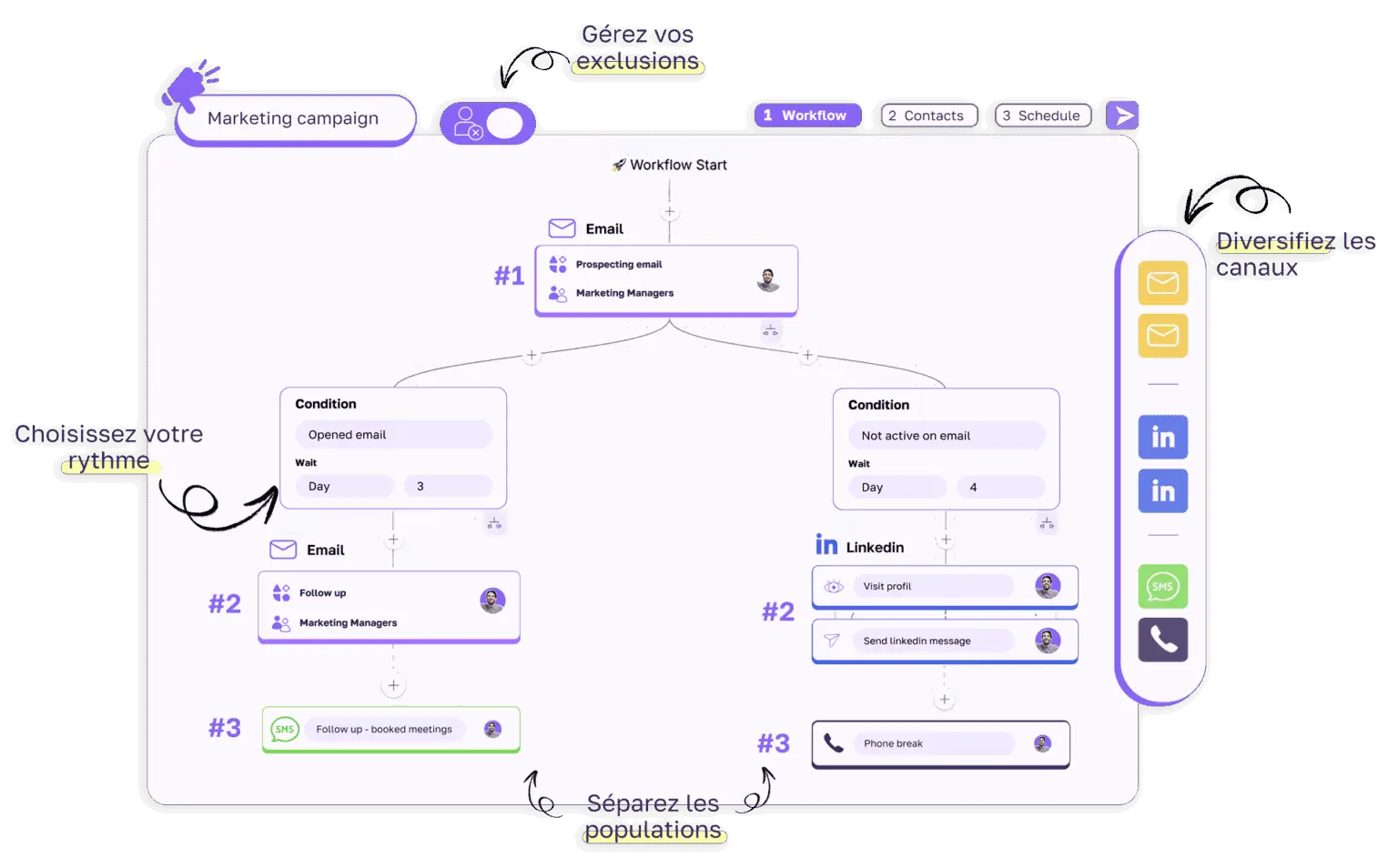
The multi-channel campaign manager allows us to generate opportunities for clients thanks to the quality of automation and deliverability it ensures.
The ease of use of the white label allows us to be autonomous on the platform and to manage all of our clients.
Furthermore, the support, close collaboration, and availability of the Magileads teams are undeniable assets in our partnership. Today, it would be difficult for us to part ways with this partner, whom we have integrated into the development of our company.

Benoit Guiet
Sales Director LearnyBox
Magileads has enabled us to structure and optimize our sales prospecting. Thanks to their intuitive platform, we've launched high-performing multichannel campaigns and significantly increased our number of qualified leads.
The team's availability and responsiveness make this collaboration incredibly fruitful. This combination of a powerful tool and high-quality support makes Magileads an essential partner for accelerating our growth at Learnybox. We are happy to recommend them without hesitation!

Michael BIA,
Founder of the Risk and Compliance Institute
As a long-time Magileads user, I've been able to follow the various phases of the platform's development, which has led to it becoming one of the most comprehensive and powerful marketing automation tools on the market today.
Magileads' main strength is the support provided by its teams, with whom we've built a true partnership, aligned with our business objectives. Today, I can't imagine managing my multichannel campaigns anywhere else but on Magileads.
Thank you to the teams for their availability, their expertise, and the remarkable quality of the tool.

Catherine Bernard
Lead Camp
We have been using Magileads as a white-label solution for over two years. This collaboration has allowed us to significantly improve the quality of our services and increase our customer retention rate from 0% to 30%.
Improvements are continuous, and the Magileads team is responsive. We intend to maintain this partnership for the long term.

Laurent JAFFRES
White Knight
A strategic ally for our company, Chevalier Blanc.
I am Laurent Jaffres, the founder of a social and solidarity economy enterprise. Its mission is to improve access to justice for all. It brings together partner lawyers guided by the values of loyalty, fairness, and solidarity. Magileads has become a major asset in our business development strategy.
Thanks to this tool, we have not only optimized our prospecting efforts but also benefited from relevant international contact lists, carefully compiled through their solution. This has allowed us to establish valuable connections with foreign lawyers, legal professionals, and partners, opening the door to concrete opportunities in new markets.

Eric Schekler,
ESR agency
An indispensable tool for our digital communication agency!
Eric Schekler, founder of ESR, a digital communication agency, I was constantly searching for high-performance tools to optimize our strategies and support our clients' growth. Magileads has been a true revelation for our white-label, branded digital prospecting.
Thanks to this branded platform, we were able to structure our email and LinkedIn campaigns, identify qualified leads with remarkable precision, and automate time-consuming tasks. Integrating Magileads into our processes has not only boosted our internal efficiency but has also allowed us to achieve concrete results for our clients: an increased conversion rate and greater client satisfaction.
Today, Magileads is much more than just a tool for us. It's a strategic partner that helps us meet the challenges of prospecting in a competitive environment. I highly recommend this solution to all agencies looking to accelerate their business development!

Romain Dias
Spacelead
Magileads is an ultra-powerful tool for customer acquisition professionals.
Through its white-label solution, Spacelead has established an authoritative and credible presence by integrating its brand identity and visual identity directly into the tool.
This allows us to demonstrate to our clients that we are committed to investing in our business development to deliver tangible and demonstrable results that will drive their growth.

Anthony ARIMBELLI
Linkforce
An indispensable tool and impeccable service!
We've been using Magileads for several years, and this platform has become an essential tool in our prospecting strategy.
It offers a complete solution, seamlessly and intuitively combining data enrichment, automation, and campaign tracking.
What sets it apart is its constant evolution. The platform continually improves to provide increasingly accurate data and offer even more extensive features, perfectly meeting market needs. Beyond the tool's technical capabilities, it's the customer support and technical service that truly make the difference.
The team is attentive, responsive, and dedicated, ready to quickly answer our questions and address our specific needs. Special mention goes to Nicolas, who, in addition to creating clear and practical explanatory videos, is always available to share his technical expertise and support us on certain technical topics with remarkable efficiency.
Magileads is much more than a platform; it's a true partner we can trust! We highly recommend it!

Virginie COMBES
Vega France
I've been using Magileads for creating automated email campaigns for a few years now and I'm extremely satisfied: the tool is very comprehensive, intuitive, and new features are implemented regularly.
The icing on the cake is the incredibly responsive customer service; they not only help us use the interface, but also provide invaluable advice for optimizing our campaigns. In short, I highly recommend it!

Jean-Luc RATIER,
Marketing Manager, TALENTS & PROJECTS
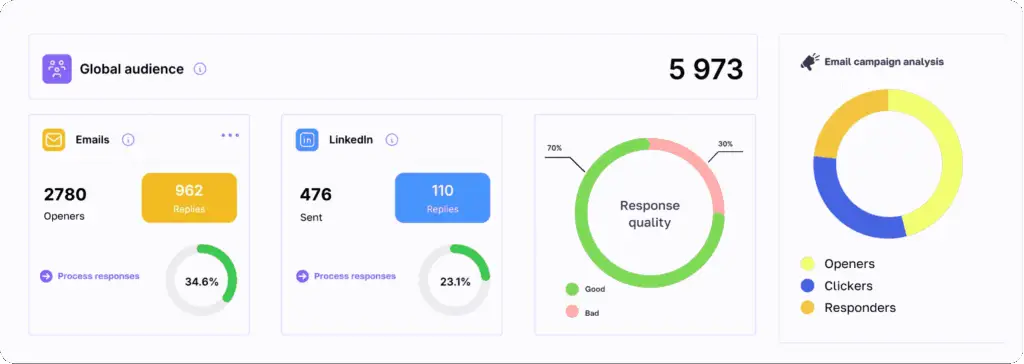
Following a Growth Hacking training course, I had the opportunity to explore several cold emailing applications, sometimes to my detriment (my LinkedIn account was blocked, for example). When I joined Talents & Projets, I discovered a new application, developed just a stone's throw from our offices: Magileads. I was immediately impressed by its ease of use and the clarity of its campaign tracking dashboard.
Subsequently, I appreciated the numerous features offered by Magileads (AI-powered message writing, data enrichment, and scraping of job postings from LinkedIn or Google Maps). The application perfectly manages sending limits without ever compromising your LinkedIn account or email addresses, and allows you to run campaigns quickly and efficiently. A real plus is the availability of Nicolas and François, who answer all my questions promptly and effectively. I wholeheartedly recommend Magileads to anyone looking for a reliable tool for effective prospecting.