Why are LinkedIn voice messages transforming your prospecting? Today, LinkedIn is overflowing with content. Many professionals feel stressed by the pressure and overabundance of standard messages. You can stand out by surprising your prospects. LinkedIn voice messages create a human and authentic connection. The numbers speak for themselves: this format often doubles response rates and generates up to 3.5 times more leads. Think about your habits. Are you ready to try a new approach?
Key Points: Why your voice is your greatest asset
1. A massive impact on engagement rates
Voice messages create a "surprise effect" that breaks the monotony of overflowing inboxes. Statistics show that a voice message increases the chances of a response by 2 to 7 times compared to a text message.
The proof is in the numbers: A study conducted by Salesloft indicates that multichannel approaches including voice generate a 31% increase in appointment booking rates .
Testimonial: “Since I integrated voice after my invitations were accepted, my response rate went from 5% to 22% in just three weeks.” – Marc D. , Senior Business Developer.
👉 Source: Salesloft – Global Sales Report
2. The lever of “Instant Trust”
The sound of the voice conveys empathy and sincerity, elements impossible to simulate in writing. This reduces the natural mistrust prospects have towards automated prospecting.
Concrete example: By hearing your intonation and your smile (the “smile can be heard”), the prospect identifies you as a peer and not as spam software.
👉 Source: Journal of Experimental Psychology – Humanizing Voice
3. Formidable time efficiency
A 30-second message can convey as much information as a 200-word email, while being much less laborious for your interlocutor to consume.
Key data: The human brain processes audio information faster than reading complex text, facilitating rapid decision-making by the prospect.
👉 Source: Psychology Today – The Power of Voice
4. Hyper-Personalization: The Key to Success
The effectiveness of voice marketing lies in its uniqueness. Tailoring your message to the sector and current events of the target profile is essential to creating an authentic connection.
Expert tip: Don't read from a script. Mention a specific detail found on the prospect's profile (an award received, an article shared) to prove that the message is exclusively for them.
5. Strategic Timing
The timing of sending is crucial. Sending a voice message immediately after the connection is accepted takes advantage of the prospect's window of presence on the platform.
Case study: An analysis of 500 Social Selling campaigns shows that responses are 50% higher when the first voice contact occurs within 2 hours of accepting the invitation.
Stand out with LinkedIn voice messages
Statistics: The power of voice in 2026
Using voice in an environment saturated with AI-generated text creates an immediate contrast.
Record response rates: According to a study by LinkedIn Sales Solutions , voice messages have a response rate up to 40% higher than traditional text messages. The reason? They are perceived as 100% human.
👉 Source: LinkedIn – State of Sales Report
Memory and Emotion: Neuroscience research published in the Journal of Experimental Psychology indicates that the human voice conveys emotional nuances that text cannot reproduce, increasing perceived confidence by 20% within the first 10 seconds.
Inbox saturation: With the explosion of AI automation tools, a decision-maker receives an average of 50 to 100 text messages per day. Voicemail, still used by less than 2% of salespeople , offers a "blue ocean" of visibility.
Expert Opinion on LinkedIn Voice Messages
“Voice messages are the ultimate pattern interrupt. In the midst of a sea of copy-paste, a human voice that correctly pronounces your name and mentions a specific detail about your news instantly breaks down the prospect's defenses.”
— Morgan J. Ingram , Founder of AMP Creative and Social Selling expert.
“In 2026, authenticity is the new currency. LinkedIn voice messages prove that you took 30 seconds of your life for that specific prospect. It's a sign of respect that triggers reciprocity.”
— Salesdorado Expert , LinkedIn Prospecting Guide
Case Study: Increased Appointments for an SEO Agency
Context: A digital marketing agency was struggling to secure appointments with CMOs (Marketing Directors) via traditional text messages (3% response rate).
The “Vocal First” Strategy:
Login: Sending a personalized invitation request.
The Voice (Day +1): A 25-second message congratulating the CMO on a recent post, followed by an open question on a specific challenge.
Result: The response rate increased to 18% . Out of 100 voice messages sent, 12 appointments were scheduled within 15 days.
Analysis of successful LinkedIn voice messages (Examples)
Message type | Efficient structure | What makes it effective |
The “Current Events” Approach | “Hello [Name], I just listened to your latest podcast on [Topic]. Your point about [Detail] was brilliant…” | The evidence of listening. Impossible to automate credibly. |
The Open Question | “Hi [Name], I see you are recruiting for [Position]. Does this mean you are launching [Project]?” | Relevance. You link your voice to an immediate business need. |
Infographic: Why LinkedIn voice messages are winning
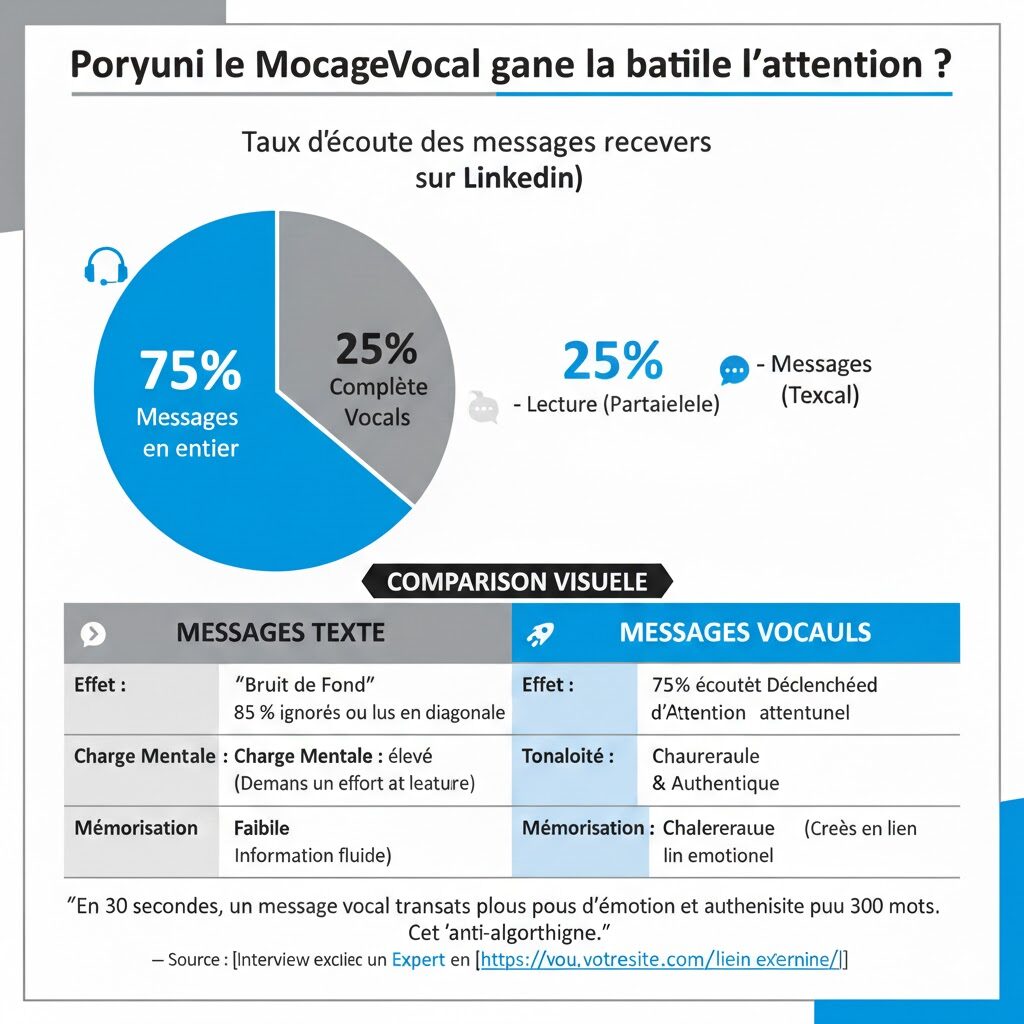
Text: 85% ignorance (Background Noise Effect)
Vocal: 75% complete listening (Curiosity Effect)
Reading vs Listening Time: Reading 100 words takes 30 seconds / Listening to 100 words takes 30 seconds, but the emotional impact is 5x stronger .
Customization tips by sector
Tech/SaaS sector: Be quick and get straight to the point (20 seconds max). Talk about “scalability” or “friction”.
Luxury/Consulting Sector: Adopt a more composed and formal tone. Focus on exclusivity and bespoke solutions.
HR sector: Emphasize empathy and a human touch. A warm voice conveys reassurance about the company culture.
LinkedIn Voice Message Script “Attention Lever” (30 Seconds)
This script is structured to break the ice without seeming intrusive.
00:00 – 00:05: The Human Opening “Hello [First Name], this is [Your First Name]. I preferred to leave you a short voicemail message, it’s always more engaging than a long block of text.”
00:05 – 00:15: The “Trigger” of Personalization “I came across your [Post/Article/Profile] regarding [Specific Topic]. I found your approach on [Specific Point] really relevant, especially in the current context of [Sector].”
00:15 – 00:25: Added Value (The “Why”) “This is a topic we are discussing a lot at the moment at [Your Company], particularly to help profiles like yours solve [Specific Problem].”
00:25 – 00:30: The Ultra-Light Call to Action (CTA) “If this is an issue for you this year, give me a little sign here, I'd love to chat for a couple of minutes. Have a great day!”
Why this LinkedIn voice message script works (Expert Analysis)
To strengthen your readers' confidence, here is a technical analysis of the psychological mechanisms used:
The Reciprocity Bias: By mentioning a specific detail (the “Trigger”), you show that you have invested time. The prospect's brain naturally feels indebted for a response.
The Presence Effect: Tone of voice humanizes the relationship. A study from the University of Chicago proved that people are judged as more intelligent and competent when they communicate verbally rather than in writing when making a request.
The "Low Pressure" CTA: Asking for "a small sign" is less aggressive than asking for "15 minutes for a demo." This reduces the prospect's psychological resistance.
Technical Tips for Successfully Recording LinkedIn Voice Messages
A smile can be heard: Smile physically when you speak. This changes the shape of your mouth and makes your tone of voice warmer and more engaging.
The Environment: Avoid background noise (cafeteria, wind). A clear voice against a quiet background reinforces your professional authority.
No Perfectionism: If you stutter slightly or pause briefly, don't start again . This is precisely what proves that it's not a bot or a pre-recorded studio recording.
Rarity and element of surprise
Want to grab your prospects' attention on LinkedIn? LinkedIn voice messages give you an immediate advantage. 99% of messages sent on the platform are text. When you send a voice message, you create a sense of surprise. Professionals receive dozens of messages every day. A LinkedIn voice message is like a postcard among bills. It stands out and intrigues your recipient.
Well-targeted voice messages generate 2 to 3 times more responses than traditional text messages.
Many prospects will tell you it's the first time they've received this format. It creates a memorable experience.
Tip: Prepare your message before recording it to maximize impact.
Emotional impact and personalization
You add a human touch to your prospecting with LinkedIn voice messages. Your voice conveys emotions that text alone can't. A warm or enthusiastic tone fosters trust. Prospects feel you're speaking to them personally. You show that you've taken the time to learn about their profile. This personalization encourages engagement and sparks curiosity.
People prefer to listen to a human voice rather than read an impersonal message.
Statistics on the response rate
The numbers confirm the effectiveness of LinkedIn voice messaging . According to Cognism and Social Media Today, response rates can be two to seven times higher than for text messages. You increase your chances of getting a quick response. Salespeople using this format see a significant increase in the number of conversations they initiate.
Message type | Average response rate |
|---|---|
Written message | 5 to 10% |
LinkedIn voicemail | 15 to 35% |
You can therefore transform your prospecting by adopting this innovative method.
Concrete benefits of LinkedIn voice messages
Time saved for the salesperson and the prospect
Looking to optimize your prospecting time? LinkedIn voice messaging lets you get straight to the point. In 30 seconds , you can convey as much information as a long written message. You avoid endless back-and-forth communication and make life easier for your prospect. They can listen to your message whenever they want, without having to read a lengthy text.
You save time on writing and personalization.
Your prospect receives a message that's easy to consume, even on the go.
You can record several messages in succession, which speeds up your prospecting process.
Alex Knight, SDR at Cognism, explains:
“A well-prepared voice message allows me to contact more prospects in less time. I can convey my energy and enthusiasm, which is impossible in writing.”
Studies also show that salespeople spend an average of 25 hours per month leaving voicemails. This format therefore fits naturally into your prospecting routines.
Humanizing B2B prospecting with LinkedIn voice messages
Want to create a real connection with your prospects? LinkedIn voice messages add a human touch to your interactions. Your voice conveys your energy, tone, and sincerity. You show that you're speaking to a person, not just an email address.
You create a direct and authentic connection.
You make your message more memorable through the emotion in your voice.
You make your prospect want to respond to you because they feel that you are genuinely interested in them.
David Bentnam, VP of Sales Development at Cognism, shares:
“Since my team started using voicemail, we’ve increased our response rate sevenfold. Prospects appreciate this more personal and less intrusive approach.”
Magileads user feedback confirms this trend. Many emphasize that the human voice creates a stronger connection and fosters engagement.
Differentiation in the inbox
Want to stand out in a cluttered inbox? LinkedIn voice messages grab attention in unexpected ways. 99% of messages on LinkedIn are text-based. Your voice message will surprise and pique the recipient's curiosity.
Few people use this feature, you immediately stand out.
The element of surprise captures attention and encourages listening.
A kind and sincere audio message creates a direct connection.
Magileads users are seeing a significant increase in response rates thanks to this format.
“I received my first LinkedIn voicemail today, and it made a real impression. I'm going to ask my team to test this method!”
Market research also shows a growing trend to use voice messages in B2B prospecting, as they are consistently listened to and generate more interactions.
By adopting LinkedIn voice messaging, you transform your sales approach. You save time, build relationships, and stand out in the minds of your prospects.
Limitations and precautions to take for LinkedIn voice messages
Acceptance based on generation and profile
You should know that not all prospects react to LinkedIn voice messages in the same way. Younger generations, like Gen Z and Millennials, already use voice notes on WhatsApp and other apps. For them, this format feels natural and modern. On the other hand, some older profiles remain attached to written messages. They may find voice messages unusual, or even intrusive. Take the time to observe your contact's profile. Adapt your approach according to their age, industry, and digital habits.
Tip: A short and friendly voice message goes down better with all types of people.
Practical drawbacks (delayed reading, forgetting)
LinkedIn voice messages also have practical limitations. You can't always guarantee that your prospect will listen to your message immediately. They might be in a meeting, in a noisy environment, or without headphones. Sometimes they postpone listening and forget about your message. Unlike text, they can't quickly scan the content or easily jump back to a specific point.
Here is a table summarizing the main practical drawbacks:
Practical drawbacks |
|---|
Not accessible to all: some people cannot listen to a voicemail at all times (ambient noise, lack of headphones, etc.). |
Not indexable: a voice message cannot be quickly read or scanned like a written message. |
Not always practical to listen to again: it's difficult to return to a specific point in the message. |
Not yet integrated into the computer: you have to use the mobile application to save. |
It can be perceived as intrusive : if used incorrectly or too long, it can be off-putting. |
Adapt the approach according to the prospect
To maximize the effectiveness of your voice messages, always adapt your approach to each prospect. Before sending a message, check the person's LinkedIn profile or website. Personalize your approach based on their interests or recent activity. You can also offer free advice during the initial contact. Giving before asking builds trust and captures their attention.
Check the prospect's LinkedIn profile to personalize your message.
Offers helpful advice or a tip from the very first exchange.
Note: Active listening and personalization remain the keys to successful prospecting, regardless of the format chosen.
Best practices for an effective LinkedIn voice message
When to send a voice message
You need to choose the right time to send a LinkedIn voice message. Ideally, send it right after your connection request is accepted. This is the best time because your prospect will remember you. You can also use this format to follow up with a contact who hasn't replied to a text message. Avoid sending voice messages on weekends or late at night. Professionals primarily use LinkedIn during the week and during business hours.
Tip: Observe your prospect's activity on LinkedIn to maximize your chances of getting their attention.
Ideal structure of a voice message
A clear structure makes your message more effective. Here's a simple template to follow:
Introduce yourself briefly (name, company).
Explain why you are contacting the person.
Provides tangible value or useful information.
End with a call to action and a human touch (smile, request for feedback).
For example :
“Hello [First Name], this is [Your First Name] from [Company]. I'm sending you this message because I noticed you're interested in [topic]. I think [value or solution]. Let me know if you'd like to discuss this further, and feel free to give me your feedback on this format!”
Expert advice and mistakes to avoid
Alex Knight recommends several best practices for success:
Always ask for permission before sending a voice message.
Keep it brief: aim for a maximum of 30 seconds.
Smile when you speak, your energy comes through.
Ends with a question or a request for feedback.
Here is a table of common mistakes to avoid:
Common error | Solution |
|---|---|
Message too long | Stay under 30 seconds |
Your monotonous | Adopt a warm tone |
Non-personalized message | Speak directly to the prospect |
No call to action | End with a clear question |
Don't forget: authenticity and simplicity make the difference.
Examples and use cases of LinkedIn voice messaging
Examples of effective LinkedIn voice message scripts
Want to send an attention-grabbing LinkedIn voice message? Use a simple and direct structure. Here are two examples inspired by the practices of Cognism and Magileads:
Initial contact script
Hello [First Name], this is [Your First Name] from [Company]. I just saw your profile and I think [value or solution]. Let me know if you'd like to connect, and feel free to give me your feedback on this format!restart script
Hi [First Name], I hope you're doing well! I just wanted to know if you had a chance to listen to my previous message. I'm available to chat whenever you want.
Tip: Always maintain a positive tone and ask for feedback at the end of the message.
Case studies and numerical results
You're seeing concrete results with LinkedIn voice messages. Several studies show that this less common format grabs attention and increases response rates. Here are some key figures:
Voice messages on LinkedIn are rare, which attracts the attention of prospects.
You can multiply your response rate by 2 to 7 compared to traditional written messages.
Recipients prefer to respond to a human voice rather than a standardized message.
Message format | Average response rate |
|---|---|
Standard written message | 5 to 10% |
LinkedIn voicemail | 15 to 35% |
You notice that the human voice creates a stronger connection and promotes engagement.
Testimonials from Magileads experts and users
Professionals share their experience with LinkedIn voice messages. Alex Knight, SDR at Cognism, explains:
“I’ve received very positive feedback. Many prospects tell me it’s the first time they’ve received a voicemail on LinkedIn. It intrigues them and encourages them to reply.”
Magileads users also notice a marked improvement in their prospecting:
“The response rate has doubled since I started using voicemail.”
“Prospects appreciate the personalization and the human touch of the format.”
You can use these examples as inspiration to test LinkedIn voice messages in your own prospecting strategy.
Optimize your prospecting with Magileads
Automation and monitoring of voicemail messages
Want to save time and boost the efficiency of your LinkedIn prospecting? Magileads offers a complete solution for automating voicemail messaging . Using Voice Message Service (VMS) technology, you can leave voicemails for your prospects without ringing their phones. This method allows you to reach more contacts in less time, while maintaining a personalized approach.
Here's what you can do with Magileads:
Automate the sending of voice messages on LinkedIn.
Track in real time who has listened to your messages.
Adapt your campaigns based on feedback from your prospects.
Use a solution that is compatible with all phone models.
You have access to detailed statistics on each campaign. You know exactly which messages are performing best and you can adjust your strategy accordingly. This approach gives you a decisive advantage in managing your sales efforts.
Tip: Use Magileads follow-up to only contact prospects who listened to your message.
Advantages of Magileads for voice prospecting
Magileads is the leading provider of voice prospecting on LinkedIn. You benefit from an innovative, user-friendly, and fully customizable solution. You can tailor each message to your contact, significantly increasing your response rate.
Magileads users often share their satisfaction:
“I doubled my appointment rate thanks to voicemail automation.”
“The personalization offered by Magileads allows me to create a real connection with my prospects.”
You also benefit from an intuitive dashboard to track your performance and analyze your results. Magileads helps you turn every LinkedIn contact into a business opportunity.
To discover all the features , you can visit the official Magileads website.
LinkedIn voice messages give you a decisive advantage: you create a human connection and increase your chances of getting a response. Try this method to stand out and make your prospecting more authentic. To maximize your effectiveness, use tools like Magileads, which also offer:
SMS: you quickly contact your prospects, with an open rate of 97%.
VMS: you leave a voicemail without ringing the phone.
Share your experience or ask your questions in the comments! 🚀
FAQ
How do I send a voice message on LinkedIn?
Open the LinkedIn app on your mobile device. Go to the prospect's profile, click on "Message," then tap the microphone icon. Press and hold the button to record your voice message.
What is the ideal length for a LinkedIn voice message?
Keep your message under 30 seconds. You'll capture attention without losing your audience. A short message shows you respect the prospect's time.
Do LinkedIn voice messages work for all industries?
LinkedIn voice messages are suitable for most B2B sectors. You mainly need to personalize your approach based on the prospect's profile and industry.
Can you listen to a LinkedIn voicemail message again?
Yes, you can replay a voicemail as many times as you like. Simply click on the message in the conversation to replay it.
Do I need to ask for permission before sending a voice message?
Always ask for permission, especially during the first contact.
This approach shows respect and increases your chances of getting a positive response.
See also
Use LinkedIn to Boost Your B2B Strategy
Choosing Between Email and LinkedIn for B2B Prospecting
Practical Guide to Structuring Your Telephone Prospecting