Looking to optimize your customer management? Discover the Best CRM Tools of 2026, selected to meet the needs of modern businesses. Today, solutions like Salesforce, HubSpot CRM, Zoho CRM, Pipedrive, mondaysales CRM, Magilead CRM , Salesflare, OnePageCRM, Bigin, and Freshsales are transforming the way you manage your customer relationships.
The CRM market is experiencing rapid growth: in France, it will reach $2.3 billion by 2025, and 91% of American companies with more than 10 employees already use it. This allows you to benefit from better organization, precise tracking, advanced personalization, and easier decision-making. Each tool offers unique strengths, notably Monday Sales CRM for its flexibility and Magilead CRM for its integrated lead nurturing.
Key Features of the Best CRM Tools
The best modern CRM tools centralize all customer data, thus facilitating team collaboration and responsiveness.
Automating repetitive tasks with a CRM increases productivity and allows you to focus on strategic activities.
Choosing a CRM that is tailored to your industry and specific needs is essential to optimizing customer relationship management.
Testing several CRMs using free versions helps you find the solution that best meets your needs.
Integrating artificial intelligence into CRM systems allows for anticipating opportunities and improving the personalization of interactions.
What is a CRM?
Simple definition
A CRM, or Customer Relationship Management system, is software that helps you manage all interactions with your customers and prospects. It allows you to centralize important information, such as contact details, communication history, and purchasing preferences. With a CRM, you can track every step of the customer journey, from lead generation to customer loyalty. You save time because you can easily find all the data you need to personalize your actions and respond quickly to your customers' needs.
A modern CRM is no longer just a simple digital address book. It becomes a true ally for structuring your business processes and improving customer satisfaction.
Role in 2026
By 2026, CRM will be central to business strategy. You'll benefit from powerful tools that go far beyond contact management. The best CRM tools now integrate artificial intelligence to anticipate opportunities and automate repetitive tasks. You'll gain a 360° view of each customer thanks to the centralization of data from marketing, sales, and support.
Here are the main roles assigned to the Best CRM Tools in 2026:
Complete customer relationship management , from acquisition to loyalty
Automating business processes to increase efficiency
Improving the overall performance of your company
Optimized return on investment thanks to precise analyses
Predicting opportunities with integrated AI
Hyper-personalization of workflows and campaigns
Data unification between marketing, sales, and support teams
Adapting to your needs through modular and sector-specific solutions
Strict adherence to GDPR requirements and enhanced security
This allows you to choose a CRM that adapts to your industry and objectives. The solutions of 2026 enable you to reduce complexity, automate tasks, and personalize every customer interaction. This evolution explains why so many companies are now adopting the best CRM tools to remain competitive.
Best CRM Tools 2026
To select the best CRM tools in 2026, you must consider several essential criteria:
Integration with other sales tools.
Overall quality of the CRM based on global assessments.
Discover now the solutions that are transforming customer management this year.
Salesforce
Salesforce remains a global leader among the best CRM tools. You benefit from a comprehensive platform, suitable for businesses of all sizes. Salesforce offers a wide variety of modules for sales, marketing, and customer service. You can customize every aspect of the CRM to meet your specific needs.
Formula | Price per user (€/month) |
|---|---|
Starter | |
Professional | 80 |
Key features:
Advanced customization
Large ecosystem of applications
Powerful Automation
Target audience: Large companies, mid-sized companies, ambitious SMEs.
Use cases: Complex sales management, multi-channel tracking, advanced reporting.
HubSpot CRM
HubSpot CRM is among the best CRM tools thanks to its simplicity and power. You benefit from a clear interface and native integration with marketing tools like Magileads. HubSpot makes it easy to automate tasks and generate leads.
Key features:
Numerous features
Various integrations
Good customer support
Weak points:
Prices considered high compared to other competitors
HubSpot is establishing itself in 2026 as a leading CRM and marketing automation platform for B2B companies.
Target audience: Startups, SMEs, and mid-sized B2B companies with structured sales cycles.
Use cases: Marketing automation, lead management, and opportunity tracking.
Zoho CRM
Zoho CRM stands out for its excellent value. You get access to a flexible solution, suitable for SMEs and growing businesses. Zoho offers advanced features such as automation, sales analytics, and multichannel management.
Key features:
Competitive prices
Easy customization
Multiple integrations
Weak points:
Learning curve for some advanced features
Target audience: SMEs, startups, growing companies.
Use cases: Sales tracking, marketing campaign management, customer support.
Pipedrive
Pipedrive is one of the best CRM tools for sales teams who want a visual and intuitive pipeline. You can see every stage of the sale and automate follow-ups. Pipedrive focuses on simplicity and ease of use.
Key features:
Visual interface
Automation of repetitive tasks
Effective follow-up of prospects
Weak points:
Less suited to the complex needs of large companies
Target audience: SMEs, agile sales teams.
Use cases: Pipeline management, deal tracking, automated follow-ups.
Monday Sales CRM
Monday Sales CRM is poised to become one of the best CRM tools of 2026 thanks to its intuitive interface and flexibility. Whether you're a small business or a large organization, you can get started quickly. This CRM allows you to automate workflows, track emails, and analyze customer data in real time.
Predictive scoring
Personalized reminders
You benefit from a 360° view of your customers and seamless team collaboration . Advanced automation optimizes sales management and customer loyalty. monday sales CRM offers a free trial, ideal for testing its features before committing.
Key features:
User-friendly interface
Flexibility for all types of businesses
Intelligent automation
Real-time collaboration
Target audience: Startups, SMEs, large, high-growth companies.
Use cases: Sales tracking, marketing campaign management, customer loyalty.
Magilead CRM
Magilead CRM stands out thanks to its integrated lead nurturing , making it a relevant choice among the best CRM tools for businesses looking to automate lead qualification and nurture. You benefit from a tool that centralizes data and facilitates campaign personalization.
Key features:
Automated feeding
Data centralization
Advanced prospecting tools
Target audience: SMEs, agencies, B2B sales teams.
Use cases: Prospecting, lead nurturing, multichannel campaign management.
Salesflare
Salesflare is for sales teams who want to automate data entry and save time. Easily connect your emails, calls, and meetings. Salesflare offers smart reminders and a clean interface.
Key features:
Automating data entry
Integration with messaging tools
Simple interface
Weak points:
Limited functionality for large structures
Target: SMEs, tech startups.
Use cases: Lead tracking, task automation, contact management.
OnePageCRM
OnePageCRM focuses on simplicity and efficiency. You manage your contacts and tasks on a single page. The tool promotes quick action and lead prioritization.
Key features:
Extreme simplicity
Integrated task management
Quick start
Weak points:
Fewer advanced features
Target audience: Freelancers, small sales teams.
Use cases: Contact management, task tracking, rapid prospecting.
Bigin
Bigin, developed by Zoho, offers a simple and affordable CRM solution. You benefit from a free version and competitive pricing, making it an ideal choice for small businesses.
CRM Free: free
Starter: approximately €20/month
Professional: approximately €90
Enterprise: approximately €150+
Key features:
Financial accessibility
Clean interface
Integration with Zoho
Target audience: Micro-businesses, very small businesses, small teams.
Use cases: Contact management, sales tracking, CRM implementation.
Freshsales
Freshsales combines sales management, automation, and artificial intelligence. You benefit from comprehensive lead tracking and advanced analytics tools. Freshsales integrates seamlessly with other solutions in the Freshworks suite.
Key features:
AI integrated for lead scoring
Task automation
Modern interface
Weak points:
Limited customization for certain sectors
Target: SMEs, growing businesses.
Use cases: Lead tracking, sales automation, reporting.
In 2026, you'll have access to a diverse range of top CRM tools. Each solution addresses specific needs, whether you're looking for simplicity, automation, personalization, or advanced sales management. Take the time to analyze the features, pricing, and use cases to choose the CRM that will support your company's growth.
Comparison of the Best CRM Tools in 2026
Main features
When you compare the best CRM tools in 2026, you'll see that each solution offers advanced features to simplify customer management. You'll generally find:
Managing prospects and clients to track each opportunity.
Automating contact elements to save time.
Digital marketing tools to manage your campaigns.
Dashboards offering a 360-degree view of your activities.
Automated chatbots to improve responsiveness.
Claims management using artificial intelligence.
Analysis of developments and forecasts using AI to anticipate trends.
These features allow you to optimize your processes and improve customer satisfaction.
Pricing and free versions of the best CRM tools
Choosing a CRM also depends on your budget. Prices vary significantly depending on the features and level of customization. Here's an overview of monthly prices per user for the main solutions:
CRM | Price per user / month | Subscription type |
|---|---|---|
Magileads | Free, integrated into the multichannel prospecting offer | Focused on sales prospecting |
Salesforce | €25 (Starter) to €330 | Different levels depending on the features |
Zoho | €14 (Standard) to €52 | Variety of options for SMEs |
noCRM | €22 (Starter) to €33 | Focused on commercial action |
Monday | €10 (Basic) to be quoted | Customization according to needs |
Freshsales | €9 (Growth) to €69 | Options adapted to growth |
Axonaut | €39 to €49 | All-in-one package |
HubSpot | Free to €150 | Evolves according to needs |
Microsoft Dynamics | €60 to €95 | Modules based on the Microsoft ecosystem |
Pipedrive | €14 (Essential) to €79 | Focused on sales |
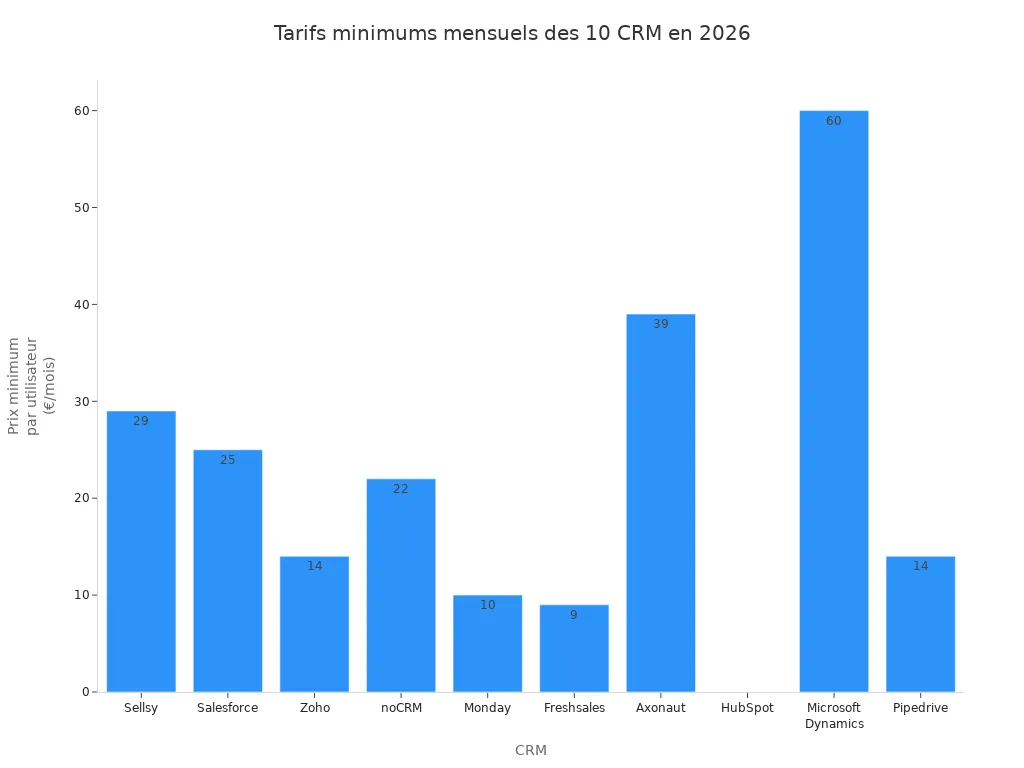
You'll notice that some CRMs offer a free version, ideal for testing before committing.
Strengths/Weaknesses of the Best CRM Tools
Each CRM has its advantages and limitations. You should consider:
Complexity of implementation without specialized support.
Costs increase with modules and customizations.
Longer learning curve for field teams.
Risk of duplicate contacts or outdated information.
Workflows that consume resources without producing concrete results.
By analyzing these points, you can anticipate challenges and choose the solution best suited to your team.
Targets
CRMs target different types of businesses. You'll find:
monday sales CRM : A favorite for sales teams looking for a customizable interface.
HubSpot CRM : Ideal for growing startups thanks to its free version.
Salesforce : Suitable for large organizations with complex processes.
Pipedrive : Suitable for teams that want a visual and intuitive sales pipeline.
Freshsales : Targeted for growing sales teams with an integrated approach.
By identifying the target audience for each CRM, you facilitate your decision-making and ensure better adoption by your teams.
Advantages of the best CRM tools in 2026
Data centralization
A modern CRM centralizes all your customer and prospect information. With a single click, you can access the history of interactions, shared documents, and ongoing actions. This centralization facilitates collaboration between teams. Each employee can instantly find the data needed to respond to requests. You become more responsive and improve customer satisfaction because you no longer waste time searching for scattered information.
A powerful customer management tool allows you to track every interaction and ensure continuity in the relationship, even if your contact changes.
Automation and productivity
Automation transforms the way you work in 2026. You eliminate repetitive tasks and focus on what matters most. Here's how a CRM optimizes your productivity:
welcome emails
Creating tasks in the CRM without manual intervention
Instant notifications on Slack or Microsoft Teams
Freeing up time for strategic and creative activities
You quickly notice an increase in your teams' efficiency. Automation reduces errors and ensures regular follow-up on every opportunity.
Customer customization
Personalization becomes a major asset with a CRM in 2026. You adapt each interaction thanks to the analysis of centralized data. You anticipate your customers' needs and ensure proactive follow-up. Here are some concrete examples:
Personalization of exchanges based on history and preferences
Anticipating needs through behavioral analysis
Automatic reminders so you don't miss any deadlines
Consistency in customer relations, regardless of the contact person
You can easily plan actions and ensure continuity of follow-up thanks to complete contact documentation.
Security and compliance
Security and compliance are top priorities for all businesses in 2026. You must protect your customers' data and adhere to applicable regulations. CRMs integrate advanced features to ensure trust:
GDPR compliance for all businesses, even the smallest ones
Transparent and secure collection of personal data
Respect for user rights: access, rectification, deletion
Integration of standards such as ISO 20022 for financial management
You strengthen your customers' trust and ensure the sustainability of your business by choosing a CRM that meets the most demanding security standards.
Choose from the best CRM tools
Essential criteria
To select the ideal CRM, you need to analyze several fundamental criteria. Start by identifying the essential features for your business. List your team's needs and verify that the solution meets them. Usability plays a key role: an intuitive interface facilitates adoption by all users. Technical support must be responsive and tailored to your level of requirements. Budget is also a determining factor. Make sure the cost of the CRM fits your financial capacity, without compromising the quality of the services offered.
List the essential features for your business.
Check the ergonomics and the level of support.
Check the compatibility of the budget with the selected tools.
Take the time to try the solutions before committing.
Integrations and scalability
A good CRM should integrate seamlessly into your digital ecosystem. Analyze its compatibility with your existing tools: email, marketing automation, project management, and invoicing. Scalability ensures the solution will support your company's growth. Opt for a CRM that can add modules or adapt to new needs. This way, you benefit from a platform that evolves with your goals, without having to switch tools at every stage.
A scalable and well-integrated CRM helps you centralize data and streamline collaboration between teams.
Test before you adopt
Before making a decision, test several CRMs. This step allows you to verify that the tool meets the expectations of modern customers. Evaluate the integration of artificial intelligence, ease of use, and quality of customer support. Take advantage of free trials to compare predictive lead scoring , personalized recommendations, and intelligent task automation. Involve your teams in the testing process to gather their feedback and ensure rapid adoption.
Check the ergonomics and ease of use.
Analyzes AI and automation functionalities.
Evaluate the quality of customer support.
Involve end users in the choice.
Choosing the right CRM directly influences customer growth and loyalty. Here's how:
Appearance | |
|---|---|
Conversion optimization | Improves the ability to convert prospects into customers |
Loyalty | Strengthens the relationship with existing customers |
Revenue visibility | Allows for better forecasting of future revenues |
Use the comparison tool and criteria to refine your selection. Test solutions with free trials and contact vendors with a detailed specification document. A high-performing CRM transforms the customer experience and becomes a driver of sustainable performance.
FAQs about the best CRM tools
What criteria should you consider when choosing a CRM in 2026?
You need to analyze your company's needs, ease of use, budget, available integrations, and data security. Take the time to test several solutions before committing.
How does a CRM improve your team's productivity?
A CRM automates repetitive tasks, centralizes information, and facilitates collaboration. You save time and ensure accurate follow-up with prospects and customers.
Are there free versions available for testing CRM systems?
Yes, several CRMs offer free versions or trials. You can test Monday Sales CRM, HubSpot CRM, or Bigin without obligation to evaluate their features.
What is the difference between a CRM for SMEs and a CRM for large companies?
A CRM for SMEs prioritizes simplicity and ease of use. A CRM for large companies offers advanced features, extensive customization, and multi-user management.
See also
Top 10 Email Marketing Solutions for Prospecting in 2024
30 Essential AI Marketing Tools to Discover in 2025
10 Best Tools for Scraping LinkedIn in 2024