
Aujourd’hui, tu fais face à un bouleversement inédit dans la recherche en ligne. L’IA générative transforme les résultats de recherche en privilégiant des réponses synthétiques, ce qui réduit le taux de clic de 60%. Les entreprises qui adoptent une démarche proactive, comme la Stratégie GEO, constatent un meilleur retour sur investissement. En 2024, près de la moitié des organisations ont déjà intégré cette approche pour rester la référence auprès des moteurs d’IA, et ce taux dépassera 80% d’ici deux ans. Pour conserver ta visibilité et ton influence, tu dois repenser ta stratégie et viser à devenir la source incontournable citée par les intelligences artificielles.
Points Clés de la Stratégie GEO
Adopte la Stratégie GEO pour devenir une source incontournable citée par les intelligences artificielles.
Optimise ton contenu avec des métadonnées et des balises pour faciliter l’indexation par les IA.
Anticipe les sous-questions des utilisateurs pour enrichir ton contenu et améliorer sa pertinence.
Renforce l’autorité de ta marque en obtenant des mentions sur des plateformes reconnues.
Utilise des données structurées pour rendre tes informations facilement exploitables par les algorithmes.
Assure la lisibilité de tes textes pour les rendre accessibles aux moteurs d’IA et aux utilisateurs.
Mets à jour régulièrement tes contenus pour garantir leur pertinence et leur fiabilité.
Surveille les indicateurs de performance pour ajuster ta stratégie et maximiser ta visibilité.
IA génératives : comment elles citent les contenus
Fonctionnement des moteurs IA
Algorithmes d’indexation
Les moteurs d’IA générative utilisent des algorithmes avancés pour indexer et organiser les contenus. Tu dois comprendre que ces systèmes analysent la structure sémantique de chaque page. Ils identifient les entités, les sous-thèmes et les liens entre les informations. L’optimisation de ton contenu pour le mécanisme de Fan-Out devient essentielle. Ce mécanisme décompose chaque requête en sous-questions précises, puis recherche des réponses fiables pour chacune d’elles. Les moteurs privilégient les contenus qui présentent une cohérence sémantique, une vérifiabilité claire et une autorité reconnue. Tu dois aussi intégrer des microdonnées et des schémas de balisage pour faciliter l’indexation automatique.
Sources privilégiées
Les IA génératives sélectionnent en priorité des sources reconnues et vérifiables. Elles favorisent les contenus issus de marques ou de médias ayant une forte autorité. Par exemple, Copilot Studio sépare la récupération des résultats de recherche et la phase de résumé. Le système vérifie chaque résultat pour garantir la fiabilité des références. Tu dois donc inclure des sources vérifiables et soigner la structure de tes contenus pour augmenter tes chances d’être cité.
Critères de sélection
Qualité sémantique
La qualité sémantique joue un rôle central dans la sélection des contenus par les IA. Tu dois rédiger des phrases courtes et utiliser des titres clairs. Les moteurs d’IA privilégient les contenus qui présentent une optimisation sémantique et une organisation logique. La cohérence des informations et la pertinence des réponses renforcent la probabilité d’être cité. L’optimisation du contenu pour le Fan-Out, qui consiste à anticiper les sous-questions, reste une tendance forte en 2024.
Métadonnées
Les métadonnées structurées facilitent la compréhension de ton contenu par les algorithmes. Tu dois utiliser des balises, des titres précis et des microdonnées pour rendre tes pages accessibles aux IA. L’ajout de schémas de balisage améliore la visibilité de tes contenus dans les réponses génératives. Les moteurs d’IA accordent une attention particulière à la vérifiabilité et à l’autorité des sources citées.
Plateformes et différences
LLM vs moteurs spécialisés
Les plateformes d’IA générative présentent des différences notables dans la manière dont elles citent les sources. Par exemple :
Perplexity met en avant la clarté et la vérifiabilité des sources citées.
Deep Research (OpenAI) génère des rapports détaillés avec des références précises.
NotebookLM (Google) synthétise les documents fournis tout en citant systématiquement les sources.
Tu dois adapter ta stratégie GEO selon la plateforme ciblée pour maximiser ta visibilité.
Assistants vocaux
Les assistants vocaux, comme Google Assistant ou Alexa, utilisent des moteurs spécialisés pour fournir des réponses directes. Ils privilégient les contenus structurés, faciles à lire et à synthétiser à l’oral. Tu dois donc soigner la lisibilité et la clarté de tes contenus pour qu’ils soient repris dans les réponses vocales. La confiance des utilisateurs dans les recommandations des IA dépend souvent de la source citée. Plus de la moitié des utilisateurs ajustent leur niveau de confiance selon la marque ou le média mentionné. En optimisant ton contenu pour ces critères, tu renforces ta position comme référence auprès des IA génératives.
Stratégie GEO : piliers et fondamentaux
La Stratégie GEO marque une rupture nette avec le SEO traditionnel. Tu ne cherches plus seulement à attirer du trafic, mais à devenir la source citée directement par les intelligences artificielles génératives. Le SEO vise la visibilité dans les résultats de recherche pour générer des clics. La Stratégie GEO, elle, cherche à positionner ton contenu comme référence dans les réponses produites par les IA. Cette approche privilégie la qualité, l’unicité et la structuration de l’information, plutôt que la simple longueur du texte ou la densité de mots-clés.
Query Fan Out
Anticipation des sous-questions
Le Query Fan Out transforme une question simple en une multitude de requêtes techniques. Tu dois anticiper les sous-questions que les utilisateurs ou les IA pourraient poser autour de ton sujet principal. Cette anticipation approfondit l’analyse et permet de couvrir l’ensemble des angles d’un sujet. Par exemple, si tu traites d’un produit, tu dois prévoir les questions sur ses caractéristiques, son prix, sa disponibilité, ou encore ses usages spécifiques.
Le Query Fan Out permet de transformer une question simple en plusieurs requêtes techniques, ce qui approfondit l’analyse du sujet.
Il aide à fournir des réponses plus complètes et pertinentes, augmentant ainsi la visibilité dans les résultats générés par les IA.
Contenu exhaustif
Pour réussir, tu dois produire un contenu exhaustif. Cela signifie que tu dois répondre à toutes les sous-questions identifiées, sans te limiter à une réponse superficielle. Un contenu complet augmente la probabilité d’être cité par une IA, car il offre des informations fiables et vérifiables sur chaque aspect du sujet. Cette méthode te distingue des approches classiques du SEO, où la longueur du texte prime souvent sur la profondeur de l’analyse.
Autorité de marque
Mentions médias
L’autorité de ta marque joue un rôle déterminant dans la Stratégie GEO. Les IA privilégient les sources reconnues et fiables. Tu dois donc renforcer ta présence dans les médias et obtenir des mentions sur des plateformes crédibles. L’identité des auteurs, la méthodologie utilisée et la clarté des messages contribuent à cette autorité. Les contenus canoniques et les sections faciles à référencer facilitent la citabilité par les IA.
L’autorité de marque est renforcée par des signaux visibles tels que l’identité des auteurs et la méthodologie.
La citabilité est favorisée par des contenus canoniques et des sections faciles à référencer.
Crédibilité IA
Pour augmenter ta crédibilité auprès des IA, tu dois appliquer les principes E-E-A-T (Expérience, Expertise, Autorité, Confiance). Ces critères rassurent les moteurs d’IA sur la fiabilité de tes contenus. Une stratégie médiatique intégrée à 360 degrés, associée à une cohérence de l’expression de la marque, te permet de te différencier et d’augmenter la probabilité d’être cité.
L’E-E-A-T (Expérience, Expertise, Autorité, Confiance) est essentiel pour établir la crédibilité et augmenter la probabilité d’être cité.
Données structurées
Formats recommandés
Les données structurées constituent un pilier technique de la Stratégie GEO. Tu dois structurer tes informations pour qu’elles soient facilement exploitables par les machines. Un flux produit bien conçu, contenant des informations claires, cohérentes et à jour (prix, disponibilité, caractéristiques), facilite l’indexation et la comparaison par les IA. Ce format s’avère plus fiable qu’un site web traditionnel pour les moteurs d’IA.
Le flux produit est conçu pour être exploitable par les machines, ce qui le rend plus fiable qu’un site web traditionnel.
Il doit contenir des informations claires, cohérentes et à jour sur les produits, comme le prix et la disponibilité.
Accessibilité machine
L’accessibilité machine repose sur la capacité de ton contenu à être lu, compris et utilisé par les algorithmes d’IA. Une bonne structuration permet aux IA de vérifier la disponibilité, d’évaluer la cohérence des prix et de comparer les produits. Tu dois veiller à la clarté des messages et à la cohérence de l’expression de ta marque pour éviter toute dissuasion des moteurs de réponse.
Une bonne structuration des informations permet aux IA de comparer des produits, vérifier la disponibilité et évaluer la cohérence des prix.
Astuce : Intègre régulièrement des audits de ta Stratégie GEO à tes audits SEO existants pour garantir la cohérence et la performance de ta stratégie.
Magileads s’impose aujourd’hui comme un acteur de référence dans la Stratégie GEO. Tu peux t’appuyer sur leur expertise pour structurer tes contenus, renforcer ton autorité de marque et optimiser l’accessibilité machine de tes données. Cette démarche proactive te permet de rester visible et pertinent dans un environnement dominé par l’IA générative.
Préparer son contenu pour la Stratégie GEO
Scripts et textes optimisés
Lisibilité machine
Tu dois garantir que tes scripts et textes soient facilement interprétables par les moteurs d’IA. La lisibilité machine repose sur plusieurs principes essentiels. Les modèles de langage privilégient les contenus rédigés avec un niveau de lecture compris entre la 8e et la 11e année. Ce choix assure une clarté maximale et une accessibilité optimale pour la synthèse automatique. Simplifie le vocabulaire technique sans sacrifier la précision. Nomme explicitement chaque concept clé dès son introduction. Structure ton texte en sections distinctes et utilise des transitions verbales pour faciliter la compréhension.
Astuce : Intègre 3 à 5 questions longue traîne formulées naturellement dans tes scripts. Cette méthode augmente la probabilité d’être cité dans les AI Overviews.
Voici les meilleures pratiques pour optimiser tes scripts et textes :
Intègre des questions longue traîne dans le dialogue.
Utilise un niveau de lecture accessible pour tous.
Nomme les concepts clés dès leur apparition.
Structure en sections claires avec transitions.
Crée des slides avec une police sans-serif d’au moins 24pt et assure un contraste texte/fond supérieur à 7:1.
Structuration logique
La structuration logique de ton contenu joue un rôle déterminant dans la Stratégie GEO. Tu dois organiser tes informations en sections cohérentes et hiérarchisées. Cette organisation facilite l’indexation par les IA et améliore la citabilité de tes contenus. Double la production sur les formats et angles qui génèrent le plus de citations. Teste différentes variations de titres grâce à des A/B tests manuels. Mets à jour les descriptions de tes vidéos anciennes en appliquant le framework MECE (Mutuellement Exclusif, Collectivement Exhaustif). Cette démarche garantit que chaque partie de ton contenu apporte une valeur unique et complète.
Transcriptions et sous-titres
Formats SRT/VTT
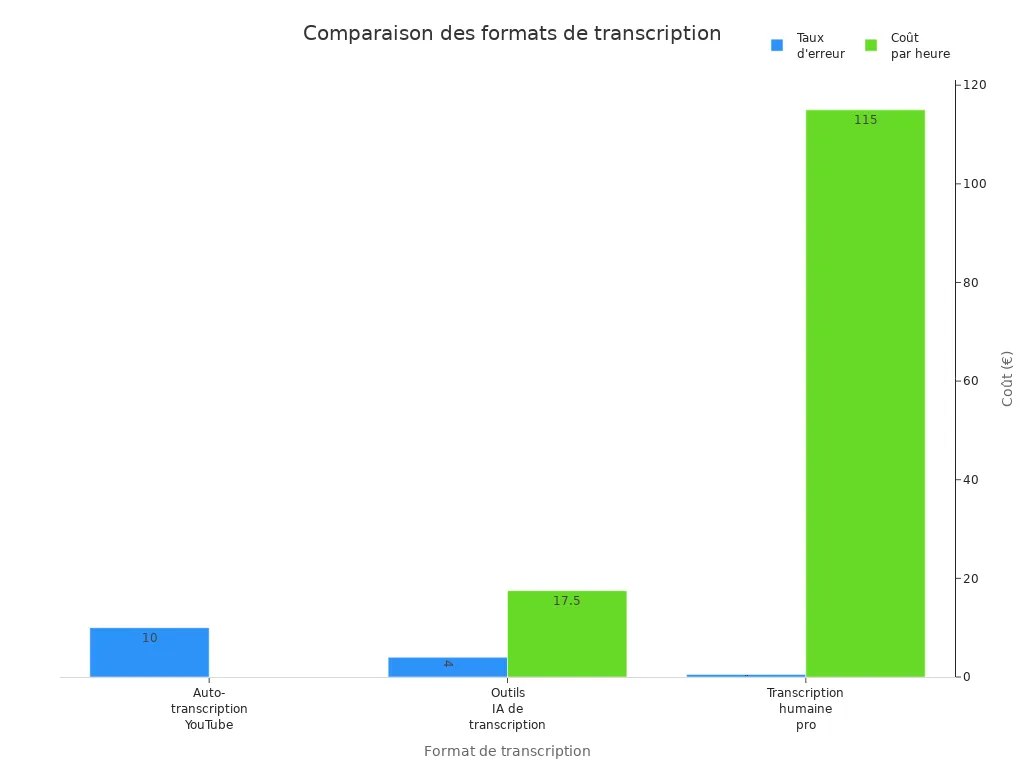
Les formats de transcription et de sous-titres influencent directement l’indexabilité GEO de tes contenus audiovisuels. Tu dois choisir le format adapté à tes besoins et à ton budget. Le format SRT ou VTT reste le standard pour une indexation optimale par les moteurs d’IA. Les outils de transcription IA offrent une précision supérieure à celle des auto-transcriptions gratuites, tout en restant abordables. Pour les contenus stratégiques, privilégie la transcription humaine professionnelle qui garantit une exactitude maximale, notamment sur les termes techniques.
Niveau de transcription | Taux d’erreur | Coût par heure | Description |
|---|---|---|---|
Auto-transcription YouTube | 8-12% | Gratuit | Pratique mais imprécise, acceptable pour contenu casual. |
Outils IA de transcription | 3-5% | 10-25€ | Meilleure précision, détection des speakers multiples. |
Transcription humaine professionnelle | <1% | 80-150€ | Précision maximale, respect des termes techniques. |
Segmentation
La segmentation des transcriptions et sous-titres améliore la lisibilité et l’indexabilité de tes contenus. Découpe tes textes en séquences courtes et logiques. Cette méthode facilite la navigation pour les IA et permet une meilleure attribution des réponses. Ajoute des SRT professionnels rétroactivement sur tes dix vidéos les plus performantes. Mets à jour régulièrement tes descriptions pour garantir la cohérence et la pertinence de chaque segment.
Conseil : La segmentation précise des sous-titres augmente la probabilité que ton contenu soit repris dans les réponses génératives des IA.
Texte à l’écran et visuels
Incrustations
Tu dois soigner l’intégration du texte à l’écran pour maximiser la citabilité de tes contenus par les IA. Les incrustations jouent un rôle clé dans la compréhension et l’indexation des informations visuelles. Chaque élément textuel affiché sur une vidéo ou une image doit être lisible, précis et pertinent. Utilise une police sans-serif, comme Arial ou Roboto, avec une taille minimale de 24pt. Assure un contraste élevé entre le texte et le fond, idéalement supérieur à 7:1, pour garantir la visibilité sur tous les supports.
Conseil : Place les informations essentielles dans les premières secondes de la vidéo ou dans les zones centrales de l’image. Les IA privilégient les contenus où les données clés sont immédiatement accessibles.
Voici quelques bonnes pratiques pour les incrustations :
Affiche les titres et sous-titres de façon claire et concise.
Utilise des couleurs neutres pour éviter toute distraction.
Ajoute des mots-clés pertinents directement sur les visuels.
Évite les effets graphiques complexes qui nuisent à la lisibilité.
Élément | Recommandation | Impact GEO |
|---|---|---|
Police | Sans-serif, 24pt+ | Lisibilité accrue |
Contraste | > 7:1 | Indexation rapide |
Positionnement | Zone centrale/haut | Citabilité élevée |
Mots-clés | Intégrés sur visuel | Référencement IA |
Indexabilité
L’indexabilité des visuels dépend de leur capacité à être interprétés par les algorithmes d’IA. Tu dois structurer chaque image et chaque vidéo pour faciliter leur lecture automatique. Ajoute des balises ALT descriptives et des métadonnées enrichies à tous tes fichiers. Nomme tes images avec des titres explicites et utilise des tags cohérents avec le contenu principal. Les IA analysent les visuels pour extraire des informations, alors tu dois fournir des données claires et structurées.
Astuce : Prépare une checklist sur ta Stratégie GEO pour chaque visuel publié. Vérifie la présence de balises ALT, de titres explicites et de mots-clés stratégiques.
Pour améliorer l’indexabilité, adopte ces méthodes :
Rédige des descriptions ALT précises pour chaque image.
Ajoute des tags sémantiques à tes vidéos et infographies.
Structure les fichiers avec des noms clairs et pertinents.
Intègre des données structurées (JSON-LD, schema.org) pour chaque visuel important.
Tu peux aussi utiliser des outils d’audit pour ta Stratégie GEO pour analyser la performance de tes visuels. Magileads propose des solutions pour automatiser la vérification et l’optimisation des incrustations et de l’indexabilité. En appliquant ces techniques, tu assures une meilleure présence de tes contenus dans les réponses générées par les IA.
Suivi et optimisation d’une Stratégie GEO

Pour garantir l’efficacité de ta Stratégie GEO, tu dois mettre en place un suivi rigoureux et des optimisations continues. Cette démarche te permet de mesurer la performance, d’ajuster tes contenus et de rester la référence citée par les intelligences artificielles.
KPI d’une Stratégie GEO
Indicateurs de performance
Tu dois définir des indicateurs de performance précis pour évaluer l’impact de ta Stratégie GEO. Les principaux KPI incluent le taux de citation dans les réponses IA, la fréquence d’apparition de ta marque dans les résultats générés, et le taux de reprise de tes contenus sur différentes plateformes. Analyse aussi le trafic issu des réponses IA et la qualité des mentions obtenues. Utilise des tableaux de bord pour visualiser l’évolution de ces indicateurs et détecter rapidement les axes d’amélioration.
Présence dans les IA
La présence de ton contenu dans les réponses générées par l’IA devient un critère central. Tu dois surveiller la façon dont les moteurs d’IA reprennent tes informations, citent ta marque ou référencent tes produits. L’AI Visibility Toolkit de Semrush te permet de suivre cette présence, d’analyser le sentiment de marque et d’identifier de nouvelles opportunités pour renforcer ta position comme source de confiance. Mets en place des alertes pour être informé dès qu’une IA mentionne ton contenu.
Veille et analyse
Suivi des citations
Le suivi des citations te donne une vision claire de l’impact de ta Stratégie GEO. Tu dois recenser chaque mention de ta marque ou de tes contenus dans les réponses IA. Utilise des outils d’analyse spécialisés pour automatiser cette veille. Compare les résultats obtenus avec tes objectifs initiaux. Identifie les thématiques ou formats qui génèrent le plus de citations et adapte ta production en conséquence.
Patterns de réponses
L’analyse des patterns de réponses te permet de comprendre comment les IA utilisent tes contenus. Observe les formulations, les extraits repris et les contextes d’utilisation. Repère les tendances émergentes et les sujets porteurs. Cette veille active t’aide à anticiper les évolutions des moteurs IA et à ajuster ta stratégie éditoriale pour maximiser la citabilité.
Amélioration continue
Feedback loop
La boucle de feedback constitue un levier essentiel pour optimiser ta Stratégie GEO. Collecte les retours issus des outils d’analyse, des équipes internes et des utilisateurs. Identifie les points forts et les axes d’amélioration. Mets en place un processus de revue régulier pour intégrer ces enseignements dans tes futures productions.
Tests et itérations
Teste différentes variantes de contenus, de formats ou de structurations. Mesure l’impact de chaque modification sur la présence dans les réponses IA. Utilise les résultats pour affiner ta stratégie et renforcer ton positionnement. L’itération continue garantit que tu restes en phase avec les attentes des moteurs d’IA et que tu conserves ton statut de source de référence.
Conseil : Intègre des outils de tracking et d’analytics dès la conception de tes contenus pour faciliter le suivi et l’optimisation de ta Stratégie GEO.
Checklist opérationnelle d’une Stratégie GEO
Production de contenu
Préparation et vérification
Avant de publier, tu dois préparer chaque contenu avec rigueur. Commence par définir une structure claire et adapte-la à la lecture en ligne. Utilise des titres fonctionnels pour chaque section. Les intelligences artificielles privilégient les contenus qui répondent précisément aux intentions de recherche. Rédige des phrases courtes et actives. Clarifie chaque formulation pour éviter toute ambiguïté. Intègre des mots-clés pertinents sans surcharger le texte. Une stratégie éditoriale solide te permet de garantir la qualité et la pertinence de chaque publication.
N’oublie pas de vérifier la crédibilité de tes sources. Cite des références fiables et identifie clairement les auteurs. Ajoute la date de publication pour renforcer la légitimité de ton contenu. Les IA accordent une grande importance à la qualité des signaux de confiance. Pour faciliter l’indexation, assure-toi que chaque lien est descriptif et que le contenu reste accessible à tous.
Astuce : Utilise des blocs réutilisables pour les définitions et les checklists. Corrige les erreurs à la source pour gagner du temps lors des mises à jour.
Post-production
Ajout de données structurées
Après la rédaction, tu dois enrichir ton contenu avec des données structurées. Cette étape améliore la compréhension de tes pages par les moteurs d’IA. Intègre des comparaisons structurées, comme des tableaux produit A vs produit B, pour faciliter l’extraction d’informations. Crée des guides étape par étape numérotés et ajoute une section FAQ avec des questions explicites. Les IA valorisent les contenus qui apportent de l’information nouvelle. Publie tes propres enquêtes, statistiques ou études de cas pour augmenter ton taux de citation.
Inclure des références externes vers des sources reconnues renforce la crédibilité de ton contenu. Les moteurs d’IA font davantage confiance aux pages qui citent d’autres sources fiables. Structure chaque section avec des titres cohérents et évite les paragraphes trop longs.
Point clé à vérifier | Pourquoi c’est important ? |
|---|---|
Titres fonctionnels | Facilite l’extraction d’informations |
Données structurées | Optimise l’indexation par les IA |
Références fiables | Renforce la crédibilité et la citabilité |
Distribution multi-plateforme
Publication IA-friendly
Pour maximiser ta visibilité, publie sur plusieurs plateformes adaptées à ton audience. Utilise des outils comme GetMint si tu gères une marque ou une agence a vec un budget marketing conséquent. GetMint te permet de suivre la performance de ta Stratégie GEOsur plus de 150 000 partenaires médias et plusieurs LLMs. Si tu travailles dans une PME e-commerce, Meteoria offre une solution pragmatique pour surveiller les LLMs pertinents sur le marché français et optimiser ta diffusion avec des prompts stratégiques.
Avant chaque publication, vérifie ces points essentiels :
Lisibilité : privilégie la voix active et raccourcis les phrases.
Structure : assure-toi que les titres sont cohérents.
Accessibilité : rends chaque lien descriptif et le contenu compréhensible.
Signaux de qualité : identifie les auteurs, cite des sources fiables, et indique la date de publication.
Conseil : Une publication IA-friendly repose sur la clarté, la structure et la crédibilité. Mets à jour régulièrement ta checklist pour rester aligné avec les exigences des moteurs d’IA.
Mise à jour et itération
Gestion des anciens contenus
Gérer tes anciens contenus représente un levier essentiel pour maintenir ta position dans l’écosystème GEO. Les moteurs d’IA évoluent rapidement. Tu dois donc adapter régulièrement tes pages pour rester pertinent et visible. Une gestion proactive de tes archives optimise la citabilité de ta marque et garantit la cohérence de ton message.
Commence par réaliser un audit de tes contenus existants. Identifie les pages qui génèrent encore du trafic ou des citations dans les réponses IA. Analyse leur structure, leur lisibilité et leur pertinence. Mets à jour les informations obsolètes, corrige les erreurs et enrichis les sections qui manquent de profondeur. Les IA privilégient les contenus à jour et fiables.
Pour maximiser l’impact de tes mises à jour, applique les meilleures pratiques suivantes :
Optimise chaque page pour les IA génératives : simplifie le langage, clarifie les concepts et évite les formulations ambiguës.
Structure l’information de façon logique : utilise des titres de section sous forme de questions précises.
Fournis des réponses directes et concises à chaque question.
Utilise des listes à puces pour présenter les points clés.
Présente les données chiffrées de manière claire, par exemple dans des tableaux.
Cite systématiquement tes sources pour renforcer la crédibilité de ton contenu.
Astuce : Planifie une revue trimestrielle de tes contenus stratégiques. Cette fréquence te permet d’anticiper les évolutions des moteurs d’IA et d’ajuster rapidement ta stratégie GEO.
Voici un exemple de tableau pour organiser la gestion de tes anciens contenus :
Page à mettre à jour | Dernière mise à jour | Points à améliorer | Statut |
|---|---|---|---|
Guide IA 2022 | 01/2023 | Ajouter FAQ, actualiser stats | En cours |
Étude de cas Magileads | 11/2022 | Structurer en sections Q/R | À faire |
Comparatif outils GEO | 03/2024 | Vérifier sources, ajouter données récentes | Terminé |
N’oublie pas d’intégrer des FAQ ou des encadrés pour répondre aux nouvelles questions des utilisateurs. Les IA apprécient les contenus qui anticipent les besoins et offrent des réponses précises. Mets à jour les liens internes et externes pour éviter les erreurs 404 et garantir une navigation fluide.
En adoptant une démarche d’itération continue, tu assures la pérennité de ta visibilité GEO. Chaque mise à jour renforce la confiance des moteurs d’IA et positionne ta marque comme une source fiable et incontournable.
Pour réussir ta Stratégie GEO et rester visible auprès des IA, tu dois miser sur l’authenticité et la preuve d’humanité. Mets en avant tes processus et partage tes erreurs. Optimise tes contenus autour des entités et concepts clés. Crée un écosystème digital robuste et lisible. Assure la clarté des informations de marque. Mets à jour tes profils sur les plateformes d’autorité. Mesure régulièrement tes résultats et ajuste ta démarche. Découvre les solutions Magileads pour accélérer ta performance GEO.
FAQ sur une Stratégie GEO
Qu’est-ce que la Stratégie GEO ?
La Stratégie GEO optimise ton contenu pour que les intelligences artificielles te citent comme source de référence. Tu adaptes tes textes, tes données et ta structure pour répondre aux critères des moteurs IA.
Comment savoir si une IA cite mon contenu ?
Tu peux utiliser des outils de suivi comme Semrush AI Visibility Toolkit. Ces solutions détectent les citations, analysent la fréquence et t’aident à mesurer ta présence dans les réponses générées par l’IA.
Dois-je remplacer le SEO par une Stratégie GEO?
Non, tu dois combiner les deux. Le SEO attire le trafic humain, la Stratégie GEO vise la visibilité auprès des IA. Tu renforces ta stratégie digitale en travaillant sur les deux axes.
Quels formats de données structurées privilégier ?
Privilégie les formats JSON-LD et schema.org. Ces standards facilitent l’indexation par les moteurs IA et améliorent la compréhension automatique de tes contenus.
Pourquoi l’autorité de marque est-elle importante pour le GEO ?
Les IA citent en priorité les sources fiables et reconnues. Tu dois renforcer ta présence médiatique et obtenir des mentions sur des plateformes crédibles pour augmenter ta citabilité.
Comment optimiser mes vidéos pour une Stratégie GEO ?
Ajoute des sous-titres SRT ou VTT, segmente les informations et incruste des mots-clés sur l’écran. Structure chaque vidéo avec des titres clairs et des descriptions détaillées.
À quelle fréquence dois-je mettre à jour mes contenus GEO ?
Planifie une revue trimestrielle de tes contenus stratégiques. Mets à jour les informations, ajoute des FAQ et vérifie la pertinence des sources pour rester la référence auprès des IA.
Voir également
L’IA Reconnaît-Elle Vraiment Votre GEO Et Référencement En 2026 ?
Stratégies Efficaces Pour Prospecter Avec L’IA En 2025
Utiliser L’IA Pour Optimiser Votre Prospection Commerciale